
FREE 6-HOUR LIVE EXECUTIVE FUNCTIONING MASTERCLASS FOR LICENSED MENTAL HEALTH PROFESSIONALS · 6 CEs AVAILABLE
TUESDAY, OCTOBER 27, 2026 · 10:00 AM TO 5:30 PM ET
Do Your Adult Clients Know What To Do But Still Don’t Do It? Use This 3-Part Executive Functioning Coaching Framework To Help Them Finally Act On Their Goals
In this free 6-hour Masterclass, Dr. Dawson walks you through her coaching framework in three parts: find the specific executive skills your client has the most trouble with, match each one to the exact intervention built for that skill & build a realistic action plan around what your client is working toward, backed by three specific types of support designed to keep the plan working long-term.
Taught by Peg Dawson, EdD, co-developer of the executive skills model this Masterclass is built on and co-author of The Smart but Scattered Guide to Success, written for adults.
6 CEs and lifetime recording access are available for purchase after free registration.

Register Free Below. This Event Is For Licensed Mental Health Professionals
By providing your phone number, you consent to receive SMS messages about joining the webinar. You may reply STOP at any time to unsubscribe.

The Masterclass Begins In:
SCREEN FOR FIVE HIDDEN DEFICIENCIES
Omega-3, Vitamin D, B12, Magnesium & Iron in One Training
9 Board-Approved CEs
Available for Purchase in Next Step
RECORDING WITH CE PURCHASE
Watch on Your Own Schedule




When Youth Therapy Gets Stuck: Trauma, Anxiety, and Emotional Dysregulation in Children
What You'll Discover At The Executive Functioning Masterclass
Pinpoint which of the 12 executive skills are holding your client back, match the exact intervention to each one & build an action plan your client can act on at work, at home & in their relationships.
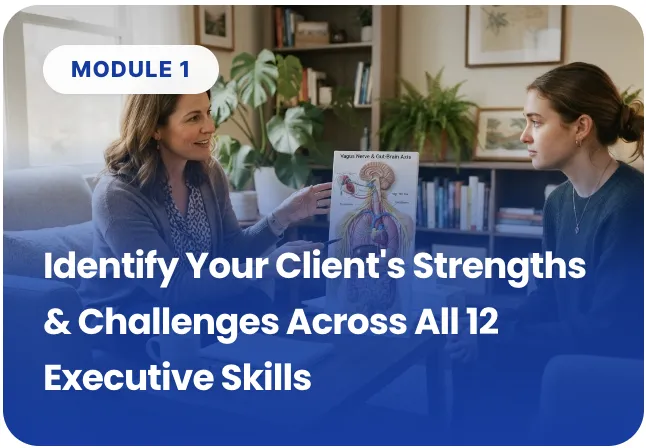
Identify Your Client’s Strengths & Challenges Across All 12 Executive Skills
Dr. Dawson gives you her executive skills model and walks you through all 12 skills, from task initiation and working memory to emotional control and stress tolerance, with everyday adult examples of each. You'll see a client's full profile of what they do well and what gets in their way.
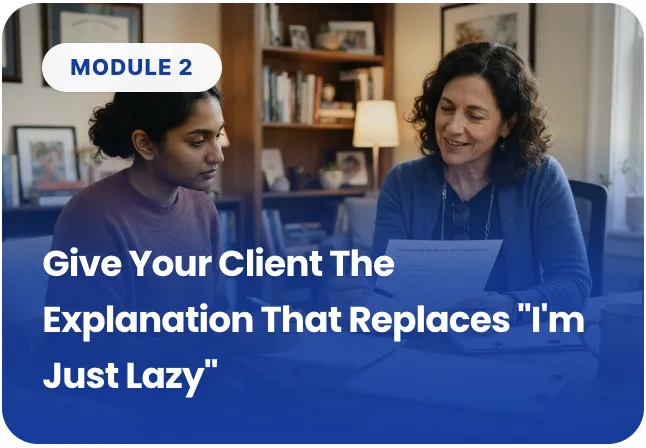
Give Your Client The Explanation That Replaces "I'm Just Lazy"
Dr. Dawson covers the neuroscience of how executive skills develop from childhood through adulthood, and what it means when an adult's skills are uneven. You'll be able to explain why a skill that carries your client through the workday falls apart at home, in language they can accept about themselves, which leads to stronger action.

Narrow To The 1 Or 2 Skills Standing Between Your Client & Their Goal
A client can show challenges across half the model, and working all of them at once is how a plan collapses. Dr. Dawson shows you how to assess your client and narrow their biggest challenges down to the one or two skills most tied to what they came in wanting. You'll focus the work on the skills that matter now, with a clear target your client can work toward.
Match The Right Intervention To Every One Of The 12 Executive Skills
In Dr. Dawson's model, each executive skill calls for its own interventions: task initiation, working memory, and time management are three different problems. She lays out specific intervention strategies for every one of the 12 skills, drawn from the executive skills model she co-developed. You'll have a matched intervention ready for whichever skill is in your client's way, so each client gets an approach built for their actual challenge.
Build Realistic Action Plans Around The Client's Own Goals
A plan built off the wrong skill is the one that comes back undone. Dr. Dawson shows you how to build a plan around what your client is working toward, drawing on the strengths you mapped, targeting the skills you pinpointed, and sized to what your client can take on now, at work, at home, or in their relationships. Your client gets a plan made for them and ready to start.
Set Up The 3 Kinds Of Support That Keep A Plan Working For The Long Term
Dr. Dawson shows you how to put three specific types of support behind your client's plan, each doing a different job: one makes the task easier to start, one gives your client a reason to act now, and one builds the new behavior into their day, designed to take less effort over time. She shows you how to set up all three for an adult client, including routines designed to support long-term behavior change. Your client gets real support in place for acting on what they came in wanting, on hard days as well as good ones.
Step 1 / 2
Register For This Free 6-Hour Clinical Summit On June 2nd
Somatic Interventions Clinical Summit: Body-Based Healing for Trauma Clients When Talk Therapy Has Failed
The Masterclass Begins In:
When Youth Therapy Gets Stuck: Trauma, Anxiety, and Emotional Dysregulation in Children
What You'll Discover At The Executive Functioning Masterclass
Pinpoint which of the 12 executive skills are holding your client back, match the exact intervention to each one & build an action plan your client can act on at work, at home & in their relationships.
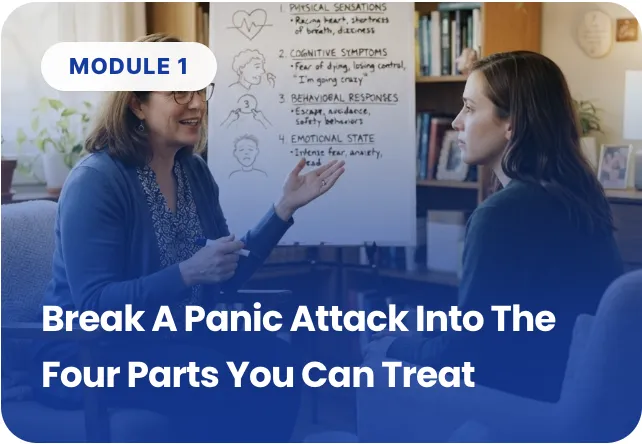
Break A Panic Attack Into The Four Parts You Can Treat
See how to separate any panic attack into its four components: the thought, the physical arousal, the emotion, and what the client does in response. Then map those onto the antecedent, behavior, consequence cycle so you can see which response is keeping the attacks coming, and cover anxiety sensitivity and the role of the amygdala in language you can use with a client.

Separate A Panic Attack From Panic Disorder & Agoraphobia
Know how to identify the presentation you’re witnessing. A panic attack is four or more sensations that peak fast, and it can appear in any anxiety presentation. Panic disorder is different: at least one attack that came out of nowhere, followed by fear of the next one and the avoidance that follows. Agoraphobia can show up with panic disorder or without it, and the two often travel together.
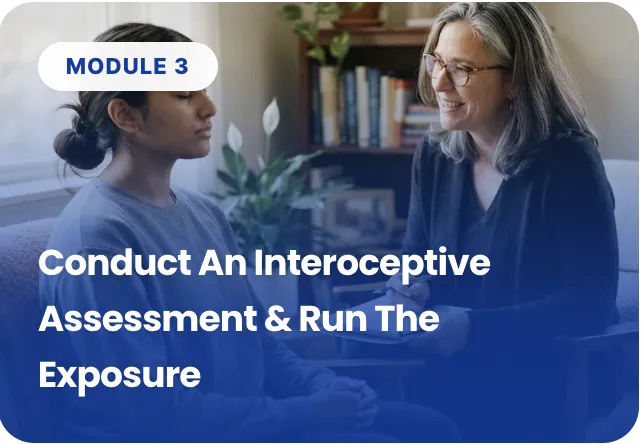
Conduct An Interoceptive Assessment & Run The Exposure
Watch Ashley Smith conduct an interoceptive assessment live, then learn to run the exposures in session: how to choose the exercise for the sensation the client fears most, how long to stay with it, what to say while the client is having the sensation, and how to set up the practice they do between sessions. You will get her decision rules for when a client repeats an exposure and when they move to a harder one, the self-report measures for tracking progress week to week, why safety signals have to come out before in vivo work, and how imaginal exposure brings the client's thoughts into it.
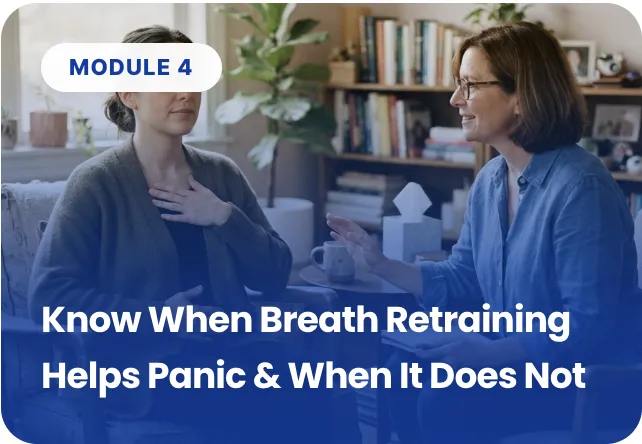
Know When Breath Retraining Helps Panic & When It Does Not
Discover which automatic thoughts and core beliefs drive panic, how to build self-talk a client can actually use during an attack, and where self-compassion fits. Then learn what mindfulness is and is not in panic treatment, and when breath retraining is useful versus when it is contraindicated.
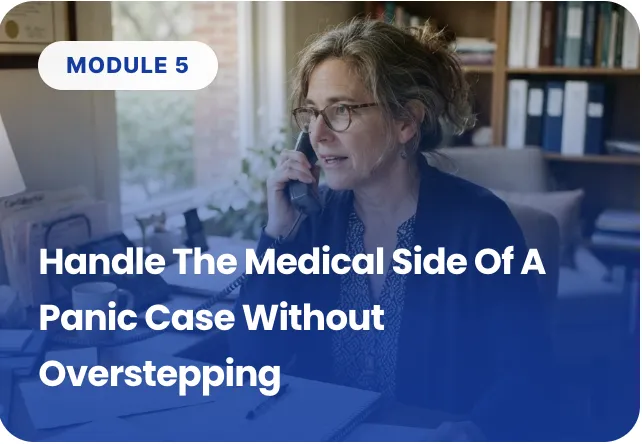
Handle The Medical Side Of A Panic Case Without Overstepping
Understand why a full medical workup belongs early in a panic case and what it rules in as well as out, what your role is on the parts of the plan you do not control, and how to talk with a client and with the other providers on their case. You will leave with language that stays inside your scope and keeps the rest of a client's care lined up with the exposure work instead of pulling against it.

Know Exactly What To Do When A Client Panics In Session
Be able to move a stalled panic case forward using four specific methods. When the client stops doing the exposures between sessions, how to bring in their values and use rewards and consequences to get adherence back. When a client will not give up a safety signal, what to do about it. When the family accommodates every avoidance, what to say to them. And when a panic attack starts in your office, what to do for the rest of the session. You will also learn how to sequence interventions when panic shows up alongside another presentation, and how to close treatment on the right goal.
Step 1 / 2
Register For This Free 6-Hour Clinical Summit On June 2nd
Somatic Interventions Clinical Summit: Body-Based Healing for Trauma Clients When Talk Therapy Has Failed
Dr. Dawson gives you her executive skills model and walks you through all 12 skills, from task initiation and working memory to emotional control and stress tolerance, with everyday adult examples of each. You'll see a client's full profile of what they do well and what gets in their way.
Dr. Dawson covers the neuroscience of how executive skills develop from childhood through adulthood, and what it means when an adult's skills are uneven. You'll be able to explain why a skill that carries your client through the workday falls apart at home, in language they can accept about themselves, which leads to stronger action.
A client can show challenges across half the model, and working all of them at once is how a plan collapses. Dr. Dawson shows you how to assess your client and narrow their biggest challenges down to the one or two skills most tied to what they came in wanting. You'll focus the work on the skills that matter now, with a clear target your client can work toward.
In Dr. Dawson's model, each executive skill calls for its own interventions: task initiation, working memory, and time management are three different problems. She lays out specific intervention strategies for every one of the 12 skills, drawn from the executive skills model she co-developed. You'll have a matched intervention ready for whichever skill is in your client's way, so each client gets an approach built for their actual challenge.
A plan built off the wrong skill is the one that comes back undone. Dr. Dawson shows you how to build a plan around what your client is working toward, drawing on the strengths you mapped, targeting the skills you pinpointed, and sized to what your client can take on now, at work, at home, or in their relationships. Your client gets a plan made for them and ready to start.
Dr. Dawson shows you how to put three specific types of support behind your client's plan, each doing a different job: one makes the task easier to start, one gives your client a reason to act now, and one builds the new behavior into their day, designed to take less effort over time. She shows you how to set up all three for an adult client, including routines designed to support long-term behavior change. Your client gets real support in place for acting on what they came in wanting, on hard days as well as good ones.
The Masterclass Begins In:
6 HOURS OF LIVE DEMONSTRATION, HANDS-ON PRACTICE & CLINICAL TROUBLESHOOTING
Peg Dawson, EdD, Co-Developed The 12 Executive Skills Model You'll Learn In This Masterclass
Dr. Dawson spent her career on one question: once you know which skills are getting in someone's way, what do you actually do about it? She worked 16 years as a school psychologist, then 32 years, from 1992 to 2024, at a center for learning and attention disorders, specializing in the assessment of children and adults. Alongside that work, she co-developed the executive skills model this Masterclass teaches, along with the coaching approach built on it, and coauthored The Smart but Scattered Guide to Success, written for adults.
Helping an adult act on a goal takes more than a set of strategies: it takes knowing which skill the plan depends on, and sizing the plan to fit. Dr. Dawson has taught that work to professionals in hands-on coaching seminars. On October 27, she reveals her entire model: all 12 executive skills, an intervention for each one, and the three kinds of support that she has personally used to make sure clients take action on their plan long-term.




The Masterclass Begins In:
Here's What You Can Do After This Webinar (And What You'll Miss)
WITH THIS WEBINAR:
The exact executive skills preventing clients from reaching their goals
An intervention matched to the skill that's in the way
Action plans matched to each client's current skills
Plans backed by 3 kinds of executive skill support
WITHOUT THIS WEBINAR:
A stalled goal with no clear skill to point to
The same general tips offered for every skill
Plans that assume skills the client doesn't have yet
Plans that depend on the client's willpower alone
The Masterclass Begins In:
After you register, you'll have the option to add 6 CEs and lifetime access to the full recording.
Frequently Asked Questions
What is this, and what do I get for free?
A free 6-hour live Masterclass with Peg Dawson, EdD, on the 3-part coaching framework she co-developed for adult clients' executive skills. The live training is free, and 6 CEs are available to add after you register.
Is this really free?
Yes. Attending live costs nothing, and nothing is required to attend.
The Masterclass runs 10:00 AM to 5:30 PM ET, and you can join for any part of it. Lifetime access to the full recording is available to add after you register, so the day is covered either way.
Live on October 27th. Dr. Dawson presents in real time across the six hours.
Can I get the recording?
Yes. Lifetime access to the full recording comes with the Premium Pass, available after free registration.
How many CEs is this, and how do I get them?
6 CEs, available with the Premium Pass after free registration.
Isn't Dr. Dawson's work mostly about kids?
She co-developed the executive skills model for both, and coauthored The Smart but Scattered Guide to Success, written for adults. This Masterclass teaches the adult model, and every example is an adult client.
Is this for my license type?
It's built for licensed mental health professionals: counselors, social workers, marriage and family therapists, psychologists, and other licensed behavioral health clinicians.
Will this be too basic for me?
It's an intermediate training for licensed clinicians who already work with adults. You'll get all 12 executive skills, the interventions matched to each, and the action-planning process.
Will this be too theoretical?
No. You'll see the assessment process, the interventions skill by skill, and the three kinds of support that go behind a plan.
Will this conflict with the approach I already use?
No. It adds a structured way to help clients act on the goals you're already working on, whatever approach you practice.
Are the CEs approved for my license?
To check approval for your license type & state, scroll to the bottom of this page & click the Board Approvals button.
Scope and Limitations Disclosure:
Scope and limitations. This Masterclass is educational and is intended for licensed mental health professionals practicing within their scope of practice and jurisdiction. It supports recognition, assessment, formulation, and intervention planning for executive skills in adult clients. It does not train participants in neuropsychological evaluation, psychological testing, the use of published rating instruments, medical evaluation, or prescribing decisions, and it does not qualify participants to conduct assessments outside their scope of practice. All clinical decisions remain the responsibility of the licensed clinician.
Commercial Support Disclosure
Peg Dawson, EdD is an independent psychologist & continuing education presenter whose work focuses on executive skills, the assessment of children and adults, and coaching. This training does not require participants to purchase any additional products, books, or materials to complete the training.