
FREE 6-HOUR LIVE TRAUMA & SELF-HARM MASTERCLASS FOR LICENSED MENTAL HEALTH PROFESSIONALS
WEDNESDAY, OCTOBER 21, 2026 | 10:00 AM TO 5:30 PM ET
When The Urge To Self-Harm Flares Up, Your Client Needs A Way Out: The CARESS Method Helps Them Self-Soothe Safely & Break The Cycle Of Self-Destruction
In this free 6-hour Masterclass, you'll discover how Lisa Ferentz maps the cycle that keeps pulling a client back to self-destructive behavior, the points along it where you can step in, how to increase a client's internal and external safety, how to reduce flashbacks and bring a client back when they dissociate, and how to teach CARESS so there is somewhere for them to turn at the worst moment.
Lisa Ferentz, MSW, LCSW-C, DAPA, developed CARESS in her own practice and wrote the clinician's guide on treating self-destructive behaviors in trauma survivors.
6 CEs and lifetime recording access available for purchase after free registration.

Register Free Below. This Event Is For Licensed Mental Health Professionals
By providing your phone number, you consent to receive SMS messages about joining the webinar. You may reply STOP at any time to unsubscribe.

Registration Closes When The Masterclass Begins
SCREEN FOR FIVE HIDDEN DEFICIENCIES
Omega-3, Vitamin D, B12, Magnesium & Iron in One Training
9 Board-Approved CEs
Available for Purchase in Next Step
RECORDING WITH CE PURCHASE
Watch on Your Own Schedule




When Youth Therapy Gets Stuck: Trauma, Anxiety, and Emotional Dysregulation in Children
What You Will Discover In The Trauma & Self-Harm Masterclass
Nine parts to this presentation, each aimed at a different point in the cycle: what starts it, what keeps it running, what to do when a client is inside it, and what a client can reach for to break the cycle when the urge arrives.

Some clients settle in session and cannot get there on their own between sessions. Lisa Ferentz explains the impact of insecure attachment on co-regulation and auto-regulation, and what it means for a client in that position. You'll be able to tell how much of a client's regulation depends on your presence, and build toward self-soothing they can use alone.
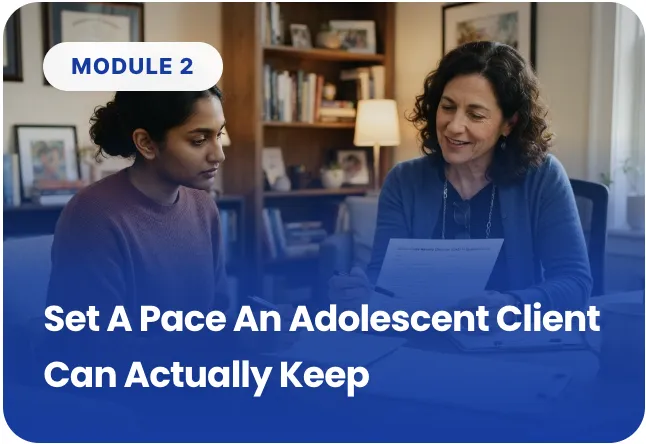
Trauma, dysregulation, and the adolescent brain combine in ways that raise a teenage client's vulnerability to self-destructive behavior. Lisa describes how that confluence works, and shows how to pace treatment and develop a plan an adolescent client can actually follow.
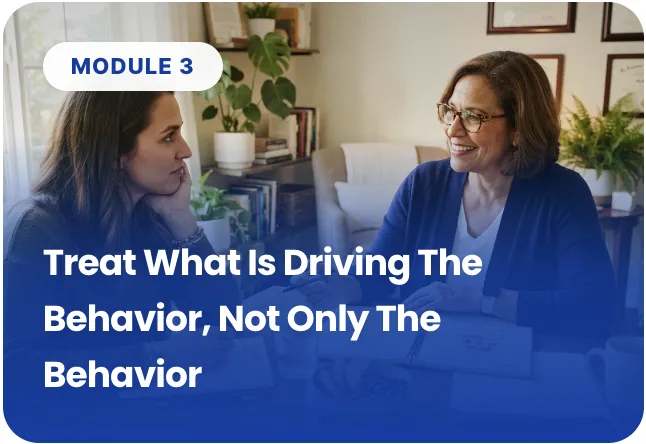
Trauma re-enactment and meta-communication both show up in self-destructive behavior. Lisa explains each concept, how they apply here, and what each one changes clinically. You'll be able to recognize both in session and work with what is underneath the behavior, so you treat the real driver of the cycle.
Triggering events, negative cognitions and affect, dissociation, and anxiety feed a chronic cycle that returns a client to the same place. Lisa describes that cycle and uses it as a template for the intervention sites along it. You'll be able to find where a case keeps turning and choose where treatment enters, so you can guide a client forward on the treatment plan.
CARESS is built for the moment the urge to self-harm arrives, rather than for the agreement made before it. Lisa walks through implementing all three steps with a client and gives at least three reasons it is a more effective approach to helping a client navigate that urge. You'll be able to teach it and make the case for it in supervision or to a treatment team, so a client has a real way out at the moment the urge arrives.
Lisa's position is that triggers are easier to treat when a client catches them as they happen. She presents REACTS, her journal prompt for addressing triggers, and walks through implementing it. You'll be able to set it up as between-session work, so a client arrives with what actually happened and you can do your work with real, recorded material.
Containment lets a client set difficult material aside for a time, which supports affect regulation between sessions. Lisa describes and implements at least two containment strategies. You'll be able to teach them, so what surfaces in session does not become the next trigger.
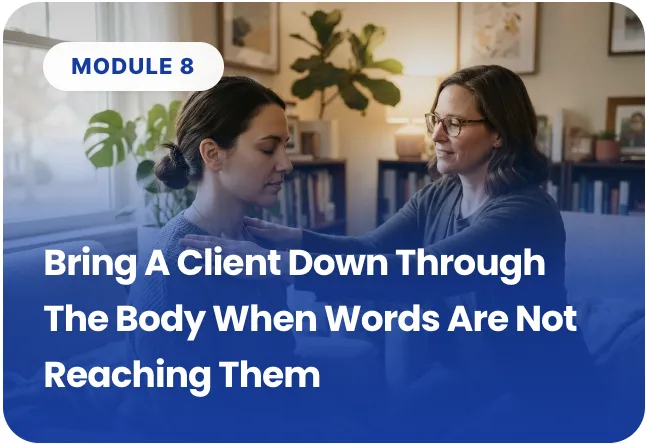
Some of the hardest minutes in a session come when a client is too activated to use anything you say. Lisa implements at least three strategies for somatic resourcing, each one a client can use on their own afterward. You'll be able to settle a client physically when talking cannot get there.
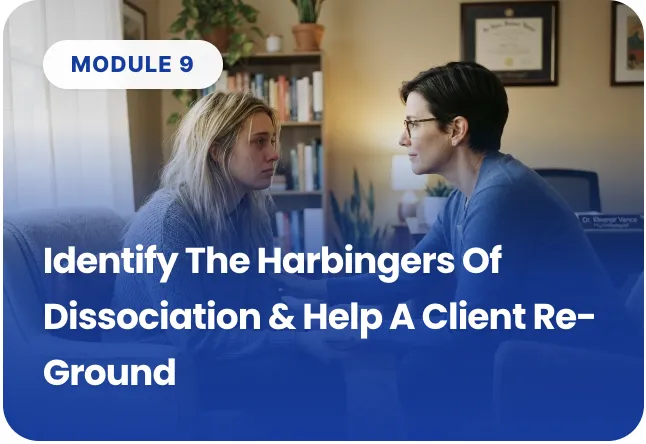
Dissociation has early signs, and a client who is drifting can look calm and present. Lisa explains how to identify the harbingers and how to help a client re-ground. You'll be able to catch it before the hour is gone and bring a client back, so nobody leaves your office still somewhere else.
Step 1 / 2
Register For This Free 6-Hour Clinical Summit On June 2nd
Somatic Interventions Clinical Summit: Body-Based Healing for Trauma Clients When Talk Therapy Has Failed
Registration Closes When The Masterclass Begins
When Youth Therapy Gets Stuck: Trauma, Anxiety, and Emotional Dysregulation in Children
What You Will Discover In The Trauma & Self-Harm Masterclass
Nine parts to this presentation, each aimed at a different point in the cycle: what starts it, what keeps it running, what to do when a client is inside it, and what a client can reach for to break the cycle when the urge arrives.
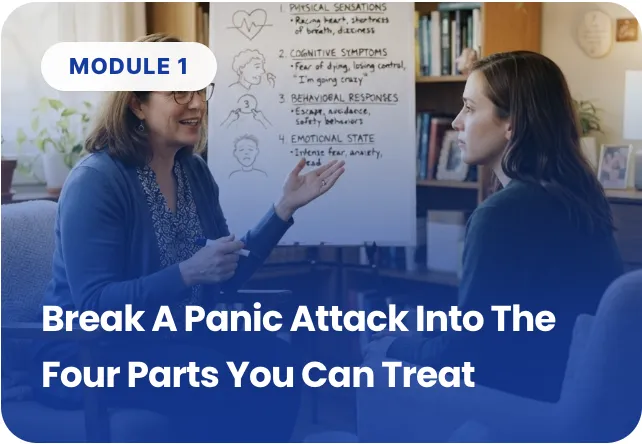
Break A Panic Attack Into The Four Parts You Can Treat
See how to separate any panic attack into its four components: the thought, the physical arousal, the emotion, and what the client does in response. Then map those onto the antecedent, behavior, consequence cycle so you can see which response is keeping the attacks coming, and cover anxiety sensitivity and the role of the amygdala in language you can use with a client.

Separate A Panic Attack From Panic Disorder & Agoraphobia
Know how to identify the presentation you’re witnessing. A panic attack is four or more sensations that peak fast, and it can appear in any anxiety presentation. Panic disorder is different: at least one attack that came out of nowhere, followed by fear of the next one and the avoidance that follows. Agoraphobia can show up with panic disorder or without it, and the two often travel together.

Conduct An Interoceptive Assessment & Run The Exposure
Watch Ashley Smith conduct an interoceptive assessment live, then learn to run the exposures in session: how to choose the exercise for the sensation the client fears most, how long to stay with it, what to say while the client is having the sensation, and how to set up the practice they do between sessions. You will get her decision rules for when a client repeats an exposure and when they move to a harder one, the self-report measures for tracking progress week to week, why safety signals have to come out before in vivo work, and how imaginal exposure brings the client's thoughts into it.
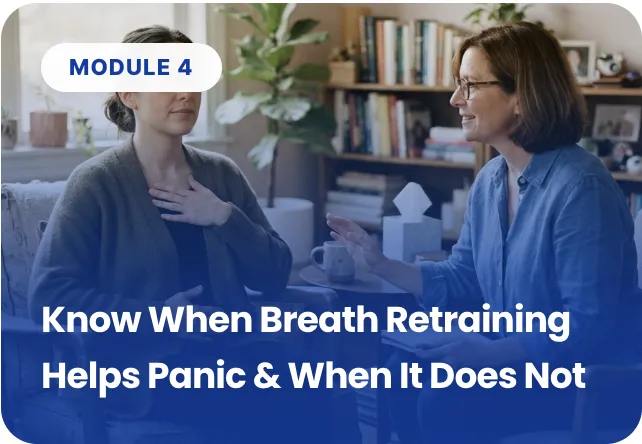
Know When Breath Retraining Helps Panic & When It Does Not
Discover which automatic thoughts and core beliefs drive panic, how to build self-talk a client can actually use during an attack, and where self-compassion fits. Then learn what mindfulness is and is not in panic treatment, and when breath retraining is useful versus when it is contraindicated.
Handle The Medical Side Of A Panic Case Without Overstepping
Understand why a full medical workup belongs early in a panic case and what it rules in as well as out, what your role is on the parts of the plan you do not control, and how to talk with a client and with the other providers on their case. You will leave with language that stays inside your scope and keeps the rest of a client's care lined up with the exposure work instead of pulling against it.

Know Exactly What To Do When A Client Panics In Session
Be able to move a stalled panic case forward using four specific methods. When the client stops doing the exposures between sessions, how to bring in their values and use rewards and consequences to get adherence back. When a client will not give up a safety signal, what to do about it. When the family accommodates every avoidance, what to say to them. And when a panic attack starts in your office, what to do for the rest of the session. You will also learn how to sequence interventions when panic shows up alongside another presentation, and how to close treatment on the right goal.
Step 1 / 2
Register For This Free 6-Hour Clinical Summit On June 2nd
Somatic Interventions Clinical Summit: Body-Based Healing for Trauma Clients When Talk Therapy Has Failed
Some clients settle in session and cannot get there on their own between sessions. Lisa Ferentz explains the impact of insecure attachment on co-regulation and auto-regulation, and what it means for a client in that position. You'll be able to tell how much of a client's regulation depends on your presence, and build toward self-soothing they can use alone.
Trauma, dysregulation, and the adolescent brain combine in ways that raise a teenage client's vulnerability to self-destructive behavior. Lisa describes how that confluence works, and shows how to pace treatment and develop a plan an adolescent client can actually follow.
Trauma re-enactment and meta-communication both show up in self-destructive behavior. Lisa explains each concept, how they apply here, and what each one changes clinically. You'll be able to recognize both in session and work with what is underneath the behavior, so you treat the real driver of the cycle.
Triggering events, negative cognitions and affect, dissociation, and anxiety feed a chronic cycle that returns a client to the same place. Lisa describes that cycle and uses it as a template for the intervention sites along it. You'll be able to find where a case keeps turning and choose where treatment enters, so you can guide a client forward on the treatment plan.
CARESS is built for the moment the urge to self-harm arrives, rather than for the agreement made before it. Lisa walks through implementing all three steps with a client and gives at least three reasons it is a more effective approach to helping a client navigate that urge. You'll be able to teach it and make the case for it in supervision or to a treatment team, so a client has a real way out at the moment the urge arrives.
Lisa's position is that triggers are easier to treat when a client catches them as they happen. She presents REACTS, her journal prompt for addressing triggers, and walks through implementing it. You'll be able to set it up as between-session work, so a client arrives with what actually happened and you can do your work with real, recorded material.
Containment lets a client set difficult material aside for a time, which supports affect regulation between sessions. Lisa describes and implements at least two containment strategies. You'll be able to teach them, so what surfaces in session does not become the next trigger.
Some of the hardest minutes in a session come when a client is too activated to use anything you say. Lisa implements at least three strategies for somatic resourcing, each one a client can use on their own afterward. You'll be able to settle a client physically when talking cannot get there.
Dissociation has early signs, and a client who is drifting can look calm and present. Lisa explains how to identify the harbingers and how to help a client re-ground. You'll be able to catch it before the hour is gone and bring a client back, so nobody leaves your office still somewhere else.
Registration Closes When The Masterclass Begins
6 HOURS OF LIVE DEMONSTRATION, HANDS-ON PRACTICE & CLINICAL TROUBLESHOOTING
Lisa Ferentz, MSW, LCSW-C, DAPA, developed the CARESS method that this Masterclass teaches.
Lisa Ferentz has spent her career in private practice with trauma clients. She wrote the clinician's guide on treating self-destructive behaviors in trauma survivors, now in its second edition, along with the companion workbook written for clients.
Treating self-destructive behavior asks for more than technique. It asks for a clear position on what the behavior does for the client, and for something the client can use when the urge arrives, and no one is there to talk them through it. Lisa developed CARESS and REACTS in her own practice, teaches this material to other clinicians, and presents workshops and keynotes nationally and internationally. Now she’s sharing it all with you: the full self-harm cycle and its intervention sites, the CARESS method in full, containment and somatic resourcing strategies, and the harbingers of dissociation, all while using clinical case examples and clients' own writing and artwork.




Registration Closes When The Masterclass Begins
The Difference After One Day
WITH THIS WEBINAR:
A client has a way out when the urge flares up
You know where on the cycle to step in, & when
You catch dissociation early & bring a client back
A client self-soothes in ways that leave no damage
WITHOUT THIS WEBINAR:
The urge arrives, and the client has no way to stop it
The self-destructive cycle restarts without intervention
A client drifts without making progress
The client is only ever calm in session and struggles to self-soothe later
Registration Closes When The Masterclass Begins
Registration is free. On the next page you can add 6 CEs and lifetime access to the recording.
Frequently Asked Questions
What exactly is this Webinar, & what do I get for registering?
A free 6-hour live Masterclass with Lisa Ferentz on treating self-injury and other self-destructive behavior in clients with trauma histories, covering the cycle, CARESS, REACTS, containment, somatic resourcing, and dissociation. Registration is free. After you register you can add 6 CEs and lifetime recording access.
I have clients on a Wednesday. Can I still take this?
Yes. The Masterclass is recorded, and you can watch live, on demand, or do a mix.
Is the live training really free?
Yes. The live Masterclass costs nothing to attend.
Is this live, or a recording being run as live?
Live. Lisa presents on Wednesday, October 21, 2026, from 10:00 AM to 5:30 PM ET.
Will this be too theoretical to use with an actual client?
No. The day covers CARESS in full, REACTS, at least two containment strategies, and at least three somatic resourcing strategies, with clinical case examples and clients' own writing and artwork.
Is this too basic for someone already doing trauma work?
No. The level is Intermediate, written for licensed clinicians already carrying these cases.
Which license types is this for?
Licensed mental health professionals, including LCSWs, LPCs, LMFTs, psychologists, and other master's-level clinicians.
My agency requires a safety contract. Does this replace it?
Lisa presents CARESS as an alternative approach and gives at least three reasons it is more effective, so you can take the case to whoever sets policy where you work.
I have a client self-injuring right now. Will this help soon enough?
The Masterclass is built around that client. Lisa teaches CARESS in full on the day, so you have it as soon as the training runs.
How many CEs are available, and how do I get them?
6 CEs, included with the Premium Pass, which you can add after free registration.
Can I get the recording?
Yes. Lifetime recording access comes with the Premium Pass, so CARESS and the rest of the day are there the next time a case calls for them.
Are the CEs approved for my license?
To check approval for your license type & state, scroll to the bottom of this page & click the Board Approvals button.
Registration Closes When The Masterclass Begins
Scope and Limitations Disclosure:
Scope and limitations. This Masterclass is educational and is intended for licensed mental health professionals practicing within their scope of practice and jurisdiction. It supports treatment planning, intervention selection, and the use of specific clinical strategies with clients who engage in self-destructive behavior. It does not train participants in risk assessment, crisis intervention, safety planning, medical evaluation, or medication management, and it does not qualify participants to work outside their scope of practice. All clinical decisions remain the responsibility of the licensed clinician.
Commercial Support Disclosure
Lisa Ferentz, MSW, LCSW-C, DAPA maintains a private practice and is the founder and president of a clinical training institute. She receives royalties as a published author, and she receives speaking honoraria and product royalties from continuing education organizations. This training does not require participants to purchase any additional products, books, or materials to complete the training.