
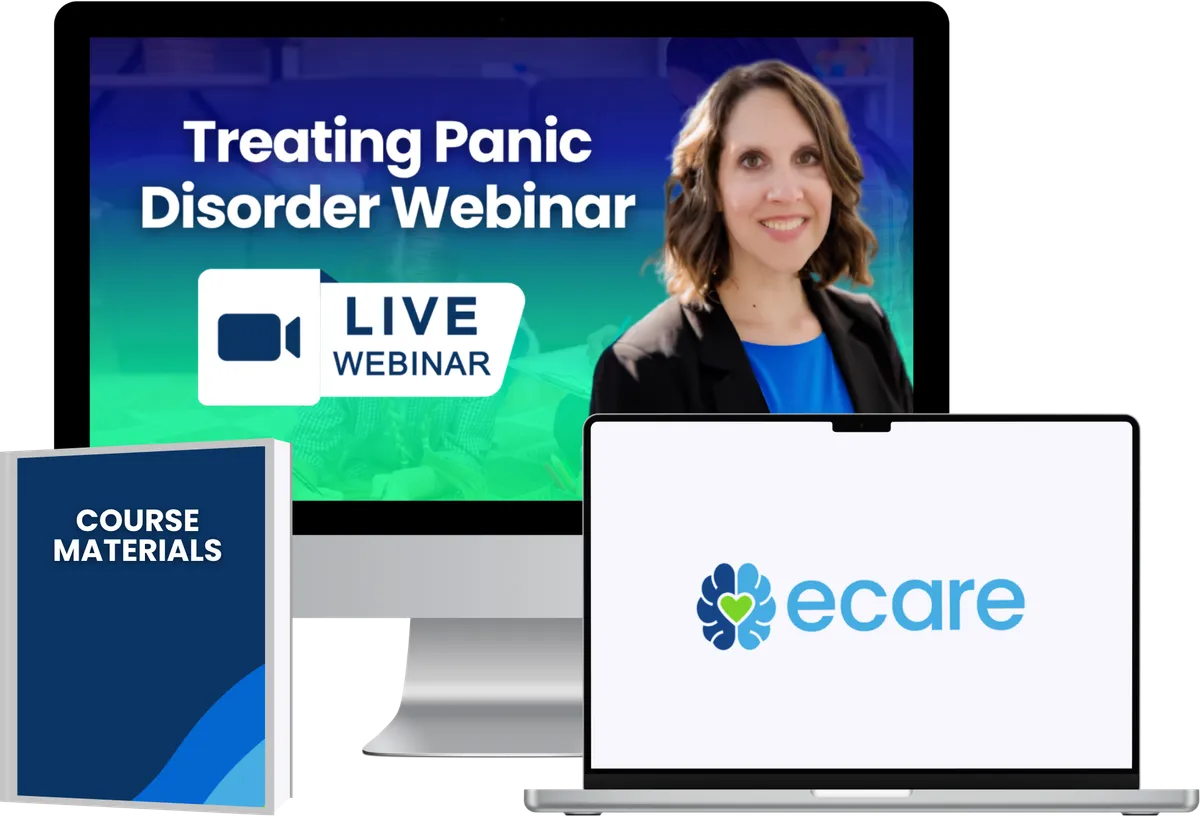
FREE 6-HOUR LIVE WEBINAR ON TREATING PANIC DISORDER FOR LICENSED THERAPISTS
THURSDAY, OCTOBER 1ST, 2026 @ 10:00 AM TO 5:30 PM ET
Why Your Clients Keep Having Panic Attacks, & The Frightening Intervention That Ends Their Fear Of The Next
In this free 6-hour Webinar, you'll discover how to run an interoceptive assessment, bring on the exact sensation your client fears right there in session, and break the link between that sensation and the fear that keeps the attacks coming.
Taught live by Ashley Smith, PhD, a licensed clinical psychologist who has spent her entire career treating anxiety disorders.
6 CE CREDITS + LIFETIME ACCESS to the recording available for purchase after free registration.

Register Free Below. This Event is for Licensed Mental Health Professionals
By providing your phone number, you consent to receive SMS messages about joining the webinar. You may reply STOP at any time to unsubscribe.

Treating Panic Disorder Starts In:
SCREEN FOR FIVE HIDDEN DEFICIENCIES
Omega-3, Vitamin D, B12, Magnesium & Iron in One Training
9 Board-Approved CEs
Available for Purchase in Next Step
RECORDING WITH CE PURCHASE
Watch on Your Own Schedule




When Youth Therapy Gets Stuck: Trauma, Anxiety, and Emotional Dysregulation in Children
What You'll Discover During The Treating Panic Disorder Webinar
How to assess a panic case, run the exposure in session, change the beliefs underneath it, & end treatment so the fear of the next attack no longer runs the client’s life.
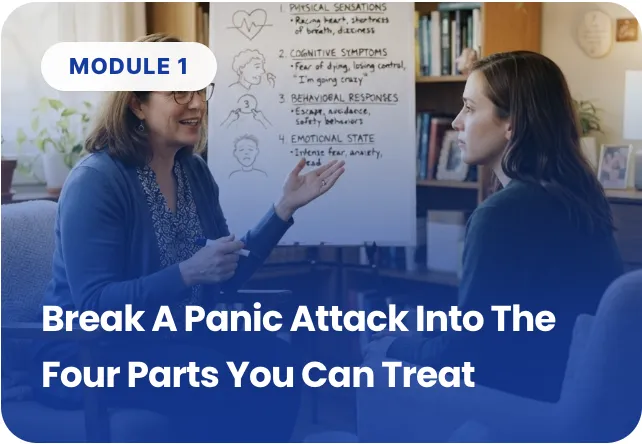
Break A Panic Attack Into The Four Parts You Can Treat
See how to separate any panic attack into its four components: the thought, the physical arousal, the emotion, and what the client does in response. Then map those onto the antecedent, behavior, consequence cycle so you can see which response is keeping the attacks coming, and cover anxiety sensitivity and the role of the amygdala in language you can use with a client.
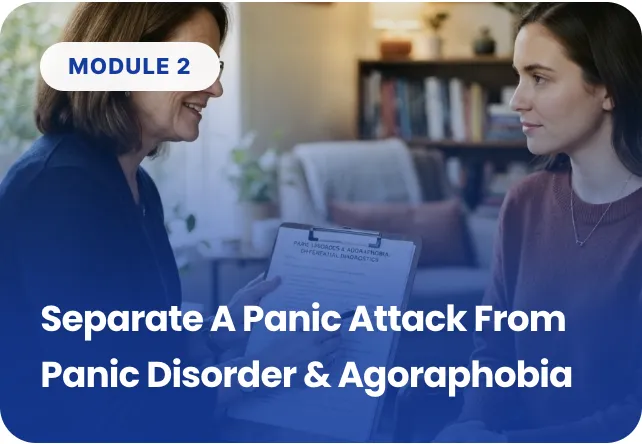
Separate A Panic Attack From Panic Disorder & Agoraphobia
Know how to identify the presentation you’re witnessing. A panic attack is four or more sensations that peak fast, and it can appear in any anxiety presentation. Panic disorder is different: at least one attack that came out of nowhere, followed by fear of the next one and the avoidance that follows. Agoraphobia can show up with panic disorder or without it, and the two often travel together.
Conduct An Interoceptive Assessment & Run The Exposure
Watch Ashley Smith conduct an interoceptive assessment live, then learn to run the exposures in session: how to choose the exercise for the sensation the client fears most, how long to stay with it, what to say while the client is having the sensation, and how to set up the practice they do between sessions. You will get her decision rules for when a client repeats an exposure and when they move to a harder one, the self-report measures for tracking progress week to week, why safety signals have to come out before in vivo work, and how imaginal exposure brings the client's thoughts into it.
Know When Breath Retraining Helps Panic & When It Does Not
Discover which automatic thoughts and core beliefs drive panic, how to build self-talk a client can actually use during an attack, and where self-compassion fits. Then learn what mindfulness is and is not in panic treatment, and when breath retraining is useful versus when it is contraindicated.
Handle The Medical Side Of A Panic Case Without Overstepping
Understand why a full medical workup belongs early in a panic case and what it rules in as well as out, what your role is on the parts of the plan you do not control, and how to talk with a client and with the other providers on their case. You will leave with language that stays inside your scope and keeps the rest of a client's care lined up with the exposure work instead of pulling against it.
Know Exactly What To Do When A Client Panics In Session
Be able to move a stalled panic case forward using four specific methods. When the client stops doing the exposures between sessions, how to bring in their values and use rewards and consequences to get adherence back. When a client will not give up a safety signal, what to do about it. When the family accommodates every avoidance, what to say to them. And when a panic attack starts in your office, what to do for the rest of the session. You will also learn how to sequence interventions when panic shows up alongside another presentation, and how to close treatment on the right goal.
Step 1 / 2
Register For This Free 6-Hour Clinical Summit On June 2nd
Somatic Interventions Clinical Summit: Body-Based Healing for Trauma Clients When Talk Therapy Has Failed
When Youth Therapy Gets Stuck: Trauma, Anxiety, and Emotional Dysregulation in Children
What You'll Discover During The Treating Panic Disorder Webinar
How to assess a panic case, run the exposure in session, change the beliefs underneath it, & end treatment so the fear of the next attack no longer runs the client’s life.
Break A Panic Attack Into The Four Parts You Can Treat
See how to separate any panic attack into its four components: the thought, the physical arousal, the emotion, and what the client does in response. Then map those onto the antecedent, behavior, consequence cycle so you can see which response is keeping the attacks coming, and cover anxiety sensitivity and the role of the amygdala in language you can use with a client.
Separate A Panic Attack From Panic Disorder & Agoraphobia
Know how to identify the presentation you’re witnessing. A panic attack is four or more sensations that peak fast, and it can appear in any anxiety presentation. Panic disorder is different: at least one attack that came out of nowhere, followed by fear of the next one and the avoidance that follows. Agoraphobia can show up with panic disorder or without it, and the two often travel together.
Conduct An Interoceptive Assessment & Run The Exposure
Watch Ashley Smith conduct an interoceptive assessment live, then learn to run the exposures in session: how to choose the exercise for the sensation the client fears most, how long to stay with it, what to say while the client is having the sensation, and how to set up the practice they do between sessions. You will get her decision rules for when a client repeats an exposure and when they move to a harder one, the self-report measures for tracking progress week to week, why safety signals have to come out before in vivo work, and how imaginal exposure brings the client's thoughts into it.
Know When Breath Retraining Helps Panic & When It Does Not
Discover which automatic thoughts and core beliefs drive panic, how to build self-talk a client can actually use during an attack, and where self-compassion fits. Then learn what mindfulness is and is not in panic treatment, and when breath retraining is useful versus when it is contraindicated.
Handle The Medical Side Of A Panic Case Without Overstepping
Understand why a full medical workup belongs early in a panic case and what it rules in as well as out, what your role is on the parts of the plan you do not control, and how to talk with a client and with the other providers on their case. You will leave with language that stays inside your scope and keeps the rest of a client's care lined up with the exposure work instead of pulling against it.
Know Exactly What To Do When A Client Panics In Session
Be able to move a stalled panic case forward using four specific methods. When the client stops doing the exposures between sessions, how to bring in their values and use rewards and consequences to get adherence back. When a client will not give up a safety signal, what to do about it. When the family accommodates every avoidance, what to say to them. And when a panic attack starts in your office, what to do for the rest of the session. You will also learn how to sequence interventions when panic shows up alongside another presentation, and how to close treatment on the right goal.
Step 1 / 2
Register For This Free 6-Hour Clinical Summit On June 2nd
Somatic Interventions Clinical Summit: Body-Based Healing for Trauma Clients When Talk Therapy Has Failed
See how to separate any panic attack into its four components: the thought, the physical arousal, the emotion, and what the client does in response. Then map those onto the antecedent, behavior, consequence cycle so you can see which response is keeping the attacks coming, and cover anxiety sensitivity and the role of the amygdala in language you can use with a client.
Know how to identify the presentation you’re witnessing. A panic attack is four or more sensations that peak fast, and it can appear in any anxiety presentation. Panic disorder is different: at least one attack that came out of nowhere, followed by fear of the next one and the avoidance that follows. Agoraphobia can show up with panic disorder or without it, and the two often travel together.
Watch Ashley Smith conduct an interoceptive assessment live, then learn to run the exposures in session: how to choose the exercise for the sensation the client fears most, how long to stay with it, what to say while the client is having the sensation, and how to set up the practice they do between sessions. You will get her decision rules for when a client repeats an exposure and when they move to a harder one, the self-report measures for tracking progress week to week, why safety signals have to come out before in vivo work, and how imaginal exposure brings the client's thoughts into it.
Discover which automatic thoughts and core beliefs drive panic, how to build self-talk a client can actually use during an attack, and where self-compassion fits. Then learn what mindfulness is and is not in panic treatment, and when breath retraining is useful versus when it is contraindicated.
Understand why a full medical workup belongs early in a panic case and what it rules in as well as out, what your role is on the parts of the plan you do not control, and how to talk with a client and with the other providers on their case. You will leave with language that stays inside your scope and keeps the rest of a client's care lined up with the exposure work instead of pulling against it.
Be able to move a stalled panic case forward using four specific methods. When the client stops doing the exposures between sessions, how to bring in their values and use rewards and consequences to get adherence back. When a client will not give up a safety signal, what to do about it. When the family accommodates every avoidance, what to say to them. And when a panic attack starts in your office, what to do for the rest of the session. You will also learn how to sequence interventions when panic shows up alongside another presentation, and how to close treatment on the right goal.
6 HOURS OF LIVE DEMONSTRATION, HANDS-ON PRACTICE & CLINICAL TROUBLESHOOTING FROM A LEADING EXPERT
Ashley Smith, PhD, Has Spent Her Entire Career Treating Almost Nothing But Anxiety
Most clinicians treat anxiety alongside everything else on their caseload. Ashley Smith, PhD, has treated almost nothing but anxiety since she earned her PhD in clinical psychology. She helped build the dedicated anxiety services at a children's hospital, then spent eight years as a senior staff psychologist at a center that treats anxiety and nothing else, and then ran her own anxiety-focused practice.
Treating panic is also a teaching job. Ashley has spent her career on that half of the work too: writing Childhood Anxiety Disorders for clinicians and The Way I See It for everyone else, speaking from a TEDx stage, training and supervising clinicians on faculty and in national workshops, and receiving the Anxiety and Depression Association of America's Special Recognition Award for that work. What she brings to the October 1st Webinar is six hours of live demonstration, hands-on practice, and clinical troubleshooting: how the interoceptive assessment is conducted, how she sets up an exposure and carries it through, what she says when a client wants to stop, what she does when a safety signal will not leave the room, and how she closes treatment so the client can get through a hard day without the avoidance coming back.
As featured in






Here's What You Can Do After This Training (And What You'll Miss)
WITH THIS WEBINAR:
You know exactly what to do when a client panics in your office
You run the exposure that takes the fear out of the sensations
You change the core beliefs driving the panic, not just the thoughts
You know what to say when a client asks about their treatment options
WITHOUT THIS WEBINAR:
A client panics in session & you improvise the rest of the session
The client is still afraid of their own racing heart months later
The client can name the catastrophic thought & still believes it
The rest of the client's care pulls against the exposure work
6 CE credits, Lifetime Replay & Clinical Tools: Available For Purchase After Registration (You Will Be Redirected Automatically)

Frequently Asked Questions
What exactly is this Webinar, & what do I get for registering?
A free 6-hour live Webinar on October 1st with Ashley Smith, PhD, covering the full exposure-based model for treating panic disorder, from the first psychoeducation session through relapse prevention. Registration is free, and 6 CE credits plus lifetime access to the recording are available for purchase after you register.
Is this really free, or do I need to buy something to attend?
The 6-hour live Webinar is free to attend LIVE. 6 CE credits and lifetime access to the recording are a paid upgrade offered after you register, and you are welcome to attend the full training without it.
Is this live, or a recording being run as a live event?
Live on October 1st. Ashley Smith, PhD presents in real time, with hands-on exercises and live demonstration throughout the six hours.
October 1st is a Thursday & I have clients. Do I have to be there for the whole six hours?
Come for the hours you can. Lifetime access to the full recording is available for purchase after you register, so anything you miss live is still yours to watch whenever a panic case calls for it.
I have been hesitant to bring on panic sensations on purpose. Will this show me how to do it safely?
Yes, and it is the center of the day. You will see the interoceptive assessment and the exposure run live, with the setup, the pacing, what to say while the client is having the sensation, and what to do if they want to stop.
I have taken exposure trainings that were too theoretical to use. How is this different?
Six hours of live demonstration, hands-on practice, and clinical troubleshooting. Ashley Smith, PhD, works through the assessment, the in-session exposure, and the moments that make panic treatment hard in practice, so you can run it with your own clients.
I have been doing exposure work for years. Will this be too basic?
No. This is an intermediate training built around doing the work, not explaining it. You will watch an interoceptive assessment run live, learn how to choose and pace the exposures in session, when to repeat one and when to move to a harder one, and what to do when a case stalls.
I am an LCSW, LPC or LMFT, not a psychologist. Is this Webinar for me?
Yes. It is built for licensed mental health professionals treating panic and related anxiety presentations, whatever the discipline. To check CE approval for your license type and state, use the Board Approvals button at the bottom of this page.
I am trained in CBT, ACT or EMDR. Will this conflict with what I already practice?
No. The model is grounded in CBT and ACT and adds an assessment and exposure layer to the approach you already use, without asking you to set anything aside.
My clients have panic attacks inside other anxiety presentations. Is this only for panic disorder?
Both are covered. You will learn to tell panic attacks apart from panic disorder and agoraphobia, and the troubleshooting hours cover presentations where panic appears alongside something else.
How many CE credits can I receive, & how do I get them?
6 CE credits from Treating Panic Disorder: Interoceptive Exposure, CBT & ACT Strategies with Ashley Smith, PhD. Available for purchase after you register.
Can I get the recording if I cannot attend live?
Yes. The full 6-hour recording with lifetime access is available for purchase at the next step, once you register for the Webinar.
Are the CE credits approved for my license?
Yes. To check approval for your license type & state, scroll to the bottom of this page & click the Board Approvals button.
Scope and Limitations Disclosure:
This training provides licensed mental health professionals with a clinical framework for understanding anxiety, including the cognitive, emotional, behavioral & physiological processes that drive & maintain anxious patterns, avoidance cycles & reinforcement patterns, common anxiety presentations including generalized anxiety, panic & high-functioning anxiety, & evidence-informed interventions drawn from cognitive-behavioral & acceptance-based approaches. Content teaches clinical application of these frameworks only & does not reproduce any proprietary assessment instrument or worksheet. This training does not offer certification & is not a substitute for clinical supervision or formal training. Participants are encouraged to apply content within their individual scope of practice & in accordance with applicable professional & ethical guidelines.
Commercial Support Disclosure
Dr. Ashley Smith, PhD, is an independent clinician & continuing education presenter specializing in anxiety treatment, avoidance, cognition & regulation. This training does not require participants to purchase any additional products, books, or materials to complete the training.