
FREE 2-DAY LIVE MASTERCLASS ON THE ASAM CRITERIA, 4TH EDITION, FOR LICENSED CLINICIANS WHO MAKE LEVEL OF CARE RECOMMENDATIONS
THURSDAY, OCTOBER 15TH & FRIDAY, OCTOBER 16TH, 2026 @ 10:00 AM TO 5:30 PM ET, BOTH DAYS
The ASAM Criteria Changed … Here’s How To Use The 6 Updated Dimensions In The 4th Edition To Recommend The Right Level Of Care For Your Client
The levels of care were renumbered, all 6 dimensions were updated, and placement is now a separate assessment from the treatment plan. Every recommendation you make must now work with the new criteria.
Over two days, Dr. Patterson takes you through every change and works real cases with you, so you can assess a client under the 4th Edition and recommend outpatient, intensive outpatient, residential or inpatient care with confidence.
Taught live by Frances Patterson, MS, PhD, LADAC II, MAC, DAC, QCS, who trains and supervises the clinicians who make these recommendations.
12 CEs + LIFETIME ACCESS to the recording of both days available for purchase after free registration.


Register Free Below. This Event Is For Licensed Mental Health Professionals
By providing your phone number, you consent to receive SMS messages about joining the webinar. You may reply STOP at any time to unsubscribe.

Day 1 Of The ASAM 4th Edition Masterclass Starts In:
SCREEN FOR FIVE HIDDEN DEFICIENCIES
Omega-3, Vitamin D, B12, Magnesium & Iron in One Training
9 Board-Approved CEs
Available for Purchase in Next Step
RECORDING WITH CE PURCHASE
Watch on Your Own Schedule




When Youth Therapy Gets Stuck: Trauma, Anxiety, and Emotional Dysregulation in Children
What You'll Discover Across Both Days Of The ASAM 4th Edition Masterclass
12 hours on the renumbered levels of care, all 6 updated dimensions & the ratings underneath them, the Dimensional Criteria for admission & continuing care, the split between placement & the treatment plan, and shared decision making with the client, worked through on real cases with Dr. Patterson.

Know What Outpatient, Intensive Outpatient, Residential & Inpatient Mean In The 4th Edition
The 4th Edition renumbered the continuum and set out what a program at each level has to provide. Dr. Patterson walks through the updated adult Levels of Care, the new chapters, the service characteristic standards behind each level, and the decimal numbers that separate one kind of care from another inside the same level. You will know what care each level provides before you recommend it.

Turn Your Dimensional Ratings Into A Level Of Care Recommendation
The 4th Edition built risk ratings into the Dimensional Admission Criteria, so the ratings from your assessment now point to the minimum level of care a client needs. Dr. Patterson shows how to take a completed multidimensional assessment and arrive at a recommendation, including when the ratings sit between two neighboring levels such as intensive outpatient and high-intensity outpatient. You will be able to match a client to the level of care their ratings support, so they are not placed in more intensive care than they need, or in less.
Keep The Level Of Care Assessment & The Treatment Planning Assessment Separate
The 4th Edition sets separate standards for the two assessments. Only certain subdimensions inform the level of care recommendation, while every subdimension feeds the treatment plan. Dr. Patterson shows which findings drive placement and which you carry into treatment planning, so a need the treatment plan can address does not push a client into a more intensive level of care than they need.

Rate All 6 Updated Dimensions & Their Subdimensions
The dimensions were renamed and reorganized and each one now breaks into subdimensions, Dr. Patterson takes each dimension one at a time, covering what its subdimensions ask you to rate and how those ratings guide placement. You will rate every client on the dimensions as they now stand, including what to do when the ratings point to two different levels.
Recommend A Level Of Care At Admission & Know When A Client Is Ready To Step Down
Dr. Patterson covers what a recommendation has to meet under the Dimensional Criteria for admission, and how Dimension 6 brings the client into the decision about which level of care they are willing and able to take part in. She then covers what a client has to meet to continue at a level, and what indicates it is time to step up to more intensive care or step down to less.

Watch Dr. Patterson Work Real Cases Through The ASAM 4th Edition, Live
Dr. Patterson presents vignette examples across both days and works each one through the dimensions, the subdimension ratings, and the Dimensional Criteria to a level of care recommendation, in guided discussion with the group. You will see the full process in real cases, and know how to run it before you use it with your next client.
Step 1 / 2
Register For This Free 6-Hour Clinical Summit On June 2nd
Somatic Interventions Clinical Summit: Body-Based Healing for Trauma Clients When Talk Therapy Has Failed
When Youth Therapy Gets Stuck: Trauma, Anxiety, and Emotional Dysregulation in Children
What You'll Discover Across Both Days Of The ASAM 4th Edition Masterclass
12 hours on the renumbered levels of care, all 6 updated dimensions & the ratings underneath them, the Dimensional Criteria for admission & continuing care, the split between placement & the treatment plan, and shared decision making with the client, worked through on real cases with Dr. Patterson.
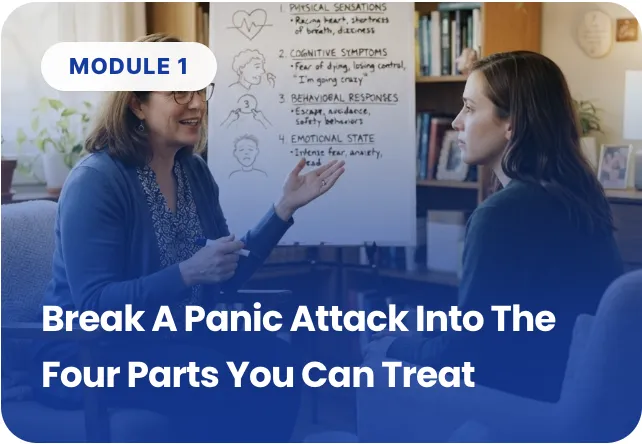
Break A Panic Attack Into The Four Parts You Can Treat
See how to separate any panic attack into its four components: the thought, the physical arousal, the emotion, and what the client does in response. Then map those onto the antecedent, behavior, consequence cycle so you can see which response is keeping the attacks coming, and cover anxiety sensitivity and the role of the amygdala in language you can use with a client.

Separate A Panic Attack From Panic Disorder & Agoraphobia
Know how to identify the presentation you’re witnessing. A panic attack is four or more sensations that peak fast, and it can appear in any anxiety presentation. Panic disorder is different: at least one attack that came out of nowhere, followed by fear of the next one and the avoidance that follows. Agoraphobia can show up with panic disorder or without it, and the two often travel together.

Conduct An Interoceptive Assessment & Run The Exposure
Watch Ashley Smith conduct an interoceptive assessment live, then learn to run the exposures in session: how to choose the exercise for the sensation the client fears most, how long to stay with it, what to say while the client is having the sensation, and how to set up the practice they do between sessions. You will get her decision rules for when a client repeats an exposure and when they move to a harder one, the self-report measures for tracking progress week to week, why safety signals have to come out before in vivo work, and how imaginal exposure brings the client's thoughts into it.
Know When Breath Retraining Helps Panic & When It Does Not
Discover which automatic thoughts and core beliefs drive panic, how to build self-talk a client can actually use during an attack, and where self-compassion fits. Then learn what mindfulness is and is not in panic treatment, and when breath retraining is useful versus when it is contraindicated.
Handle The Medical Side Of A Panic Case Without Overstepping
Understand why a full medical workup belongs early in a panic case and what it rules in as well as out, what your role is on the parts of the plan you do not control, and how to talk with a client and with the other providers on their case. You will leave with language that stays inside your scope and keeps the rest of a client's care lined up with the exposure work instead of pulling against it.

Know Exactly What To Do When A Client Panics In Session
Be able to move a stalled panic case forward using four specific methods. When the client stops doing the exposures between sessions, how to bring in their values and use rewards and consequences to get adherence back. When a client will not give up a safety signal, what to do about it. When the family accommodates every avoidance, what to say to them. And when a panic attack starts in your office, what to do for the rest of the session. You will also learn how to sequence interventions when panic shows up alongside another presentation, and how to close treatment on the right goal.
Step 1 / 2
Register For This Free 6-Hour Clinical Summit On June 2nd
Somatic Interventions Clinical Summit: Body-Based Healing for Trauma Clients When Talk Therapy Has Failed
The 4th Edition renumbered the continuum and set out what a program at each level has to provide. Dr. Patterson walks through the updated adult Levels of Care, the new chapters, the service characteristic standards behind each level, and the decimal numbers that separate one kind of care from another inside the same level. You will know what care each level provides before you recommend it.
The 4th Edition built risk ratings into the Dimensional Admission Criteria, so the ratings from your assessment now point to the minimum level of care a client needs. Dr. Patterson shows how to take a completed multidimensional assessment and arrive at a recommendation, including when the ratings sit between two neighboring levels such as intensive outpatient and high-intensity outpatient. You will be able to match a client to the level of care their ratings support, so they are not placed in more intensive care than they need, or in less.
The 4th Edition sets separate standards for the two assessments. Only certain subdimensions inform the level of care recommendation, while every subdimension feeds the treatment plan. Dr. Patterson shows which findings drive placement and which you carry into treatment planning, so a need the treatment plan can address does not push a client into a more intensive level of care than they need.
The dimensions were renamed and reorganized and each one now breaks into subdimensions, Dr. Patterson takes each dimension one at a time, covering what its subdimensions ask you to rate and how those ratings guide placement. You will rate every client on the dimensions as they now stand, including what to do when the ratings point to two different levels.
Dr. Patterson covers what a recommendation has to meet under the Dimensional Criteria for admission, and how Dimension 6 brings the client into the decision about which level of care they are willing and able to take part in. She then covers what a client has to meet to continue at a level, and what indicates it is time to step up to more intensive care or step down to less.
Dr. Patterson presents vignette examples across both days and works each one through the dimensions, the subdimension ratings, and the Dimensional Criteria to a level of care recommendation, in guided discussion with the group. You will see the full process in real cases, and know how to run it before you use it with your next client.
2 FULL DAYS OF LIVE INSTRUCTION, CASE VIGNETTES & GUIDED PLACEMENT PRACTICE
Frances Patterson, MS, PhD, LADAC II, MAC, DAC, QCS, Supervises Clinicians & Teaches The ASAM Criteria To The Teams Who Apply It
Most placement decisions get made inside one program, one case at a time. Dr. Patterson's work has sat on the other side of that. She supervises counselors working toward licensure, trains program staff, and brings a background in program administration, so her work has centered on how these decisions get taught, checked, and made consistently across a team rather than on one clinician's caseload.
Applying an updated edition takes more than knowing what changed in it. It takes hours on real cases with someone who has walked other clinicians through the same decisions and heard where they get stuck. Dr. Patterson has already taught the 4th Edition's changes to clinicians, she leads eCare's multi-day clinical certification program in this area, and she runs her own consulting practice. What she brings to October 15th and 16th is two full days of it: every change in the 4th Edition, the 6 dimensions and the ratings underneath them, the criteria for admission and for continuing care, and case after case worked through in guided discussion.

Here's What You Can Do After This Training (And What You'll Miss)
WITH THIS MASTERCLASS:
You recommend levels by the names & numbers programs now use
You know which ratings set the level & which go into the plan
You match a client to the care their ratings support, not more
You know what the criteria require before a client steps down
WITHOUT THIS WEBINAR:
You recommend from level names & numbers that have changed
Every finding weighs on the level, whether it should or not
A need the plan could handle pushes a client into more care
A client steps down without the criteria behind the decision
12 CEs, Lifetime Replay Of Both Days & A Bonus Clinician's Guide: Available For Purchase After Registration (You Will Be Redirected Automatically)

Frequently Asked Questions
What exactly is this Masterclass, & what do I get for registering?
A free 2-day live Masterclass on October 15th and 16th with Frances Patterson, PhD, covering the renumbered Levels of Care, all 6 updated dimensions and their subdimension ratings, and the Dimensional Criteria for admission and continuing care, worked through on real cases. Registration is free, and 12 CEs plus lifetime access to the recording of both days are available for purchase after you register.
Is this really free, or do I need to buy something to attend?
Both days are free to attend live, start to finish. Nothing is required to attend.
Is this really free, or do I need to buy something to attend?
Both days are free to attend live, start to finish. Nothing is required to attend.
Is this live, or a recording being run as a live event?
Live on October 15th and 16th. Dr. Patterson presents in real time on both days, working through vignette examples and guided discussion.
Both dates are weekdays & I have clients. Do I have to be there for all 12 hours?
Come for the hours you can, on either day or both. See the recording question below for the hours you miss.
Does this cover adults, adolescents, or both?
This training covers the adult criteria in the 4th Edition.
Does this cover the conversation with the client, or only the criteria?
Both. Shared decision making is part of how the 4th Edition treats a placement decision, and Dr. Patterson covers it alongside the criteria themselves.
My program is still working from the earlier edition. Is this useful to me yet?
Yes. The two days cover what the 4th Edition changed and how to use it, including the renumbered levels, the decimal numbers, and the new chapters, so you are ready whenever the change reaches your program.
I have taken trainings on the criteria that were too theoretical to use. How is this different?
This one is built around using them. Dr. Patterson runs vignette examples and guided discussion through didactic and experiential approaches across both days, so you practice the assessment rather than hear it described.
I make placement recommendations all the time. Will this be too basic?
No. What it adds is what the 4th Edition changed, the subdimension ratings that guide placement, and the Dimensional Criteria for admission and continuing care, worked through on real cases rather than described.
I'm newer to the ASAM Criteria. Will I be able to keep up?
Yes. Dr. Patterson covers the Levels of Care and all 6 dimensions in full before working cases, so you do not need prior experience with the Criteria to follow both days.
I'm an LCSW, LPC, or LMFT. Is this Masterclass for me?
Yes. It is built for licensed mental health professionals whose work includes level of care recommendations, whatever the discipline. To check CE approval for your license type and state, use the Board Approvals button at the bottom of this page.
Will this conflict with the assessment process my program already uses?
No. The two days work through the 4th Edition as it is written, and what you learn sits with your program's own forms and process rather than replacing them.
How many CEs can I receive, & how do I get them?
12 CEs from ASAM 4th Edition Masterclass: How To Choose The Most Appropriate Level Of Care Using Dimensional Criteria & Shared Client Decision Making, with Frances Patterson, PhD. Available for purchase after you register.
Can I get the recording if I cannot attend live?
Yes. The full recording of both days with lifetime access is available for purchase at the next step, once you register for the Masterclass.
Are the CEs approved for my license?
The 12 CEs are the paid upgrade offered after registration. To check approval for your license type & state, scroll to the bottom of this page & click the Board Approvals button.
Scope and Limitations Disclosure:
This course introduces mental health professionals to The ASAM Criteria, 4th Edition. While participants will gain insight into levels of care, assessment criteria and placement recommendations, this course does not serve as a substitute for more in-depth understanding and use of the ASAM Criteria. Clinicians are encouraged to apply insights from the course within their professional scope of practice and in accordance with ethical standards.
Commercial Support Disclosure
Dr. Frances Patterson has no relevant financial relationships or commercial support to disclose. Participation in this webinar does not require the purchase of any additional products or services authored or developed by the presenter.