
FREE 6-HOUR LIVE MASTERCLASS ON DIFFERENTIAL ASSESSMENT FOR LICENSED THERAPISTS
WEDNESDAY, OCTOBER 14TH, 2026 @ 10:00 AM TO 5:30 PM ET
When Two Conditions Look The Same, How Do You Know Which One You Are Treating? Here Is The 5-Part Framework For Finding The Clinical Distinction That Changes The Treatment Plan
In this free 6-hour Masterclass, you'll learn the five factors that separate two conditions when the symptoms match, the assessment interview that brings the difference to the surface, which screening results you can trust and which you can't, and how to turn your findings into a treatment plan built on the right condition.
Taught live by Diane Bigler, MSW, LCSW, LSCSW, who spent ten years teaching Mental Health and Psychopathology in the clinical master's program at the University of Kansas School of Social Welfare.
6 CEs + LIFETIME ACCESS to the recording available for purchase after free registration.


Register Free Below. This Event Is For Licensed Mental Health Professionals
By providing your phone number, you consent to receive SMS messages about joining the webinar. You may reply STOP at any time to unsubscribe.

The Differential Assessment Masterclass Starts In:
SCREEN FOR FIVE HIDDEN DEFICIENCIES
Omega-3, Vitamin D, B12, Magnesium & Iron in One Training
9 Board-Approved CEs
Available for Purchase in Next Step
RECORDING WITH CE PURCHASE
Watch on Your Own Schedule





When Youth Therapy Gets Stuck: Trauma, Anxiety, and Emotional Dysregulation in Children
What You'll Discover During The Differential Assessment Masterclass
How to apply the 5-part framework when two conditions look the same, surface the clinical distinction in the interview, & build the treatment plan on the condition it points to.

Find The Clinical Distinction In Each Look-Alike Pair
See what actually separates the conditions clinicians confuse most often: trauma versus ADHD, sleep disorders and thyroid dysfunction versus depression, autism spectrum disorder versus social anxiety, obsessive-compulsive disorder versus body dysmorphic disorder, bipolar disorder versus borderline personality disorder, and anxiety disorders versus medical conditions. For each pair, Diane Bigler works through the clinical features that genuinely distinguish the two from the ones that only appear to. You will leave able to apply the same reasoning to a pair she doesn’t cover.
Use The 5-Part Framework To Separate Two Conditions With Matching Symptoms
Learn the five things that separate two conditions when the symptom list can't. Diane Bigler covers how to take each one during an assessment, what each one rules in and out, and what to do when they point in different directions. This is where the difference between two conditions actually shows up, and a symptom checklist never gets there.

Know Which Screening Results You Can Trust & Which You Can't
Discover which screening instruments actually separate the conditions you are weighing, and which return a result that looks decisive in exactly the case where it is least reliable. Then learn to use the client's history, and information from people who knew them earlier, as evidence rather than as background: what to ask for, what to weigh it against, and what it means when the history and the client in front of you do not match. Diane Bigler covers how findings, instruments, and history combine into one read instead of three separate impressions.
Turn Your Findings Into A Formulation That Names The Treatment
Leave an assessment with a formulation a treatment plan can be built on, rather than a label that leaves the plan to guesswork. Diane Bigler covers what goes into a formulation and in what order, how the criteria and the client's biological, psychological, and social picture come together into one account, and what to do when two conditions still fit at the end of an assessment. You will also cover how the formulation drives the treatment recommendations that follow from it.

Run The Interview That Surfaces The Clinical Distinction
Know what to ask, in what order, and what each answer rules out. Diane Bigler works through the targeted questions for the conditions covered, including the wording that separates restlessness from being on alert, not wanting to do something from not being able to, and a mood shift lasting an hour from one lasting three weeks. You will also see what changes in the interview when the two conditions in front of you are a different pair.
Know When A Client Needs A Referral & Where To Send Them
Be able to recognize the cases that call for medical evaluation, neuropsychological testing, or specialty assessment, and know which findings should trigger each one. Diane Bigler covers what belongs in your assessment and what belongs with a physician, and how a referral fits into the treatment recommendations you are already making. You will leave able to make that call on evidence rather than on instinct.
Step 1 / 2
Register For This Free 6-Hour Clinical Summit On June 2nd
Somatic Interventions Clinical Summit: Body-Based Healing for Trauma Clients When Talk Therapy Has Failed
The Differential Assessment Masterclass Starts In:
When Youth Therapy Gets Stuck: Trauma, Anxiety, and Emotional Dysregulation in Children
What You'll Discover During The Differential Assessment Masterclass
How to apply the 5-part framework when two conditions look the same, surface the clinical distinction in the interview, & build the treatment plan on the condition it points to.
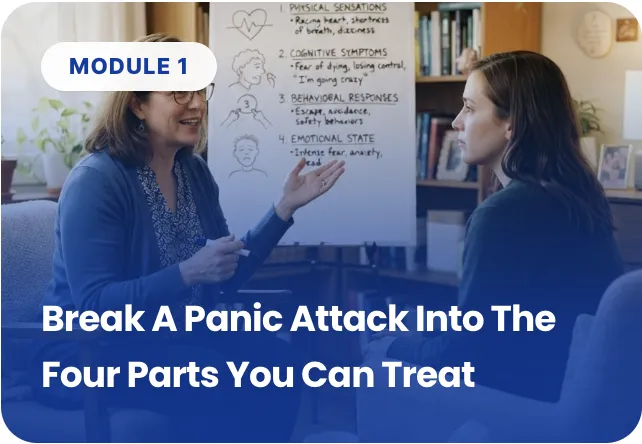
Break A Panic Attack Into The Four Parts You Can Treat
See how to separate any panic attack into its four components: the thought, the physical arousal, the emotion, and what the client does in response. Then map those onto the antecedent, behavior, consequence cycle so you can see which response is keeping the attacks coming, and cover anxiety sensitivity and the role of the amygdala in language you can use with a client.

Separate A Panic Attack From Panic Disorder & Agoraphobia
Know how to identify the presentation you’re witnessing. A panic attack is four or more sensations that peak fast, and it can appear in any anxiety presentation. Panic disorder is different: at least one attack that came out of nowhere, followed by fear of the next one and the avoidance that follows. Agoraphobia can show up with panic disorder or without it, and the two often travel together.
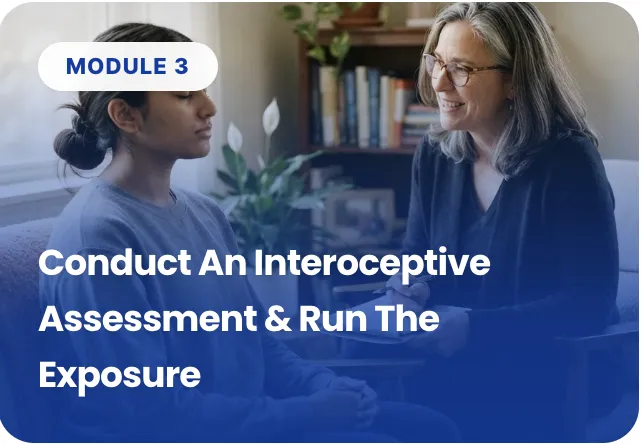
Conduct An Interoceptive Assessment & Run The Exposure
Watch Ashley Smith conduct an interoceptive assessment live, then learn to run the exposures in session: how to choose the exercise for the sensation the client fears most, how long to stay with it, what to say while the client is having the sensation, and how to set up the practice they do between sessions. You will get her decision rules for when a client repeats an exposure and when they move to a harder one, the self-report measures for tracking progress week to week, why safety signals have to come out before in vivo work, and how imaginal exposure brings the client's thoughts into it.
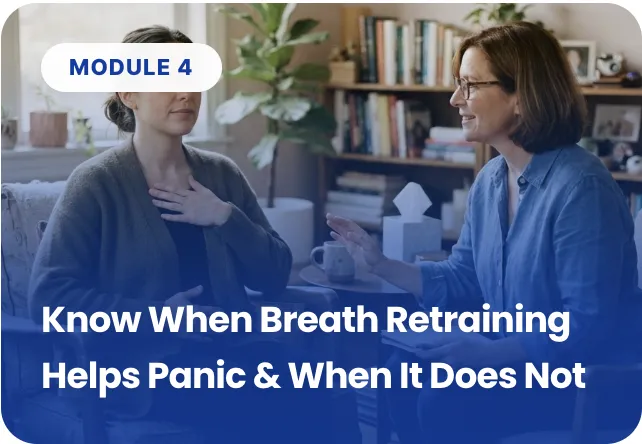
Know When Breath Retraining Helps Panic & When It Does Not
Discover which automatic thoughts and core beliefs drive panic, how to build self-talk a client can actually use during an attack, and where self-compassion fits. Then learn what mindfulness is and is not in panic treatment, and when breath retraining is useful versus when it is contraindicated.
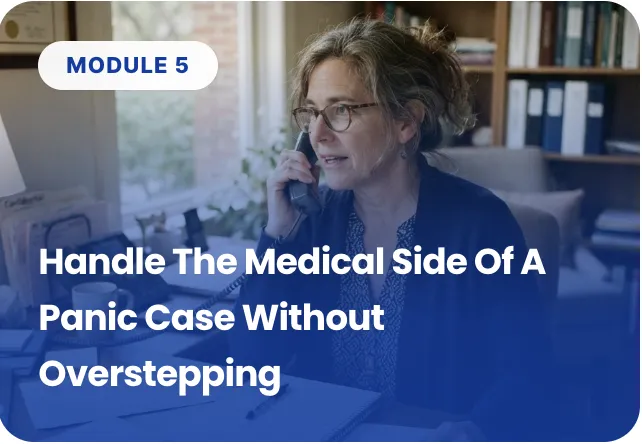
Handle The Medical Side Of A Panic Case Without Overstepping
Understand why a full medical workup belongs early in a panic case and what it rules in as well as out, what your role is on the parts of the plan you do not control, and how to talk with a client and with the other providers on their case. You will leave with language that stays inside your scope and keeps the rest of a client's care lined up with the exposure work instead of pulling against it.

Know Exactly What To Do When A Client Panics In Session
Be able to move a stalled panic case forward using four specific methods. When the client stops doing the exposures between sessions, how to bring in their values and use rewards and consequences to get adherence back. When a client will not give up a safety signal, what to do about it. When the family accommodates every avoidance, what to say to them. And when a panic attack starts in your office, what to do for the rest of the session. You will also learn how to sequence interventions when panic shows up alongside another presentation, and how to close treatment on the right goal.
Step 1 / 2
Register For This Free 6-Hour Clinical Summit On June 2nd
Somatic Interventions Clinical Summit: Body-Based Healing for Trauma Clients When Talk Therapy Has Failed
See what actually separates the conditions clinicians confuse most often: trauma versus ADHD, sleep disorders and thyroid dysfunction versus depression, autism spectrum disorder versus social anxiety, obsessive-compulsive disorder versus body dysmorphic disorder, bipolar disorder versus borderline personality disorder, and anxiety disorders versus medical conditions. For each pair, Diane Bigler works through the clinical features that genuinely distinguish the two from the ones that only appear to. You will leave able to apply the same reasoning to a pair she doesn’t cover.
Learn the five things that separate two conditions when the symptom list can't. Diane Bigler covers how to take each one during an assessment, what each one rules in and out, and what to do when they point in different directions. This is where the difference between two conditions actually shows up, and a symptom checklist never gets there.
Discover which screening instruments actually separate the conditions you are weighing, and which return a result that looks decisive in exactly the case where it is least reliable. Then learn to use the client's history, and information from people who knew them earlier, as evidence rather than as background: what to ask for, what to weigh it against, and what it means when the history and the client in front of you do not match. Diane Bigler covers how findings, instruments, and history combine into one read instead of three separate impressions.
Leave an assessment with a formulation a treatment plan can be built on, rather than a label that leaves the plan to guesswork. Diane Bigler covers what goes into a formulation and in what order, how the criteria and the client's biological, psychological, and social picture come together into one account, and what to do when two conditions still fit at the end of an assessment. You will also cover how the formulation drives the treatment recommendations that follow from it.
Know what to ask, in what order, and what each answer rules out. Diane Bigler works through the targeted questions for the conditions covered, including the wording that separates restlessness from being on alert, not wanting to do something from not being able to, and a mood shift lasting an hour from one lasting three weeks. You will also see what changes in the interview when the two conditions in front of you are a different pair.
Be able to recognize the cases that call for medical evaluation, neuropsychological testing, or specialty assessment, and know which findings should trigger each one. Diane Bigler covers what belongs in your assessment and what belongs with a physician, and how a referral fits into the treatment recommendations you are already making. You will leave able to make that call on evidence rather than on instinct.
The Differential Assessment Masterclass Starts In:
6 HOURS OF LIVE CASE WORK, CLINICAL DECISION POINTS & DIFFERENTIAL REASONING
Diane Bigler, MSW, LCSW, LSCSW, Spent Ten Years Teaching Mental Health & Psychopathology At The University Of Kansas School Of Social Welfare
Most clinicians learn the criteria in graduate school and learn clinical reasoning afterward, on the job, from the cases that went sideways. Diane Bigler taught the criteria. For ten years, she taught Mental Health and Psychopathology in the clinical master's program at the University of Kansas School of Social Welfare, alongside Clinical Social Work Practice, Cognitive Behavior Therapy, and Family Therapy, and was named the School's Adjunct Professor of the Year in 2017. She has also run a clinical supervision practice that carried more than fifty social workers through to licensure, and her own clinical work spans psychiatric hospital, outpatient, and in-home settings.
Most of the difficulty in this work is not knowing the criteria. It is getting the information out of a client in a first session, which standard training leaves to experience. Before she became a therapist, Diane Bigler worked as a criminal investigator for a district attorney's office and completed two field internships at the FBI Academy in Quantico, studying interrogation and behavioral analysis. What she brings to October 14th is six hours of that expertise applied to a caseload: how she structures an assessment interview, what she asks when two conditions fit equally well, how she weighs the history against what is in front of her, and when she decides a case belongs with a physician rather than in another session.

Here's What You Can Do After This Training (And What You'll Miss)
WITH THIS MASTERCLASS:
You know what separates trauma from ADHD and other conditions when the symptoms match
You catch the depression that is really a sleep or thyroid problem
You get an intake with a formulation that clearly identifies the treatment
You know which findings send a client to another provider
WITHOUT THIS MASTERCLASS:
Two conditions fit the same client equally & nothing settles it
The exhaustion gets treated as depression & nothing moves
The condition goes in the record & the treatment plan is still a guess
The medical cause stays in the room for the length of the case
6 CEs, Lifetime Replay & Clinical tools: Available For Purchase After Registration (You'll Be Redirected automatically)

Frequently Asked Questions
What exactly is this Masterclass, & what do I get for registering?
A free 6-hour live Masterclass on October 14th with Diane Bigler, MSW, LCSW, LSCSW, covering how to tell apart conditions that produce the same symptoms, from the first interview through the treatment plan. Registration is free, and 6 CEs plus lifetime access to the recording are available for purchase after you register.
Is this really free, or do I need to buy something to attend?
The 6-hour live Masterclass is free to attend live. 6 CEs and lifetime access to the recording are a paid upgrade offered after you register, and you are welcome to attend the full training without it.
Is this live, or a recording being run as a live event?
Live on October 14th. Diane Bigler presents in real time, working through case material and clinical decision points across the six hours.
October 14th is a Wednesday & I have clients. Do I have to be there for the whole six hours?
Come for the hours you can. Lifetime access to the full recording is available for purchase after you register, which matters more than usual here, because you need this on the day one specific client stops making sense, not on the day of the training.
I am not a physician. Am I actually allowed to rule out medical causes?
Ruling out is not what you are doing. Recognizing the findings that warrant a referral sits inside your scope and is part of competent assessment, and the training covers which findings those are and where the line falls.
I have taken DSM trainings that were too theoretical to use. How is this different?
This is built around the assessment rather than the manual. You get the five things to ask about, the order to ask them in, and what each answer rules out, applied to the conditions that are hardest to tell apart.
I have been assessing complex presentations for years. Will this be too basic?
No. This is an intermediate training and it assumes you know the criteria. What it adds is a repeatable way to separate two conditions when the symptoms match, including the features that feel like they separate them and do not.
I am an LCSW, LPC or LMFT, not a psychologist. Is this Masterclass for me?
Yes. It is built for licensed mental health professionals doing clinical assessment in outpatient practice, whatever the discipline. To check CE approval for your license type and state, use the Board Approvals button at the bottom of this page.
I practice from a specific modality. Will this conflict with how I work?
No. This sits upstream of modality. It settles what you are treating, then hands the case back to whatever approach you already use, aimed at the right condition.
How many CEs can I receive, & how do I get them?
6 CEs from Differential Assessment Masterclass: A 5-Part Framework For Identifying Which Condition A Client Actually Has When The Symptoms Overlap, with Diane Bigler, MSW, LCSW, LSCSW. Available for purchase after you register.
Can I get the recording if I cannot attend live?
Yes. The full 6-hour recording with lifetime access is available for purchase at the next step, once you register for the Masterclass.
Are the CEs approved for my license?
To check approval for your license type & state, scroll to the bottom of this page & click the Board Approvals button.
Scope and Limitations Disclosure:
This Masterclass is educational and is intended for licensed mental health professionals practicing within their scope of practice and jurisdiction. It supports recognition, assessment, formulation, and referral. It does not train participants in neuropsychological evaluation, psychological testing, formal autism assessment, medical evaluation, or medication management, and it does not qualify participants to conduct assessments outside their scope of practice. All clinical decisions remain the responsibility of the licensed clinician.
Commercial Support Disclosure
Diane Bigler, MSW, LCSW, LSCSW is an independent clinician & continuing education presenter specializing in mental health, psychopathology, clinical social work, cognitive behavior therapy, and family therapy,. This training does not require participants to purchase any additional products, books, or materials to complete the training.