
FREE 6-HOUR LIVE MASTERCLASS ON GRIEF & LOSS FOR LICENSED THERAPISTS
TUESDAY, OCTOBER 13TH, 2026 @ 10:00 AM TO 5:30 PM ET
How To Recognize Prolonged Grief When It Looks Like Depression, PTSD, Or Another Condition, & How To Treat It With 6 Grief-Focused Interventions
In this free 6-hour Masterclass, you'll learn the 4 factors that separate normative grief from Prolonged Grief Disorder, the clinical reasoning that separates prolonged grief from depression, PTSD, and adjustment disorder, how to identify whether meaning disruption, avoidance, guilt, or uncertainty is driving a client's grief, and how to match 6 grief-focused interventions to what you find, using a meaning-making approach that carries your assessment straight into the treatment plan.
Taught live by Christina Zampitella, PsyD, FT, a licensed clinical psychologist, Fellow in Thanatology, founder of The Center for Grief and Trauma Therapy
6 CEs + LIFETIME ACCESS to the recording & The Prolonged Grief Clinician's Guide available for purchase after free registration.

Register Free Below. This Event Is For Licensed Mental Health Professionals
By providing your phone number, you consent to receive SMS messages about joining the webinar. You may reply STOP at any time to unsubscribe.

The Grief & Loss Masterclass Starts In:
SCREEN FOR FIVE HIDDEN DEFICIENCIES
Omega-3, Vitamin D, B12, Magnesium & Iron in One Training
9 Board-Approved CEs
Available for Purchase in Next Step
RECORDING WITH CE PURCHASE
Watch on Your Own Schedule





When Youth Therapy Gets Stuck: Trauma, Anxiety, and Emotional Dysregulation in Children
What You'll Discover During The Grief & Loss Masterclass
You'll work through sudden & traumatic loss, ambiguous loss, non-death losses like divorce & estrangement, losses others don't recognize, & the grief that looks like depression, PTSD or adjustment disorder.
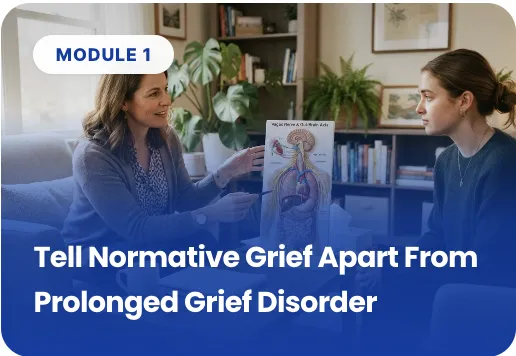
Tell Normative Grief Apart From Prolonged Grief Disorder
Learn the four factors that separate normative and integrated grief from Prolonged Grief Disorder: clinical presentation, duration, functional impairment, and context. Dr. Zampitella covers how to weigh each factor in an assessment and what to do when they point in different directions. You will leave knowing when a grieving client needs support and time, and when they need a treatment plan.
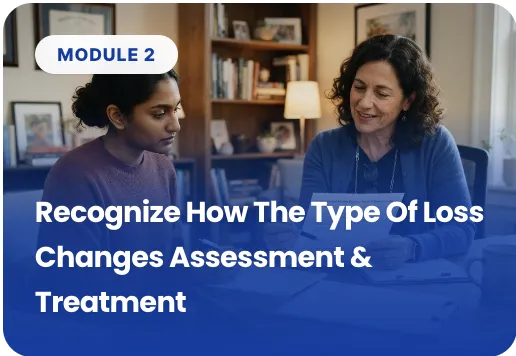
Recognize How The Type Of Loss Changes Assessment & Treatment
See how sudden and traumatic loss, ambiguous loss, non-death losses such as divorce and estrangement, and losses that other people don't recognize each shape a client's grief in different ways. You will cover what each type of loss changes about what you look for in an assessment and how you plan treatment. You will be able to identify the kind of loss in front of you before you decide how to treat the grief.
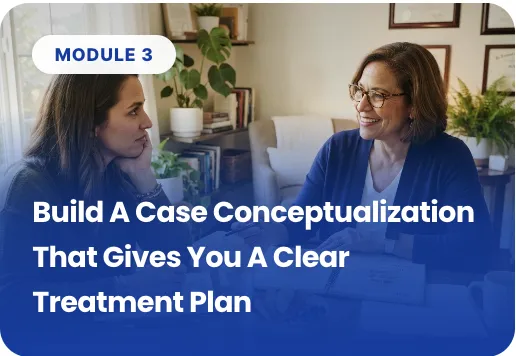
Build A Case Conceptualization That Gives You A Clear Treatment Plan
Learn how contemporary grief models, including meaning reconstruction, continuing bonds, attachment theory, and the Dual Process Model, differ from stage-based assumptions about grief, and how to use them in case conceptualization. Dr. Zampitella also covers how to explain grief to a client in terms that make sense to them. You will leave with a conceptualization that points to the next steps in treatment.
Tell Prolonged Grief Apart From Low Mood, Trauma & Adjustment Concerns
Learn the clinical reasoning that separates Prolonged Grief Disorder from major depressive disorder, PTSD, and adjustment disorder when the presentations overlap, using the current criteria. You will also cover how an unexpected or unnatural death changes what you see in the room. You will be able to build a treatment plan for the condition that is actually present.
Pinpoint What's Driving A Client's Grief & Build A Treatment Plan In The Right Order
Learn how to identify whether meaning disruption, avoidance, guilt, or uncertainty is keeping a client's grief from integrating, and how the client's cultural, spiritual, relational, and developmental context shapes what you find. Dr. Zampitella covers how to combine those findings with risk and protective factors and current functioning into a focused case conceptualization, then into a treatment plan that sets out what to address first and what follows. You will leave knowing where to start with a grieving client and why.
Apply 6 Grief-Focused Interventions For Meaning, Guilt, Uncertainty & Connection
Learn six grief-focused interventions and when to use each one: meaning-making and narrative work when a loss has disrupted the client's life story, coping flexibility work for a client who can't move between grieving and daily life, a responsibility versus control approach for guilt and regret, continuing bonds work for the client's ongoing relationship with the person who died, ritual, and approaches for uncertainty and ambiguous loss. Dr. Zampitella covers how to adapt each intervention after a sudden or traumatic loss and how to decide which one to use first. You will be able to use them with the grieving clients already on your caseload.
Step 1 / 2
Register For This Free 6-Hour Clinical Summit On June 2nd
Somatic Interventions Clinical Summit: Body-Based Healing for Trauma Clients When Talk Therapy Has Failed
When Youth Therapy Gets Stuck: Trauma, Anxiety, and Emotional Dysregulation in Children
What You'll Discover During The Treating Panic Disorder Webinar
How to assess a panic case, run the exposure in session, change the beliefs underneath it, & end treatment so the fear of the next attack no longer runs the client’s life.
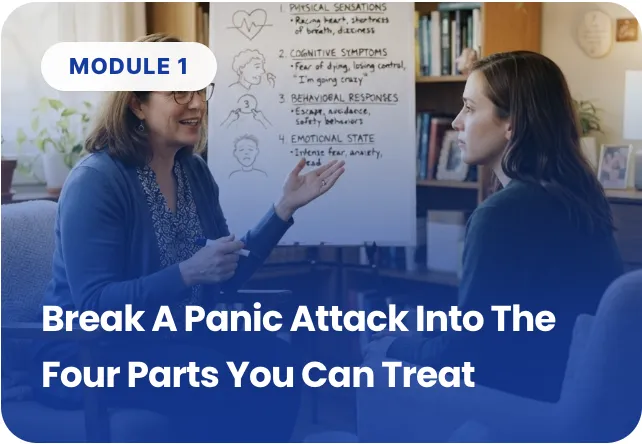
Break A Panic Attack Into The Four Parts You Can Treat
See how to separate any panic attack into its four components: the thought, the physical arousal, the emotion, and what the client does in response. Then map those onto the antecedent, behavior, consequence cycle so you can see which response is keeping the attacks coming, and cover anxiety sensitivity and the role of the amygdala in language you can use with a client.

Separate A Panic Attack From Panic Disorder & Agoraphobia
Know how to identify the presentation you’re witnessing. A panic attack is four or more sensations that peak fast, and it can appear in any anxiety presentation. Panic disorder is different: at least one attack that came out of nowhere, followed by fear of the next one and the avoidance that follows. Agoraphobia can show up with panic disorder or without it, and the two often travel together.
Conduct An Interoceptive Assessment & Run The Exposure
Watch Ashley Smith conduct an interoceptive assessment live, then learn to run the exposures in session: how to choose the exercise for the sensation the client fears most, how long to stay with it, what to say while the client is having the sensation, and how to set up the practice they do between sessions. You will get her decision rules for when a client repeats an exposure and when they move to a harder one, the self-report measures for tracking progress week to week, why safety signals have to come out before in vivo work, and how imaginal exposure brings the client's thoughts into it.
Know When Breath Retraining Helps Panic & When It Does Not
Discover which automatic thoughts and core beliefs drive panic, how to build self-talk a client can actually use during an attack, and where self-compassion fits. Then learn what mindfulness is and is not in panic treatment, and when breath retraining is useful versus when it is contraindicated.
Handle The Medical Side Of A Panic Case Without Overstepping
Understand why a full medical workup belongs early in a panic case and what it rules in as well as out, what your role is on the parts of the plan you do not control, and how to talk with a client and with the other providers on their case. You will leave with language that stays inside your scope and keeps the rest of a client's care lined up with the exposure work instead of pulling against it.
Know Exactly What To Do When A Client Panics In Session
Be able to move a stalled panic case forward using four specific methods. When the client stops doing the exposures between sessions, how to bring in their values and use rewards and consequences to get adherence back. When a client will not give up a safety signal, what to do about it. When the family accommodates every avoidance, what to say to them. And when a panic attack starts in your office, what to do for the rest of the session. You will also learn how to sequence interventions when panic shows up alongside another presentation, and how to close treatment on the right goal.
Step 1 / 2
Register For This Free 6-Hour Clinical Summit On June 2nd
Somatic Interventions Clinical Summit: Body-Based Healing for Trauma Clients When Talk Therapy Has Failed
Learn the four factors that separate normative and integrated grief from Prolonged Grief Disorder: clinical presentation, duration, functional impairment, and context. Dr. Zampitella covers how to weigh each factor in an assessment and what to do when they point in different directions. You will leave knowing when a grieving client needs support and time, and when they need a treatment plan.
See how sudden and traumatic loss, ambiguous loss, non-death losses such as divorce and estrangement, and losses that other people don't recognize each shape a client's grief in different ways. You will cover what each type of loss changes about what you look for in an assessment and how you plan treatment. You will be able to identify the kind of loss in front of you before you decide how to treat the grief.
Learn how contemporary grief models, including meaning reconstruction, continuing bonds, attachment theory, and the Dual Process Model, differ from stage-based assumptions about grief, and how to use them in case conceptualization. Dr. Zampitella also covers how to explain grief to a client in terms that make sense to them. You will leave with a conceptualization that points to the next steps in treatment.
Learn the clinical reasoning that separates Prolonged Grief Disorder from major depressive disorder, PTSD, and adjustment disorder when the presentations overlap, using the current criteria. You will also cover how an unexpected or unnatural death changes what you see in the room. You will be able to build a treatment plan for the condition that is actually present.
Learn how to identify whether meaning disruption, avoidance, guilt, or uncertainty is keeping a client's grief from integrating, and how the client's cultural, spiritual, relational, and developmental context shapes what you find. Dr. Zampitella covers how to combine those findings with risk and protective factors and current functioning into a focused case conceptualization, then into a treatment plan that sets out what to address first and what follows. You will leave knowing where to start with a grieving client and why.
Learn six grief-focused interventions and when to use each one: meaning-making and narrative work when a loss has disrupted the client's life story, coping flexibility work for a client who can't move between grieving and daily life, a responsibility versus control approach for guilt and regret, continuing bonds work for the client's ongoing relationship with the person who died, ritual, and approaches for uncertainty and ambiguous loss. Dr. Zampitella covers how to adapt each intervention after a sudden or traumatic loss and how to decide which one to use first. You will be able to use them with the grieving clients already on your caseload.
6 HOURS OF LIVE CASE MATERIAL, GRIEF ASSESSMENT & GRIEF-FOCUSED INTERVENTIONS
Christina Zampitella, PsyD, FT, Founded The Center For Grief & Trauma Therapy & Serves On The Faculty Of The Portland Institute For Loss & Transition
Christina Zampitella, PsyD, FT, is a licensed clinical psychologist, Fellow of Thanatology, and the founder of The Center for Grief and Trauma Therapy. She frequently serves as an adjunct professor and internationally recognized professional speaker, with a particular passion for training emerging mental health professionals. Her clinical practice, research, course development, and teaching are centered around grief and trauma studies, nature-based therapy, and integrative psychology. Dr. Zampitella has held leadership roles within professional institutions, serving as the chair of the continuing education committee for several organizations.
Additionally, she is a faculty member at the Portland Institute for Loss and Transition and is on the advisory committee for National University’s Integrative Psychology bachelor’s degree program. Her professional experience includes serving as the resident psychologist for 5 News in San Diego, and she frequently appeared on NBC News in San Diego and Philadelphia. Dr. Zampitella has been recognized in various publications, including HuffPost, New York Post, Elle magazine, BuzzFeed, and several Delaware publications. She also hosts her podcast, Phoenix Rising with Dr. Z., where she delves into various topics related to grief and trauma.

Here's What You Can Do After This Training (And What You'll Miss)
WITH THIS MASTERCLASS:
You know when a client's grief needs time & when it needs treatment
You can tell prolonged grief apart from depression & PTSD
You know what's driving a client's grief & where to start
You have 6 grief-focused interventions & know which one to use
WITHOUT THIS MASTERCLASS:
Normative grief gets treated as a disorder, or prolonged grief gets missed
Prolonged grief gets treated as depression & the grief goes unaddressed
Sessions cover the same ground & nothing points to a next step
The plan leans on stage-based assumptions that don't fit the client
6 CEs, Lifetime Replay & The Prolonged Grief Clinician's Guide: Available For Purchase After Registration (You Will Be Redirected Automatically)

Frequently Asked Questions
What exactly is this Masterclass, & what do I get for registering?
A free 6-hour live Masterclass on October 13th with Christina Zampitella, PsyD, FT, covering how to recognize prolonged grief, identify what's driving it, and treat it with six grief-focused interventions. Registration is free, and 6 CEs, lifetime access to the recording, and The Prolonged Grief Clinician's Guide are available for purchase after you register.
Is this really free, or do I need to buy something to attend?
The 6-hour live Masterclass is free to attend live. 6 CEs and lifetime access to the recording are a paid upgrade offered after you register, and you are welcome to attend the full training without it.
Is this live, or a recording being run as a live event?
Live on Zoom on October 13th. Dr. Zampitella presents in real time, working through case material and practical exercises across the six hours.
October 13th is a Tuesday & I have clients. Do I have to be there for the whole six hours?
Come for the hours you can. Lifetime access to the full recording is available for purchase after you register, which matters here, because you'll want this on the day a specific grieving client isn't improving, not only on the day of the training.
What time is the Masterclass in my time zone?
It runs from 10:00 AM to 5:30 PM ET, which is 9:00 AM to 4:30 PM CT, 8:00 AM to 3:30 PM MT, and 7:00 AM to 2:30 PM PT, with breaks and a lunch hour.
Grief is a normal response to loss. Will this teach me to treat it like a disorder?
No. The first thing the Masterclass covers is how to tell normative grief apart from Prolonged Grief Disorder, so you can support grief that needs time and treat only the grief that needs treatment.
I'm not a grief specialist. Is this Masterclass for me?
Yes. It is built for licensed clinicians who see grieving clients on a general caseload, not only for grief specialists.
I have taken grief trainings that mostly covered the stages. How is this different?
This is built around assessment and treatment rather than the stages. You get the four factors to assess, the four drivers to look for, and six grief-focused interventions to match to what you find.
Does this cover losses that aren't deaths?
Yes. The Masterclass covers non-death losses such as divorce and estrangement, along with ambiguous loss and losses that other people don't recognize.
Is this too basic, or too advanced, for me?
Neither. It works for any licensed clinician, whether grief is new to your caseload or a regular part of it, and it moves from assessment through treatment planning to specific interventions.
I am an LCSW, LPC or LMFT, not a psychologist. Is this Masterclass for me?
Yes. It is built for licensed mental health professionals working with grieving clients, whatever the discipline. To check CE approval for your license type and state, use the Board Approvals button at the bottom of this page.
I practice from a specific modality. Will this conflict with how I work?
No. The grief-focused interventions work alongside the approach you already use, and the assessment and case conceptualization steps apply whatever your modality.
How many CEs can I receive, & how do I get them?
6 CEs from Grief & Loss Masterclass: How To Recognize Prolonged Grief, Pinpoint What's Driving It & Treat It With 6 Targeted Interventions, with Christina Zampitella, PsyD, FT. Available for purchase after you register.
Can I get the recording if I cannot attend live?
Yes. The full 6-hour recording with lifetime access is available for purchase at the next step, and you can earn the 6 CEs from the replay.
Are the CEs approved for my license?
To check approval for your license type & state, scroll to the bottom of this page & click the Board Approvals button.
Scope and Limitations Disclosure:
Scope and limitations. This Masterclass is educational and is intended for licensed mental health professionals practicing within their scope of practice and jurisdiction. It supports grief assessment, case conceptualization, treatment planning, and grief-focused intervention. It does not train participants in formal psychological testing, medication management, or crisis intervention, and it does not qualify participants to provide services outside their scope of practice. All clinical decisions remain the responsibility of the licensed clinician.
Commercial Support Disclosure
Christina Zampitella, PsyD, FT is a licensed clinical psychologist and a Fellow in Thanatology specializing in death, loss, and grief. This training does not require participants to purchase any additional products, books, or materials to complete the training.