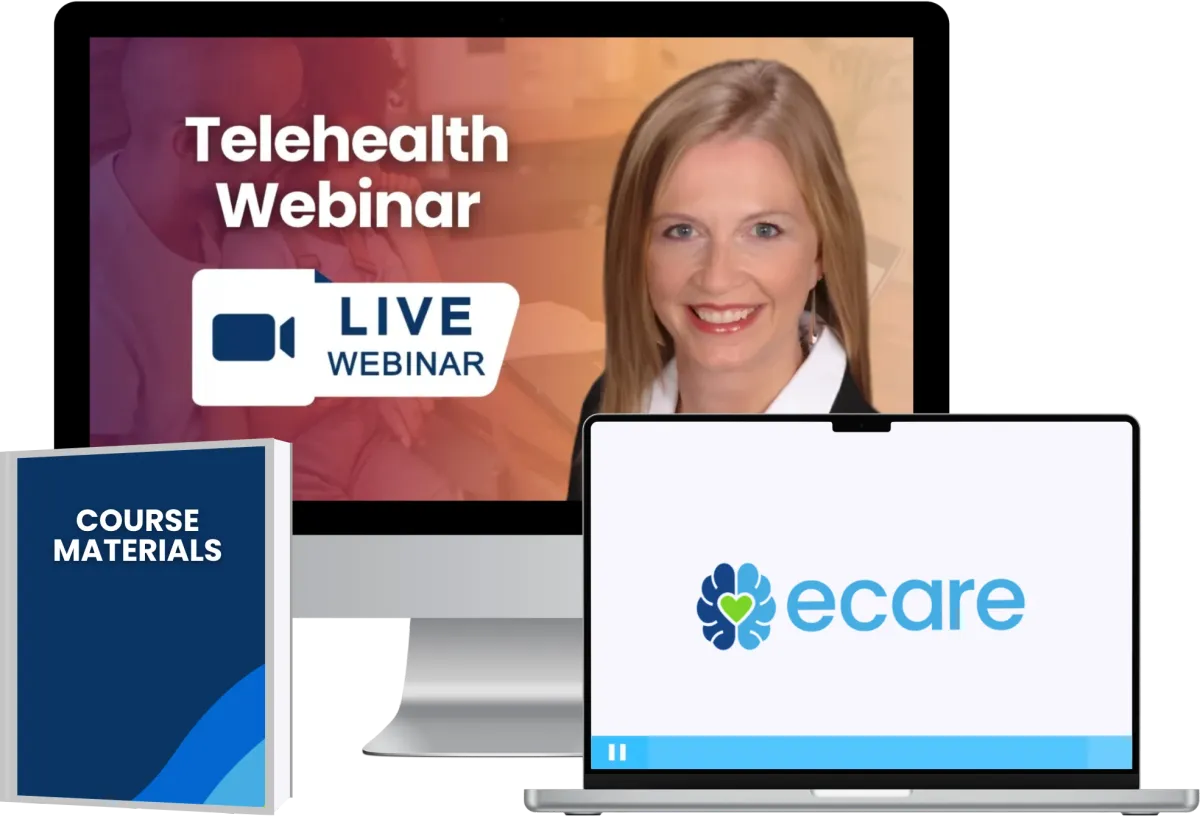
FREE 6-HOUR LIVE TELEHEALTH WEBINAR FOR LICENSED CLINICIANS
TUESDAY, NOVEMBER 17, 2026 | 10:00 AM TO 5:30 PM ET
Warning From A Former Licensing Board Member: Your Video Sessions Could Be Breaking Federal & State Law. Follow These 3 Rulebooks To Stay Compliant, Avoid Costly Mistakes, & Use AI Responsibly
In this free 6-hour Webinar, Dr. Westendorf shows you how to work with clients in other states without breaking the law, protect your clients' data & privacy, & handle boundaries, risks, & artificial intelligence (AI) tools by the standards of your ethics code, before a mistake can cost you your good standing or a client's trust
With Melissa Westendorf, PhD, JD, a clinical and forensic psychologist with a law degree who served on the Wisconsin Psychology Examining Board
Lifetime recording access and 6 CE credits available for purchase after free registration.

Register Free Below. This Event Is For Licensed Mental Health Professionals
By providing your phone number, you consent to receive SMS messages about joining the webinar. You may reply STOP at any time to unsubscribe.

The Webinar Goes Live In
SCREEN FOR FIVE HIDDEN DEFICIENCIES
Omega-3, Vitamin D, B12, Magnesium & Iron in One Training
9 Board-Approved CEs
Available for Purchase in Next Step
RECORDING WITH CE PURCHASE
Watch on Your Own Schedule



When Youth Therapy Gets Stuck: Trauma, Anxiety, and Emotional Dysregulation in Children
What You'll Discover In The Telehealth Webinar
Every video session falls under 3 rulebooks at once, & any of them can change: Dr. Westendorf shows what your profession's ethics code & federal privacy law require now, how to find out what the law requires in your state & your client's, & how to apply all three, AI tools included, so you can avoid costly mistakes & do your best work for clients
Make Telehealth Decisions Your Profession's Ethics Code Backs Up
The codes for psychology, counseling, social work, and marriage and family therapy each handle technology in their own way.
Dr. Westendorf walks through the ethical principles, professional standards, and codes of conduct that govern telehealth across all four disciplines.
You'll be able to tell what your own profession's code requires of your video work, so the next call you make on your own has that standard behind it.
Handle Client Information The Way Federal Privacy Law Requires
The pandemic-era leniency on enforcing federal privacy rules for video sessions has ended, and a platform's website calling itself private can't tell you whether your own setup meets the law.
Dr. Westendorf defines the federal regulations that apply, including the Health Insurance Portability and Accountability Act (HIPAA) and the Health Information Technology for Economic and Clinical Health (HITECH) Act, and shows how to apply them to telehealth practice.
You'll be able to check each tool that touches client information against HIPAA and HITECH, so you know which ones meet the rules before a client's information goes into them.
Work Out When You Can See Clients In Other States By Video
A client you've seen for years can move away, or a new client can call from another state, and the law of the state where they're sitting can decide whether you're allowed to see them at all.
Dr. Westendorf explains how state requirements for telehealth differ and walks through at least three considerations for interstate practice, including licensing compacts and temporary practice provisions.
You'll be able to work out which route your license allows before you say yes, so you can keep long-term clients who move and take on new ones in other states where the law permits.
Manage The Telehealth Risks That Can Lead To Costly Mistakes
If a client has moved since intake and a session turns into a crisis, the address in their file can send help to the wrong place, and that's one of several risks that come with seeing clients by video.
Dr. Westendorf walks through the risks specific to telehealth practice and the risk management strategies that address them, for ethical and legally compliant work.
You'll be able to build risk management into your video sessions, including an emergency plan tied to where each client is that day, so help can reach a client where they actually are.
Tell When A Boundary Crossing On Video Becomes A Violation
Video brings boundary questions your office used to settle for you: a text after hours, a friend request, a client who can see into your home, or a session from a parked car.
Dr. Westendorf distinguishes appropriate boundary crossings from boundary violations in telehealth, with real-world licensing board complaint examples.
You'll be able to make the call in the moment and know if a boundary has been crossed or violated, so you can catch a crossing before it becomes a violation that reaches your board.
Secure The Texts, Emails, & Records Between Your Video Sessions
A quick text to confirm a time can turn into a thread of clinical details, and messages with clients carry the same privacy duties as the session itself.
Dr. Westendorf shows how to evaluate technology, communication, and documentation practices so telehealth services stay secure and ethical from one session to the next.
You'll be able to choose the channels you'll use with clients and how you'll store and document what passes through them, so what a client shares between sessions can stay as private as what they say on screen.
Spot The Ethical Risks In An AI Note-Taker Before You Turn It On
An AI note-taker can draft a note that includes things nobody said in session; once you sign it, it's your note and part of your client's record.
Dr. Westendorf identifies the ethical concerns and potential risks of using AI in behavioral health practice.
You'll be able to weigh the risks of an AI tool before it ever reaches a session, so the time it saves you doesn't have to cost you an accurate record or a client's privacy.
Bring AI Into Your Practice In A Way That Keeps Clients' Trust
A client can ask whether software is listening to their sessions, and an answer that comes after the fact can rupture the alliance.
Dr. Westendorf develops strategies for bringing AI tools into clinical practice responsibly while protecting client confidentiality and professional standards.
You'll be able to raise AI use at the start, as part of informed consent, so clients hear about it from you first.
Step 1 / 2
Register For This Free 6-Hour Clinical Summit On June 2nd
Somatic Interventions Clinical Summit: Body-Based Healing for Trauma Clients When Talk Therapy Has Failed
The Masterclass Goes Live In
Meet Your Presenter
Melissa Westendorf, PhD, JD, Served On The Wisconsin Psychology Examining Board & Trains Clinicians In The Legal & Ethical Rules Of Telehealth
Dr. Westendorf is a clinical and forensic psychologist with a doctorate from MCP Hahnemann University and a law degree from Villanova's law and psychology program. She has a private practice in Wisconsin, where her forensic work includes criminal and civil evaluations. She is a former member of the Wisconsin Psychology Examining Board and of the American Psychological Association's Committee on Legal Issues. She co-founded the Technology Wellness Center and has appeared on Wisconsin Public Radio and TMJ4's The Morning Blend.
Dr. Westendorf has trained clinicians in telehealth law and ethics since 2020, including eCare's earlier training on telehealth ethics.
Throughout the Webinar, she teaches from real-world licensing board complaint examples, with the perspective of someone who has served on a licensing board herself.




The Webinar Goes Live In
The Difference After One Day
With This Webinar, You Will:
Know what to check about your client's state before a session starts
Know what federal privacy law asks of your platform, texts, & records today
Know how to use AI tools responsibly, with clients' informed consent & within the law
Know how to see clients who move or live in other states, where the law allows
Without It, You Could:
Find out after the fact that a session fell under another state's law
Wonder whether your platform, texts, & records meet today's privacy rules
Second-guess every AI feature your platform or records system adds
Guess whether you can keep a client who moves or see one in another state
The Webinar Goes Live In
The live Webinar is free when you register. Lifetime recording access and 6 CE credits are available as an upgrade after you sign up.

Frequently Asked Questions
What exactly is this, and what do I get?
A free 6-hour live Webinar with Dr. Melissa Westendorf on the 3 rulebooks behind every video session (your profession's ethics code, federal privacy law, and state law): what each one requires now, and how to apply it to risk, boundaries, records, and AI tools. Lifetime recording access and 6 CE credits are available as an upgrade after you register.
What are the 3 rulebooks?
The ethics code of your profession (psychology, counseling, social work, or marriage and family therapy), federal privacy law (HIPAA and HITECH), and state law, both in the state that licensed you and in the state where your client is sitting during that session, which can change from one session to the next. In the training's terms, that's ethical principles and codes of conduct, federal regulations, and state regulatory requirements.
I see clients on Tuesdays. Is it still worth registering?
Yes. The Webinar runs Tuesday, November 17, from 10:00 AM to 5:30 PM ET, so you can join for the hours you're free.
Is this live, or a recording?
Live. Dr. Westendorf teaches in real time throughout the Webinar.
I took Dr. Westendorf's earlier telehealth ethics training with eCare. Is this the same thing?
No. This Webinar runs six hours and adds artificial intelligence: the ethical risks of AI tools in practice and strategies for using them responsibly, alongside the ethics codes, federal privacy law, and interstate practice.
My video platform says it's HIPAA compliant. Isn't that enough?
Not on its own. No government body certifies platforms, and whether your telehealth setup meets HIPAA depends on a business associate agreement with each vendor and how your own practice handles client information. Dr. Westendorf covers what HIPAA and HITECH require of your setup.
I want to see more clients in other states. Is this for me?
Yes. Dr. Westendorf covers licensing compacts, temporary practice provisions, and the considerations for interstate practice to weigh before you take on a client in another state.
I don't use AI tools yet. Is this still for me?
Yes. Dr. Westendorf covers the ethical concerns and risks to weigh before you use an AI tool, and how to bring one into your practice responsibly if you decide to.
Is this legal advice for my state?
No. Dr. Westendorf covers the legal and ethical considerations for telehealth practice and how to find out what a given state requires; she doesn't go state by state. Your licensing board decides how your state's rules apply to you.
Is this for my license type?
Yes, if you're a licensed mental health professional: LCSWs, LPCs, LMFTs, psychologists, and other licensed clinicians. The training covers the ethics codes for psychology, social work, counseling, and marriage and family therapy
How many CE credits are available, and how do I get them?
6 CE credits are available as an upgrade after you register. Full attendance is required for CE credit, and the designation note at the bottom of this page explains how state boards apply the credits.
Can I get the recording?
Yes. Lifetime recording access is available as an upgrade after you register.
Are the CE credits approved for my license?
To check approval for your license type & state, scroll to the bottom of this page & click the Board Approvals button.
The Webinar Goes Live In
CE Credit Designation
CE Credit Designation: This course offers 6 CE hours designated as Ethics.
Please note: State licensing boards have the final authority to determine whether a course meets their specific continuing education requirements. We encourage participants to confirm with their licensing board that this course meets their state's ethics requirement before registering, as some states have specific criteria for ethics, jurisprudence, or laws and rules credit.
Attendance
Full attendance is required for CE credit.

APA Statement
eCare Behavioral Health Institute is approved by the American Psychological Association to sponsor continuing education for psychologists. eCare Behavioral Health Institute maintains responsibility for this program and its content.
CE Credit Designation
CE Credit Designation: This course offers 6 CE hours designated as Ethics.
Please note: State licensing boards have the final authority to determine whether a course meets their specific continuing education requirements. We encourage participants to confirm with their licensing board that this course meets their state's ethics requirement before registering, as some states have specific criteria for ethics, jurisprudence, or laws and rules credit.
Attendance
Full attendance is required for CE credit.
APA Statement
eCare Behavioral Health Institute is approved by the American Psychological Association to sponsor continuing education for psychologists. eCare Behavioral Health Institute maintains responsibility for this program and its content.
Scope and Limitations Disclosure:
This Webinar is educational and is intended for licensed mental health professionals practicing within their scope of practice and jurisdiction. It supports ethical, legal, and risk-management decisions in telehealth practice and the responsible use of AI tools. It does not provide legal advice for any jurisdiction or train participants in crisis intervention, and it does not qualify participants to work outside their scope of practice. All clinical decisions remain the responsibility of the licensed clinician.
Commercial Support Disclosure
Melissa Westendorf, PhD, JD, is an independent clinician & continuing education presenter whose work focuses on clinical and forensic psychology, telehealth ethics and law, and technology use. This training does not require participants to purchase any additional products, books, or materials to complete the training.