FREE 6-HOUR LIVE PERSONALITY DISORDERS MASTERCLASS FOR LICENSED CLINICIANS
THURSDAY, NOVEMBER 12, 2026 | 10:00 AM TO 5:30 PM ET
Frustrated & Out Of Ideas Helping A Client With A Personality Disorder? How To Pinpoint The Hidden Core Problem & Finally Make Progress With A Tailored Treatment Plan
In this free 6-hour Masterclass, Ellen Biros shows you how to use a 2-part assessment to find the core problem in a client's sense of self & relationships, build a treatment plan around it with the CBT, DBT, or schema-focused strategies that fit, & handle the pushback & boundary tests that pull the plan off course
With Ellen Biros, MS, LCSW, a licensed clinical social worker whose private practice focuses on the assessment and treatment of personality disorders
6 CEs and lifetime recording access available for purchase after free registration.


Register Free Below. This Event Is For Licensed Mental Health Professionals
By providing your phone number, you consent to receive SMS messages about joining the webinar. You may reply STOP at any time to unsubscribe.

The Webinar Goes Live In
SCREEN FOR FIVE HIDDEN DEFICIENCIES
Omega-3, Vitamin D, B12, Magnesium & Iron in One Training
9 Board-Approved CEs
Available for Purchase in Next Step
RECORDING WITH CE PURCHASE
Watch on Your Own Schedule




When Youth Therapy Gets Stuck: Trauma, Anxiety, and Emotional Dysregulation in Children
What You'll Discover In The Personality Disorders Masterclass
A 2-part assessment that finds the hidden core problem, a tailored treatment plan built around it, the CBT, DBT & schema-focused strategies that fit, & what to do when a client pushes back, tests a boundary, or is at risk, across Clusters A, B & C
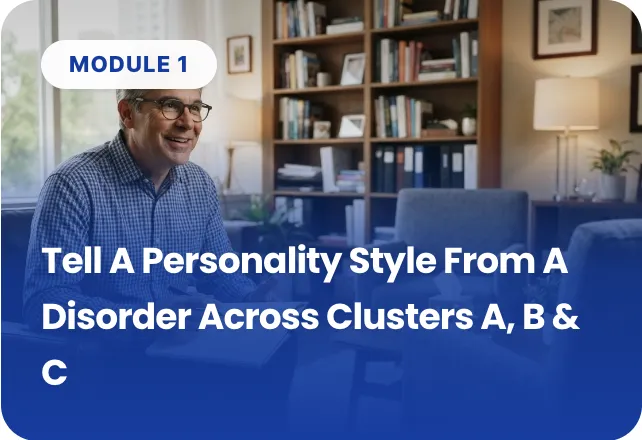
A client who is rigid, distrustful, or easily hurt can be showing a personality style or a personality disorder.
Ellen covers part 1 of the assessment: the defining features of personality disorders across Clusters A, B & C, and how to tell a personality trait from personality pathology.
You'll be able to recognize which cluster a presentation belongs to, or whether it's a style and not a disorder at all, so the goals start from what the client is actually dealing with.
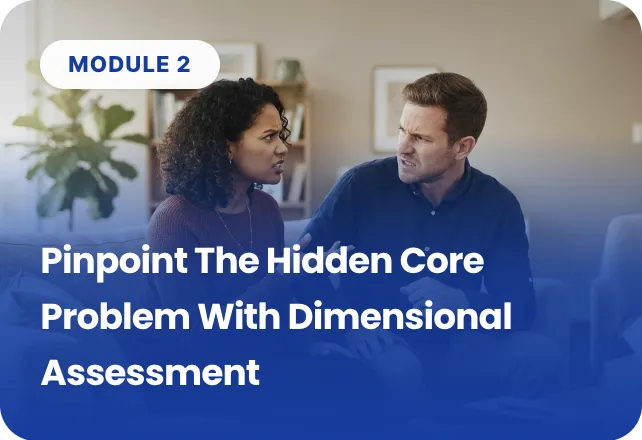
In Ellen's approach, two clients can meet criteria for the same personality disorder and need different treatment plans, because their difficulties start in different places.
Ellen walks through part 2 of the assessment: dimensional assessment of identity, self-direction, empathy, and intimacy, along with pathological personality traits and how widespread and stable the pattern is.
You'll be able to pinpoint whether a client's difficulties start with how they see themselves, how they steer their own life, how they read other people, or how they handle closeness, so you know the core problem to treat first.
Intense moods, distrust, or pulling away from people can come from another condition, a medical issue, a life stage, or a cultural context, and a plan built for a personality disorder that isn't there can leave the real problem untreated.
Ellen covers how to tell personality pathology apart from other mental health conditions, medical factors, developmental stage, and sociocultural context.
You'll be able to rule out what only looks like a personality disorder, so the treatment plan is built for the condition the client is actually living with.
A plan written from the criteria alone can miss what sets this client off, what they believe about themselves and other people, and what they already do well, and then each session ends up following whatever went wrong that week.
Ellen shows how to build an individualized case conceptualization from the client's presentation, personality functioning, traits, schemas, interpersonal patterns, and strengths, and turn it into a structured, individualized treatment plan.
You'll be able to build a tailored treatment plan around the core problem, so each session works on the goals you set together and you know what to do next.
A strategy that helps one client can fall flat with the next, even when both meet criteria for the same personality disorder.
Ellen covers how to select and apply strategies from CBT, DBT, schema-focused, behavioral, and skills-training approaches, guided by the case conceptualization you built for this client.
You'll be able to choose the strategy this client can actually use, so they can bring those skills into the next argument with a partner, a boss, or a friend.
A client can idealize you one week and turn on you the next, push on every limit you set, or agree to everything in session and change nothing at home.
Ellen covers transference, countertransference, therapeutic boundaries, and treatment resistance, along with the clinician frustration that can build in this work.
You'll be able to handle the pushback and boundary tests that pull treatment off course, so the work can keep moving when the relationship with you gets tested.
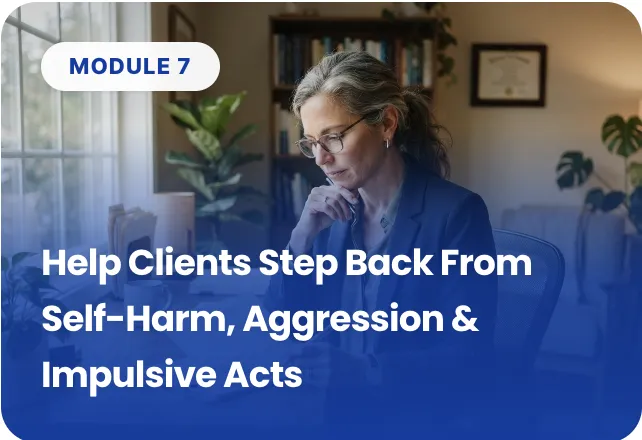
When a client moves toward self-harm, aggression, or another impulsive act, your response in that moment can affect both their safety and their trust in you.
Ellen walks through clinical strategies for assessing and responding to self-injurious behavior, aggression, impulsivity, and other high-risk behaviors.
You'll be able to respond to a high-risk moment with a structured plan, alongside your setting's safety procedures.
Step 1 / 2
Register For This Free 6-Hour Clinical Summit On June 2nd
Somatic Interventions Clinical Summit: Body-Based Healing for Trauma Clients When Talk Therapy Has Failed
The Webinar Goes Live In
When Youth Therapy Gets Stuck: Trauma, Anxiety, and Emotional Dysregulation in Children
What You'll Discover In The Personality Disorders Masterclass
A 2-part assessment that finds the hidden core problem, a tailored treatment plan built around it, the CBT, DBT & schema-focused strategies that fit, & what to do when a client pushes back, tests a boundary, or is at risk, across Clusters A, B & C
A client who is rigid, distrustful, or easily hurt can be showing a personality style or a personality disorder.
Ellen covers part 1 of the assessment: the defining features of personality disorders across Clusters A, B & C, and how to tell a personality trait from personality pathology.
You'll be able to recognize which cluster a presentation belongs to, or whether it's a style and not a disorder at all, so the goals start from what the client is actually dealing with.
In Ellen's approach, two clients can meet criteria for the same personality disorder and need different treatment plans, because their difficulties start in different places.
Ellen walks through part 2 of the assessment: dimensional assessment of identity, self-direction, empathy, and intimacy, along with pathological personality traits and how widespread and stable the pattern is.
You'll be able to pinpoint whether a client's difficulties start with how they see themselves, how they steer their own life, how they read other people, or how they handle closeness, so you know the core problem to treat first.
Intense moods, distrust, or pulling away from people can come from another condition, a medical issue, a life stage, or a cultural context, and a plan built for a personality disorder that isn't there can leave the real problem untreated.
Ellen covers how to tell personality pathology apart from other mental health conditions, medical factors, developmental stage, and sociocultural context.
You'll be able to rule out what only looks like a personality disorder, so the treatment plan is built for the condition the client is actually living with.
A plan written from the criteria alone can miss what sets this client off, what they believe about themselves and other people, and what they already do well, and then each session ends up following whatever went wrong that week.
Ellen shows how to build an individualized case conceptualization from the client's presentation, personality functioning, traits, schemas, interpersonal patterns, and strengths, and turn it into a structured, individualized treatment plan.
You'll be able to build a tailored treatment plan around the core problem, so each session works on the goals you set together and you know what to do next.
A strategy that helps one client can fall flat with the next, even when both meet criteria for the same personality disorder.
Ellen covers how to select and apply strategies from CBT, DBT, schema-focused, behavioral, and skills-training approaches, guided by the case conceptualization you built for this client.
You'll be able to choose the strategy this client can actually use, so they can bring those skills into the next argument with a partner, a boss, or a friend.
A client can idealize you one week and turn on you the next, push on every limit you set, or agree to everything in session and change nothing at home.
Ellen covers transference, countertransference, therapeutic boundaries, and treatment resistance, along with the clinician frustration that can build in this work.
You'll be able to handle the pushback and boundary tests that pull treatment off course, so the work can keep moving when the relationship with you gets tested.
When a client moves toward self-harm, aggression, or another impulsive act, your response in that moment can affect both their safety and their trust in you.
Ellen walks through clinical strategies for assessing and responding to self-injurious behavior, aggression, impulsivity, and other high-risk behaviors.
You'll be able to respond to a high-risk moment with a structured plan, alongside your setting's safety procedures.
Step 1 / 2
Register For This Free 6-Hour Clinical Summit On June 2nd
Somatic Interventions Clinical Summit: Body-Based Healing for Trauma Clients When Talk Therapy Has Failed
The Webinar Goes Live In
Meet Your Presenter
Ellen Biros, MS, LCSW, Took Her Personality Disorder Work From The Criminal Courts Into Private Practice
Ellen began her personality disorder work in the criminal court system and private probation. Today she is a Licensed Clinical Social Worker with a private practice focused on the assessment and treatment of personality disorders, and she has been practicing social work for over 25 years.
Ellen supervises social workers pursuing the LCSW, teaches social work at the University of Phoenix and UMass Global, and has taught at Tulane. She has presented personality disorder trainings for eCare before.
Throughout the Masterclass, she'll take the work in the order a case unfolds: the 2-part assessment, the core problem it shows, the tailored treatment plan, the strategies that fit, and what to do when the relationship or the client's safety is tested.




The Webinar Goes Live In
The Difference After One Day
WITH THIS MASTERCLASS:
The hidden core problem pinpointed in each client
A tailored treatment plan built around it
Strategies that fit the client in front of you
A next step ready when a client pushes back
WITHOUT IT:
A disorder named, with the core problem still hidden
A treatment plan written from the criteria alone
Strategies chosen before the core problem is known
Out of ideas when a client pushes back
The Webinar Goes Live In
The live Masterclass is free when you register. 6 CEs and lifetime recording access are available as an upgrade after you sign up
Frequently Asked Questions
What exactly is this, and what do I get?
A free 6-hour live Masterclass with Ellen Biros on finding the hidden core problem with a 2-part assessment and building a tailored treatment plan around it, across Clusters A, B & C, from the first assessment to the moments a client pushes back or is at risk. 6 CEs and lifetime recording access are available as an upgrade after you register.
What is the 2-part assessment?
Part 1 is which personality disorder a client meets criteria for, and which cluster. Part 2 is where their sense of self and relationships are most impaired: identity, self-direction, empathy, and intimacy. In Ellen's terms, that's categorical and dimensional assessment.
I see clients on Thursdays. Is it still worth registering?
Yes. The Masterclass runs Thursday, November 12, from 10:00 AM to 5:30 PM ET, so you can join for the hours you're free.
Is this really free?
Yes. Registration and the full live Masterclass are free.
Is this live, or a recording?
Live. Ellen teaches in real time throughout the Masterclass.
I've taken one of Ellen's earlier courses with eCare. Is this the same training?
No. This Masterclass covers all three clusters in one day, built around the 2-part assessment and a tailored treatment plan for each client.
Does this cover Clusters A & C, or mostly Cluster B?
All three. Ellen covers Clusters A & C alongside Cluster B, including how to tell a personality style from a disorder and how to rule out other conditions.
Will this be too theoretical to use in session?
No. The assessment finds the core problem, the core problem shapes the treatment plan, and the plan guides how you respond when a client pushes back, tests a boundary, or is at risk.
Is this too basic for me?
It's taught at the intermediate level, for clinicians who already see clients with personality disorders and want a structured way to find what to treat and build the plan.
Is this for my license type?
Yes, if you're a licensed mental health professional: LCSWs, LPCs, LMFTs, psychologists, and other licensed clinicians.
I'm not DBT-trained. Will this fit how I work?
Yes. DBT is one of five evidence-based approaches the training draws on, alongside CBT, schema-focused, behavioral, and skills-training work, and each one can add to whatever model you already use.
How many CEs are available, and how do I get them?
6 CEs are available as an upgrade after you register, and you can earn them live or from the recording.
Can I get the recording?
Yes. Lifetime recording access is available as an upgrade after you register.
Are the CEs approved for my license?
To check approval for your license type & state, scroll to the bottom of this page & click the Board Approvals button.
The Webinar Goes Live In
Scope and Limitations Disclosure:
This Masterclass is educational and is intended for licensed mental health professionals practicing within their scope of practice and jurisdiction. It supports recognizing, assessing, conceptualizing, and planning treatment for personality disorders across Clusters A, B and C. It does not train participants in emergency or crisis services, or certify participants in DBT or any other treatment model, and it does not qualify participants to work outside their scope of practice. All clinical decisions remain the responsibility of the licensed clinician.
Commercial Support Disclosure
Ellen Biros, MS, LCSW is an independent clinician & continuing education presenter whose work focuses on the assessment and treatment of personality disorders, clinical supervision, and social work education. This training does not require participants to purchase any additional products, books, or materials to complete the training.