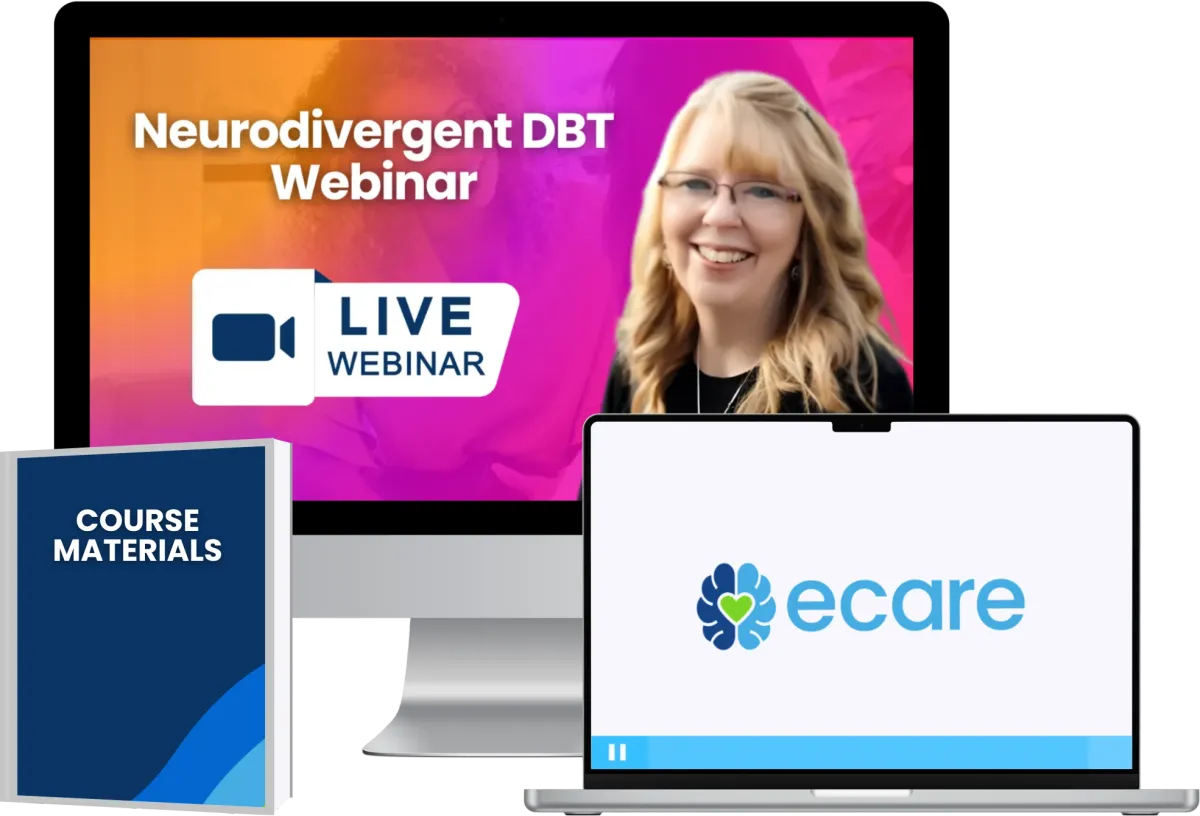
FREE 6-HOUR LIVE NEURODIVERGENT DBT WEBINAR FOR LICENSED CLINICIANS
TUESDAY, NOVEMBER 10, 2026 | 10:00 AM TO 5:30 PM ET
When DBT Skills Don’t Stick, Neurodivergent Clients Can End Up Worse Off: Neuroscience-Informed DBT Helps Them Retain & Recall Their Skills Under Stress, At Work & At Home
In this free 6-hour Webinar, Hannah Smith shows you how to teach essential DBT skills like Wise Mind & DEAR MAN so clients remember them after the session ends, work around the blocks that keep a skill from being used under stress, & adapt each skill so clients can use it on their own at work & at home without masking, burning out, or giving up on therapy
With Hannah Smith, MA, LMHC, CGP, a licensed mental health counselor whose private practice centers on neurodivergent clients
6 CE credits and lifetime recording access available for purchase after free registration.

Register Free Below. This Event Is For Licensed Mental Health Professionals
By providing your phone number, you consent to receive SMS messages about joining the webinar. You may reply STOP at any time to unsubscribe.

The Webinar Goes Live In
SCREEN FOR FIVE HIDDEN DEFICIENCIES
Omega-3, Vitamin D, B12, Magnesium & Iron in One Training
9 Board-Approved CEs
Available for Purchase in Next Step
RECORDING WITH CE PURCHASE
Watch on Your Own Schedule





When Youth Therapy Gets Stuck: Trauma, Anxiety, and Emotional Dysregulation in Children
What You'll Discover In The Neurodivergent DBT Webinar
Neuroscience-informed DBT is a fresh approach, distinct from standard ways of teaching DBT, that helps neurodivergent clients retain, recall & rely on essential DBT skills to manage overwhelm & regulate their emotions in everyday life
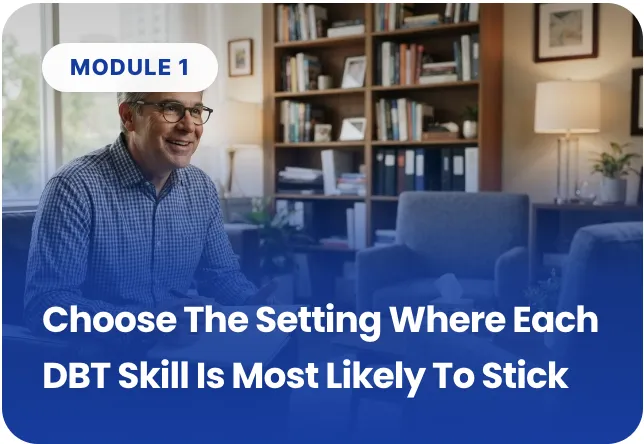
A skill taught in a busy skills group can go right past a client who's spending the hour managing the noise and the people around them, and after enough of those hours, they can stop coming.
Hannah compares individual and group DBT for neurodivergent clients: what each setting asks of a client and how to decide which skills to teach first.
You'll be able to match each skill to the setting where your client can learn and remember it best, so they can leave the session ready to practice it and keep showing up for the next one.
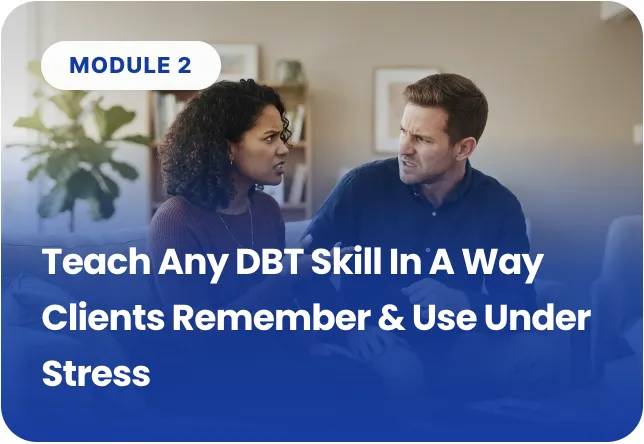
A client can understand a skill in session, practice it with you, and still blank on it the moment stress hits.
Drawing on her background in special education, Hannah walks through at least three methods for adapting any DBT skill to how your client takes in information, such as plain wording, visual steps, and extra time to process, so the skill is still there when the client needs it.
You'll be able to teach any DBT skill in a way that sticks, so your clients can use it on their own between sessions, at work and at home
You can lead a breathing exercise or a body scan, and your client may come out of it more anxious and frustrated than when they started, and less willing to try the next one.
Hannah covers the blocks in information processing that can make standard mindfulness backfire, and shows how she reworks each practice so it can calm a client down.
You'll be able to teach a mindfulness practice your client will actually use, so they have a way to calm themselves down in a loud store or a tense meeting, not just in your office.
If a client can't identify their emotional state as it builds, they may not think to use a regulation skill until they've already blown up or shut down.
Hannah walks through a neuroscience-informed, step-by-step process for identifying and naming emotions, and shows how recognizing an emotion early gives a client a point where they can step in and respond differently.
You'll be able to help clients identify their emotional state while it's still building, so they can reach for the DBT skill you taught them and handle the stress before it boils over.
Distress tolerance skills get a client through their hardest moments, but if a client can't tell where they feel distress in their body, the body-based skills you teach may have nothing to build on.
Hannah covers the blocks to body awareness that can keep a client from learning these skills, and how to tell sensory overload apart from emotional distress, so you can teach the skill that fits what your client is going through.
You'll be able to match each client's distress tolerance skills to what they're going through, so they can get through a moment of overload, calm their body down, and get back to their day.

DEAR MAN, the DBT skill for asking for what you need, can slip away the moment a client has to use it with a boss or a partner, and their job or relationship can pay the price.
Hannah teaches it in a way built around how neurodivergent clients take in information, with every step spelled out as a clear structure: what to say, and in what order.
You'll be able to teach DEAR MAN so it sticks, and asking for what they need, calmly and clearly, can start to feel natural and habitual for your client at work and at home.
Step 1 / 2
Register For This Free 6-Hour Clinical Summit On June 2nd
Somatic Interventions Clinical Summit: Body-Based Healing for Trauma Clients When Talk Therapy Has Failed
The Webinar Goes Live In
When Youth Therapy Gets Stuck: Trauma, Anxiety, and Emotional Dysregulation in Children
What You'll Discover In The Neurodivergent DBT Webinar
Neuroscience-informed DBT is a fresh approach, distinct from standard ways of teaching DBT, that helps neurodivergent clients retain, recall & rely on essential DBT skills to manage overwhelm & regulate their emotions in everyday life
A skill taught in a busy skills group can go right past a client who's spending the hour managing the noise and the people around them, and after enough of those hours, they can stop coming.
Hannah compares individual and group DBT for neurodivergent clients: what each setting asks of a client and how to decide which skills to teach first.
You'll be able to match each skill to the setting where your client can learn and remember it best, so they can leave the session ready to practice it and keep showing up for the next one.
A client can understand a skill in session, practice it with you, and still blank on it the moment stress hits.
Drawing on her background in special education, Hannah walks through at least three methods for adapting any DBT skill to how your client takes in information, such as plain wording, visual steps, and extra time to process, so the skill is still there when the client needs it.
You'll be able to teach any DBT skill in a way that sticks, so your clients can use it on their own between sessions, at work and at home
You can lead a breathing exercise or a body scan, and your client may come out of it more anxious and frustrated than when they started, and less willing to try the next one.
Hannah covers the blocks in information processing that can make standard mindfulness backfire, and shows how she reworks each practice so it can calm a client down.
You'll be able to teach a mindfulness practice your client will actually use, so they have a way to calm themselves down in a loud store or a tense meeting, not just in your office.
If a client can't identify their emotional state as it builds, they may not think to use a regulation skill until they've already blown up or shut down.
Hannah walks through a neuroscience-informed, step-by-step process for identifying and naming emotions, and shows how recognizing an emotion early gives a client a point where they can step in and respond differently.
You'll be able to help clients identify their emotional state while it's still building, so they can reach for the DBT skill you taught them and handle the stress before it boils over.
Distress tolerance skills get a client through their hardest moments, but if a client can't tell where they feel distress in their body, the body-based skills you teach may have nothing to build on.
Hannah covers the blocks to body awareness that can keep a client from learning these skills, and how to tell sensory overload apart from emotional distress, so you can teach the skill that fits what your client is going through.
You'll be able to match each client's distress tolerance skills to what they're going through, so they can get through a moment of overload, calm their body down, and get back to their day.
DEAR MAN, the DBT skill for asking for what you need, can slip away the moment a client has to use it with a boss or a partner, and their job or relationship can pay the price.
Hannah teaches it in a way built around how neurodivergent clients take in information, with every step spelled out as a clear structure: what to say, and in what order.
You'll be able to teach DEAR MAN so it sticks, and asking for what they need, calmly and clearly, can start to feel natural and habitual for your client at work and at home.
Step 1 / 2
Register For This Free 6-Hour Clinical Summit On June 2nd
Somatic Interventions Clinical Summit: Body-Based Healing for Trauma Clients When Talk Therapy Has Failed
The Webinar Goes Live In
Meet Your Presenter
Hannah Smith, MA, LMHC, CGP, Centers Her Private Practice On Neurodivergent Clients & Trains Clinicians To Adapt DBT For Them
Hannah is a licensed mental health counselor and Certified Group Psychotherapist in Washington State. Her private practice centers on neurodivergent clients, and she describes her approach as "structured, neuroscience-based, and non-pathologizing." She holds master's degrees in special education and counseling psychology, and she is certified in interpersonal neurobiology.
Hannah trains clinicians nationally on adapting DBT for neurodivergent clients, group therapy, and neuroscience-informed treatment of anxiety.
Throughout the Webinar, she'll take each DBT skills module in turn and show how she adapts it in individual sessions and in skills groups. She describes her teaching as fun, personal, and practical.




The Webinar Goes Live In
The Difference After One Day
WITH THIS WEBINAR:
Clients able to recall their DBT skills when they need them most
Clients able to calm themselves down before a meltdown
Clients able to ask for what they need at work & at home
Clients able to handle stress without masking or burning out
WITHOUT THIS WEBINAR:
Clients forgetting their DBT skills when they need them most
Clients melting down before they can calm themselves
Clients unable to ask for what they need at work or at home
Clients masking to get through the week until they burn out
The Webinar Goes Live In
The live Webinar is free when you register. 6 CE credits and lifetime recording access are available as an upgrade after you sign up.

Frequently Asked Questions
What exactly is this, and what do I get?
A free 6-hour live Webinar with Hannah Smith on neuroscience-informed DBT for neurodivergent clients: how to teach the essential DBT skills, from mindfulness to DEAR MAN, so they stick and your clients use them. 6 CE credits and lifetime recording access are available as an upgrade after you register.
I see clients on Tuesdays. Is it still worth registering?
Yes.The Webinar runs Tuesday, November 10, from 10:00 AM to 5:30 PM ET, so you can join for the hours you're free.
Is this really free?
Yes. Registration and the full live Webinar are free.
Is this live, or a recording?
Live. Hannah teaches in real time throughout the Webinar.
Is this only about autism?
No. Hannah covers adapting DBT for neurodivergent clients, in individual sessions and in skills groups.
Will the neuroscience be too theoretical to use in session?
No. Each part of the training is tied to a DBT skill you already teach: mindfulness, emotion regulation, distress tolerance, and DEAR MAN.
Is this too basic for me?
It's taught at the intermediate level, for clinicians who already use DBT or DBT skills and want to adapt it for neurodivergent clients.
Is this for my license type?
Yes, if you're a licensed mental health professional: LCSWs, LPCs, LMFTs, psychologists, and other licensed clinicians.
I'm already DBT-trained. Will this conflict with how I teach DBT?
No. These adaptations work inside the DBT you already teach, for the clients the standard delivery isn't reaching.
How many CE credits are available, and how do I get them?
6 CE credits are available as an upgrade after you register. Complete a short quiz and evaluation, and your certificate is available right away.
Can I get the recording?
Yes. Lifetime recording access is available as an upgrade after you register.
Are the CE credits approved for my license?
To check approval for your license type & state, scroll to the bottom of this page & click the Board Approvals button.
The Webinar Goes Live In
Scope and Limitations Disclosure:
This Webinar is educational and is intended for licensed mental health professionals practicing within their scope of practice and jurisdiction. It supports adapting the delivery of DBT skills for neurodivergent clients in individual and group settings. It does not train participants in risk or safety assessment, crisis intervention, or formal assessment of autism or ADHD, and it does not qualify participants to work outside their scope of practice. All clinical decisions remain the responsibility of the licensed clinician.
Commercial Support Disclosure
Hannah Smith, MA, LMHC, CGP is an independent clinician & continuing education presenter whose work focuses on neurodivergent clients, DBT skills, group psychotherapy, and neuroscience-informed treatment. This training does not require participants to purchase any additional products, books, or materials to complete the training.