
Free 6-Hour Live Bipolar Overlap Masterclass For Therapists
Tuesday, December 8, 2026 @ 10:00 AM To 5:30 PM ET
When Bipolar Overlaps With PTSD, ADHD, GAD Or Borderline, The Wrong Plan Can Harm A Client: How To Tell Them Apart & Choose Lower-Risk Treatment Even When Unsure Which It Is
In this free 6-hour Masterclass, you'll discover how to separate bipolar from depression with PTSD, ADHD or GAD & from borderline personality disorder so you know which possibilities to treat, weigh the treatment options for every possibility at once so you can start with the lowest-risk one, beginning with psychotherapy, & use simplified Social Rhythm Therapy to help a client keep a regular daily routine
With Jim Phelps, MD, a psychiatrist with 30 years of experience, 20 of them focused on complex mood problems, who served on the International Society for Bipolar Disorders task force on how bipolar is identified
After registration, you'll have the option to get the "Premium Pass," which gives you lifetime access to the recording and the transcript to turn this training into a clinical reference you can use for the rest of your career, plus 6 CEs.


Register Free Below. This Event Is For Licensed Mental Health Professionals
By providing your phone number, you consent to receive SMS messages about joining the webinar. You may reply STOP at any time to unsubscribe.

The Masterclass Goes Live In
SCREEN FOR FIVE HIDDEN DEFICIENCIES
Omega-3, Vitamin D, B12, Magnesium & Iron in One Training
9 Board-Approved CEs
Available for Purchase in Next Step
RECORDING WITH CE PURCHASE
Watch on Your Own Schedule
What Therapists Say About eCare Trainings
"I was very surprised and delighted by this presentation. My expectations were low, to be honest, but I was blown away by the knowledge, examples, and tangible tips (exercises, books, resources) provided in this training. Honestly, the BEST TRAINING I've attended in YEARS!!!!"
- eCare attendee

"This is the first webinar in FOREVER that kept me fully engaged for more than 20 minutes! Almost always I'm drifting toward other windows & presentations become a background podcast. Not this one..."
- eCare attendee
"Totally excellent presentation! I've been in practice for over 30 years, so seldom do seminars give me such clear, fresh, helpful information from an interesting and engaging presenter. This was great, and I'll look for other webinars given by this presenter. Thank you!!"
- eCare attendee
"Loved this training. It was well organized & easy to follow & understand. It felt like something I could apply in practice. Often in other presentations I think that was a great abstract concept, now how do I apply it, but that was not an issue here. I loved that there were many examples of techniques and how to implement them."
- eCare attendee
"I loved and appreciated the interactive format. It kept me engaged. Having the presenter keep pace with the comments, reflect on them, and being able to read other attendees' comments made this feel much more LIVE and in person. I really appreciated that much more than presentations that go on for a while and then answer questions out of context."- eCare attendee
"The presenters you choose seem to really know the material and they live it, they just don't pontificate, they believe in what they are sharing. This is what holds my attention. I get bored with a canned lecture, your instructors keep me focused and excited about putting to use what I've learned."- eCare attendee
eCare Behavioral Health Institute is a continuing education provider for licensed mental health professionals, offering live and recorded trainings across the clinical work they do every day.





When Youth Therapy Gets Stuck: Trauma, Anxiety, and Emotional Dysregulation in Children
What You'll Discover In The Bipolar Overlap Masterclass
Dr. Phelps compares bipolar disorder, including mixed states & subtle hypomania, with depression alongside posttraumatic stress disorder (PTSD), attention-deficit/hyperactivity disorder (ADHD) or generalized anxiety disorder (GAD), & with borderline personality disorder, including when more than one fits, then shows how to start lower-risk treatment, beginning with psychotherapy, while the answer is still uncertain
A client can arrive already told they meet criteria for bipolar disorder, or for unipolar depression, and neither may fit what you see in session, since a depression can carry hypomanic features without meeting criteria for bipolar disorder.
Dr. Phelps teaches the mood spectrum, from unipolar depression to bipolar I, shows how it works alongside DSM categories and specifiers such as Major Depression with Mixed Features, and explains why he expects a spectrum approach to appear in the next DSM.
You'll be able to use the DSM category and the mood spectrum together, and know which to use for which decision, so a client who has more than unipolar depression can get a treatment plan built for the mood they have.
When a depressed client reports more energy, less need for sleep and a burst of new plans, it can be the improvement you've worked toward or the start of hypomania, and people in a depression may not recall past periods of hypomania or see them as a problem.
Dr. Phelps shows how to recognize hypomania when it's overt, and why the subtler form is so hard to tell apart from a client simply feeling better.
You'll be able to recognize overt hypomania and know which changes in sleep, energy and activity call for a closer look, so a client's good stretch can get the follow-up it needs before the treatment plan counts it as progress.
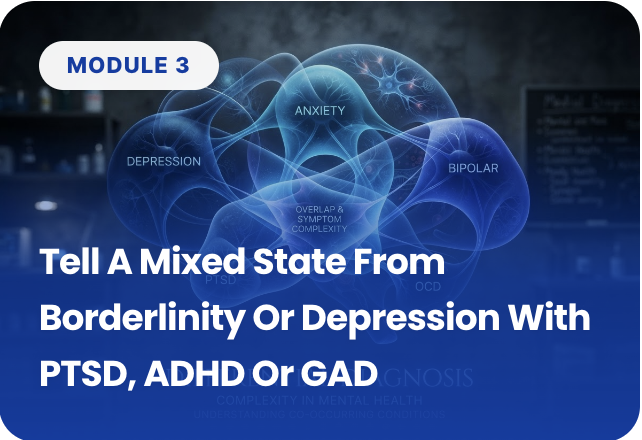
Dr. Phelps teaches that anxiety, anger, agitation and attention problems can show up in a bipolar mixed state, in depression with PTSD, ADHD or GAD, and in borderline personality disorder, so one client can look like several of them, or have more than one, and treatment aimed at only one can fall short or do harm.
He sets a bipolar mixed state side by side with each one, including borderline personality disorder, which he frames as a spectrum he calls borderlinity, and teaches the Four A's (anxiety, anger, agitation and attention problems) for recognizing a mixed state.
You'll be able to tell which of these possibilities fit a client, including when more than one does, so the treatment plan can address every condition that fits.

When you can't yet tell which condition it is, a treatment chosen for one possibility can make another worse, and Dr. Phelps teaches that this can cost a client twice: once when they're told they meet criteria for a condition that doesn't fit, and again in treatment that falls short or does harm.
Dr. Phelps explains why uncertainty can be the wise position, puts the treatment options for every possibility into one overarching context, and covers three ways to work a case that stays uncertain, starting with psychotherapy.
You'll be able to start with psychotherapy as the lower-risk first step and work the case three ways, so you have a plan for next session while the answer is still uncertain.
When a client first hears "bipolar," they can take it as a verdict on who they are, and some reject the word outright.
Dr. Phelps covers five factors that research from the past five years suggests may contribute to bipolarity, including trauma and economic factors, and shows how he uses them in therapy as a source of empathy and a way to reduce stigma.
You'll be able to help a client see the factors they didn't choose, so they can hear why this is happening without hearing that it's their fault.
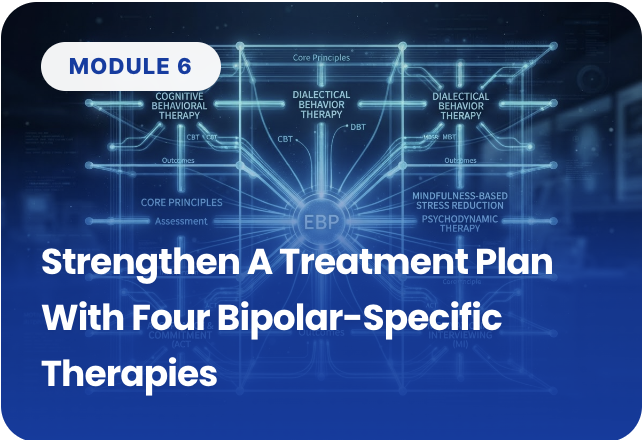
When a client's mood sits toward the bipolar end, a treatment plan built for unipolar depression can leave out the psychotherapies designed for bipolar disorder.
Dr. Phelps reviews four bipolar-specific psychotherapies, each with randomized trial support.
You'll be able to choose which of the four to add to a treatment plan or refer for, so the plan for a client toward the bipolar end includes a psychotherapy designed for it.
Clients toward the bipolar end are often told a regular routine helps their mood, but not how to build one that survives a late night, a trip or a new work schedule.
Dr. Phelps teaches a simplified form of Social Rhythm Therapy that adds to the behavioral skills you already use, and that you can start right after the Masterclass.
You'll be able to start simplified Social Rhythm Therapy with a client in your next session, so the client can build and keep a more regular daily routine.

Clients often ask what you think about the options their psychiatrist or primary care provider has raised, and a client without clear questions can leave their next appointment knowing no more than before.
Dr. Phelps walks through how to talk with clients about treatment options and their relative risks, for discussion with the client's psychiatrist or primary care provider.
You'll be able to talk with clients about treatment options and their relative risks, so a client can walk into their next appointment knowing what to ask.
Step 1 / 2
Register For This Free 6-Hour Clinical Summit On June 2nd
Somatic Interventions Clinical Summit: Body-Based Healing for Trauma Clients When Talk Therapy Has Failed
The Masterclass Goes Live In
When Youth Therapy Gets Stuck: Trauma, Anxiety, and Emotional Dysregulation in Children
What You'll Discover In The Bipolar Overlap Masterclass
Dr. Phelps compares bipolar disorder, including mixed states & subtle hypomania, with depression alongside posttraumatic stress disorder (PTSD), attention-deficit/hyperactivity disorder (ADHD) or generalized anxiety disorder (GAD), & with borderline personality disorder, including when more than one fits, then shows how to start lower-risk treatment, beginning with psychotherapy, while the answer is still uncertain
A client can arrive already told they meet criteria for bipolar disorder, or for unipolar depression, and neither may fit what you see in session, since a depression can carry hypomanic features without meeting criteria for bipolar disorder.
Dr. Phelps teaches the mood spectrum, from unipolar depression to bipolar I, shows how it works alongside DSM categories and specifiers such as Major Depression with Mixed Features, and explains why he expects a spectrum approach to appear in the next DSM.
You'll be able to use the DSM category and the mood spectrum together, and know which to use for which decision, so a client who has more than unipolar depression can get a treatment plan built for the mood they have.
When a depressed client reports more energy, less need for sleep and a burst of new plans, it can be the improvement you've worked toward or the start of hypomania, and people in a depression may not recall past periods of hypomania or see them as a problem.
Dr. Phelps shows how to recognize hypomania when it's overt, and why the subtler form is so hard to tell apart from a client simply feeling better.
You'll be able to recognize overt hypomania and know which changes in sleep, energy and activity call for a closer look, so a client's good stretch can get the follow-up it needs before the treatment plan counts it as progress.
Dr. Phelps teaches that anxiety, anger, agitation and attention problems can show up in a bipolar mixed state, in depression with PTSD, ADHD or GAD, and in borderline personality disorder, so one client can look like several of them, or have more than one, and treatment aimed at only one can fall short or do harm.
He sets a bipolar mixed state side by side with each one, including borderline personality disorder, which he frames as a spectrum he calls borderlinity, and teaches the Four A's (anxiety, anger, agitation and attention problems) for recognizing a mixed state.
You'll be able to tell which of these possibilities fit a client, including when more than one does, so the treatment plan can address every condition that fits.
When you can't yet tell which condition it is, a treatment chosen for one possibility can make another worse, and Dr. Phelps teaches that this can cost a client twice: once when they're told they meet criteria for a condition that doesn't fit, and again in treatment that falls short or does harm.
Dr. Phelps explains why uncertainty can be the wise position, puts the treatment options for every possibility into one overarching context, and covers three ways to work a case that stays uncertain, starting with psychotherapy.
You'll be able to start with psychotherapy as the lower-risk first step and work the case three ways, so you have a plan for next session while the answer is still uncertain.
When a client first hears "bipolar," they can take it as a verdict on who they are, and some reject the word outright.
Dr. Phelps covers five factors that research from the past five years suggests may contribute to bipolarity, including trauma and economic factors, and shows how he uses them in therapy as a source of empathy and a way to reduce stigma.
You'll be able to help a client see the factors they didn't choose, so they can hear why this is happening without hearing that it's their fault.
When a client's mood sits toward the bipolar end, a treatment plan built for unipolar depression can leave out the psychotherapies designed for bipolar disorder.
Dr. Phelps reviews four bipolar-specific psychotherapies, each with randomized trial support.
You'll be able to choose which of the four to add to a treatment plan or refer for, so the plan for a client toward the bipolar end includes a psychotherapy designed for it.
Clients toward the bipolar end are often told a regular routine helps their mood, but not how to build one that survives a late night, a trip or a new work schedule.
Dr. Phelps teaches a simplified form of Social Rhythm Therapy that adds to the behavioral skills you already use, and that you can start right after the Masterclass.
You'll be able to start simplified Social Rhythm Therapy with a client in your next session, so the client can build and keep a more regular daily routine.
Clients often ask what you think about the options their psychiatrist or primary care provider has raised, and a client without clear questions can leave their next appointment knowing no more than before.
Dr. Phelps walks through how to talk with clients about treatment options and their relative risks, for discussion with the client's psychiatrist or primary care provider.
You'll be able to talk with clients about treatment options and their relative risks, so a client can walk into their next appointment knowing what to ask.
Step 1 / 2
Register For This Free 6-Hour Clinical Summit On June 2nd
Somatic Interventions Clinical Summit: Body-Based Healing for Trauma Clients When Talk Therapy Has Failed
The Masterclass Goes Live In
Meet Your Presenter
Jim Phelps, MD, A Psychiatrist With 30 Years Of Experience, 20 Of Them Focused On Complex Mood Problems
Dr. Phelps earned his MD at Case Western Reserve University and completed his psychiatry residency and a fellowship in medical education at the University of New Mexico. He directed the Mood Disorders Program at Samaritan Mental Health in Oregon, where he's now psychiatrist emeritus. He served on the International Society for Bipolar Disorders task forces on how bipolar is identified and on chronotherapy, which works with the body's daily rhythms.
He wrote A Spectrum Approach to Mood Disorders: Not Fully Bipolar But Not Unipolar for clinicians, along with two books for patients and families, and he has served as the bipolar disorder section editor for Psychiatric Times. He founded two public education websites on the mood spectrum, and he's the consulting psychiatrist on a documentary about the bipolar spectrum.
He has taught clinicians how a depressed mixed state overlaps with PTSD, GAD, ADHD and borderline presentations for national audiences, including the American Psychiatric Nurses Association, and took part in a recorded Psych Congress discussion on the same overlap.
Throughout the Masterclass, he teaches in what he calls plain, kitchen-table English, with hypothetical cases drawn from adult, child and adolescent clients across genders and racial backgrounds, and short video segments from that documentary.




The Masterclass Goes Live In
The Difference After One Day
With The Bipolar Overlap Masterclass, You Can:
Tell bipolar apart from PTSD, ADHD, GAD & borderline & know which possibilities to treat
Spot overt hypomania & know when a client's good stretch needs a closer look
Start lower-risk treatment with psychotherapy while the answer is still uncertain
Use simplified Social Rhythm Therapy next session to build clients' daily routines
Without It, You Could Face:
Treatment built for the wrong condition, in either direction
Hypomania taken for improvement, which can escalate between sessions
Treatment for a condition the client doesn't have, carried in their record
Clients told to keep a routine with no structured way to build one
The Masterclass Goes Live In
After you register, you'll see the option to get the Premium Pass: lifetime access to the recording and the transcript, plus 6 CEs.

Frequently Asked Questions
What exactly is this, and what do I get?
A free 6-hour live Masterclass with Jim Phelps, MD, on Tuesday, December 8, 2026, from 10:00 AM to 5:30 PM ET (6 instructional hours, breaks included), on telling bipolar apart from depression with PTSD, ADHD or GAD and from borderline personality disorder, then choosing lower-risk treatment while the answer is still uncertain. Registration is free, and after you register you can add the Premium Pass: lifetime access to the recording and the transcript, plus 6 CEs.
Why are these conditions so hard to tell apart?
Symptoms alone often can't answer it, in Dr. Phelps's view. Anxiety, anger, agitation and attention problems (what he teaches as the Four A's) can show up in all of these conditions, and some clients have more than one. He also points out that the DSM's mixed features specifier leaves irritability, psychomotor agitation and distractibility out of its count, and people in a depression may not recall past periods of hypomania.
It's a Tuesday and I see clients all day. Can I watch it later?
Yes, with the Premium Pass. It includes lifetime access to the recording and the transcript, so you can watch the whole day, or return to the parts you need, whenever your schedule allows.
Isn't telling bipolar apart the psychiatrist's job?
Not only theirs. Dr. Phelps built this Masterclass for therapists: telling the possibilities apart for your own treatment plan, and talking with clients about their options so they can take clear questions to their psychiatrist or primary care provider.
I've never seen hypomania in session with a client. Does that rule out bipolar?
Not on its own. People in a depression may not remember past periods of hypomania, or may not think of them as a problem. Dr. Phelps shows which changes in sleep, energy and activity call for a closer look.
I already know the bipolar basics. Will this be too basic?
It starts with the foundations, then goes well past them, into the side-by-side comparisons, mixed states, borderlinity and lower-risk treatment while the answer is still uncertain.
Is this the same as Dr. Phelps's earlier Masterclass with eCare?
It's a different Masterclass, though some ground is shared, such as the mood spectrum and working with uncertainty. New here: the side-by-side comparisons with PTSD, ADHD, GAD and borderline personality disorder, the Four A's, Major Depression with Mixed Features, and simplified Social Rhythm Therapy.
Will this ask me to work outside my scope?
No. On treatment, Dr. Phelps covers how to talk with clients about treatment options and their relative risks, for discussion with the client's psychiatrist or primary care provider. Their decisions stay with them and the client; your psychotherapy decisions stay with you.
Does this cover teens and children?
It includes them. Dr. Phelps uses hypothetical cases drawn from adult, child and adolescent clients across genders and racial backgrounds.
Will this conflict with the approach I already use?
It's designed to add to it. Simplified Social Rhythm Therapy builds on the behavioral skills you already use, and you can start it in your next session.
How do I get the 6 CEs?
With the Premium Pass. You can earn the 6 CEs live or from the recording. The free seat doesn't include CEs.
Is this approved for my license type and state?
To check approval for your license type & state, scroll to the bottom of this page & click the Board Approvals button.
The Masterclass Goes Live In
Scope and Limitations Disclosure:
This Masterclass is educational and is intended for licensed mental health professionals practicing within their scope of practice and jurisdiction. It supports assessment, treatment planning, psychotherapy and collaboration with the client's psychiatrist or primary care provider, within each participant's scope of practice. It does not train participants to make decisions that belong to the client's psychiatrist or primary care provider, and it does not qualify participants to work outside their scope of practice. All clinical decisions remain the responsibility of the licensed clinician.
Commercial Support Disclosure
Jim Phelps, MD is an independent psychiatrist & continuing education presenter whose work focuses on bipolar disorder & the mood spectrum. This training does not require participants to purchase any additional products, books, or materials to complete the training.