
FREE 6-HOUR LIVE POLYVAGAL THEORY MASTERCLASS FOR LICENSED THERAPISTS
THURSDAY, DECEMBER 3, 2026 | 10:00 AM TO 5:30 PM ET
How To Apply Polyvagal Theory With Trauma Clients: 4 Interventions For Hyperarousal & Shutdown, Built Into A Trauma-Informed Treatment Plan
Whether you're new to Polyvagal Theory or already use it with clients, in this free 6-hour Masterclass you'll learn to identify hyperarousal & shutdown by what a client does, thinks & feels, use 4 interventions for safety, co-regulation & self-regulation matched to the state they're in, & build them into a trauma-informed treatment plan that supports stabilization, resilience & recovery
With Courtney Rolfe, MA, LCPC, co-author of Polyvagal Prompts (W. W. Norton, 2024), who consults with therapists on bringing polyvagal-guided work into their sessions and has taught this work to clinicians through continuing education trainings in the US and the UK
Lifetime recording access and 6 CEs available for purchase after free registration.


Register Free Below. This Event Is For Licensed Mental Health Professionals
By providing your phone number, you consent to receive SMS messages about joining the webinar. You may reply STOP at any time to unsubscribe.

The Masterclass Goes Live In
SCREEN FOR FIVE HIDDEN DEFICIENCIES
Omega-3, Vitamin D, B12, Magnesium & Iron in One Training
9 Board-Approved CEs
Available for Purchase in Next Step
RECORDING WITH CE PURCHASE
Watch on Your Own Schedule
What Therapists Say About eCare Trainings
"Loved this training. It was well organized & easy to follow & understand. It felt like something I could apply in practice. Often in other presentations I think that was a great abstract concept, now how do I apply it, but that was not an issue here. I loved that there were many examples of techniques and how to implement them."
- eCare attendee

"This training was highly valuable in several ways. It reaffirmed the effectiveness of my current practices, refreshed my knowledge of existing tools I have not utilized recently, and introduced new tools and interventions I can implement in future sessions. The session was engaging, and I appreciated the continuous opportunities for questions and additional educational insights."
- eCare attendee
"The training offered: 1. Practical strategies to use right away, not just theory. 2. Clear explanations and step-by-step exercises that made the concepts easy to apply. 3. The trainer explained things well and created a comfortable learning environment."
- eCare attendee
eCare Behavioral Health Institute is a continuing education provider for licensed mental health professionals, offering live and recorded trainings across the clinical work they do every day.





When Youth Therapy Gets Stuck: Trauma, Anxiety, and Emotional Dysregulation in Children
How You'll Apply Polyvagal Theory With Trauma Clients
Courtney Rolfe turns Polyvagal Theory into principles, techniques & treatment plans you can use with your clients right away, from identifying hyperarousal & shutdown in session to choosing the intervention for each & building it into your trauma-informed treatment plan

A trauma client can understand the treatment plan, agree with it, and still go into hyperarousal or shutdown as soon as a trauma memory comes up in session.
Courtney covers the fundamental principles of Polyvagal Theory and how autonomic nervous system states shape a client's trauma responses, emotional regulation, and relationships.
You'll be able to explain these principles to clients in plain terms and use them to decide when to focus on regulation and when to move into the trauma work.

Once a client is fully in hyperarousal or shutdown, the rest of the session can go to regulation instead of the trauma work you planned.
Courtney walks through at least four clinical indicators of autonomic dysregulation tied to trauma and to attachment-related difficulties.
You'll be able to catch those signs as they start, so you can step in early and keep more of the session for the trauma work.

A client who is talking fast and scanning the room and a client who has gone quiet, flat, and far away are in two different states, and in Courtney's approach, each one calls for a different intervention.
Courtney shows how to tell the ventral vagal (safe and connected), sympathetic (mobilized, as in hyperarousal or fight-or-flight), and dorsal vagal (shut down, as in collapse, numbness, or disconnection) states apart, using what you observe and what a client tells you about their behavior, thinking, emotions, and engagement.
You'll be able to identify which state a client is in, so you can choose the intervention that best matches that state.
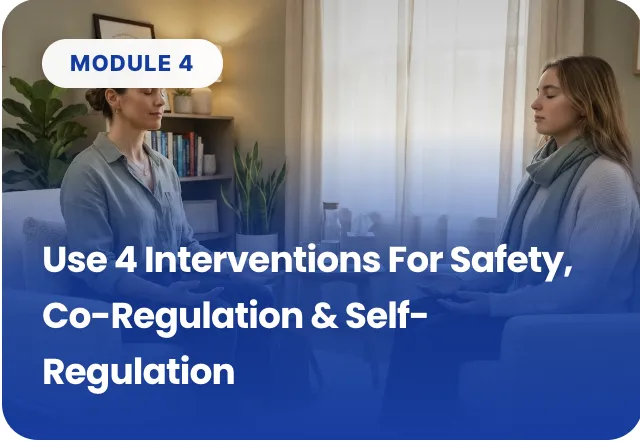
A worksheet or a breathing exercise can help between sessions and still not work once a client is in hyperarousal or shutdown in front of you.
Courtney teaches at least four polyvagal-informed interventions that promote safety, co-regulation (regulation supported through your interaction with the client in session), and self-regulation (a client's own capacity to shift out of hyperarousal or shutdown) for clients experiencing trauma-related dysregulation.
You'll be able to use the intervention that fits the state a client is in, in session, as soon as they go into hyperarousal or shutdown.
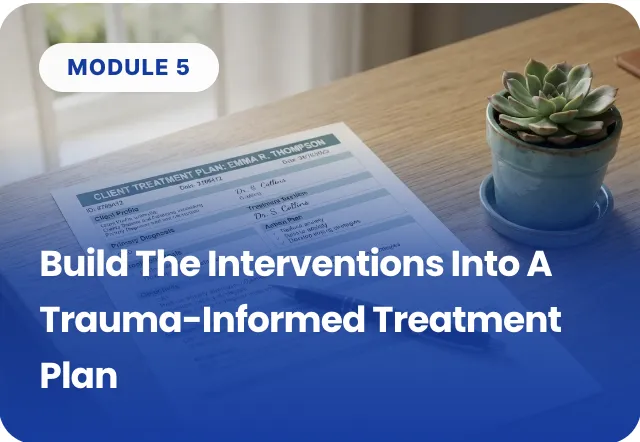
When a treatment plan has no goals or interventions for hyperarousal and shutdown, the regulation work happens session by session, off the plan, and the trauma work waits.
Courtney shows how to develop a trauma-informed treatment plan that integrates Polyvagal Theory with evidence-informed interventions to address attachment disruptions and nervous system dysregulation.
You'll be able to write polyvagal-informed interventions into the plan alongside the model you already use, so the plan covers hyperarousal and shutdown as well as the trauma work.

An intervention that helps a client in hyperarousal during early stabilization may not fit the same client in shutdown during trauma processing.
Courtney works through case examples and case-based scenarios: identifying the state a client is in, where they are in treatment, from stabilization to trauma processing, and which intervention fits both.
You'll be able to make that call with your own clients, so each intervention you choose supports their stabilization, resilience, and recovery.
Step 1 / 2
Register For This Free 6-Hour Clinical Summit On June 2nd
Somatic Interventions Clinical Summit: Body-Based Healing for Trauma Clients When Talk Therapy Has Failed
The Masterclass Goes Live In
When Youth Therapy Gets Stuck: Trauma, Anxiety, and Emotional Dysregulation in Children
How You'll Apply Polyvagal Theory With Trauma Clients
Courtney Rolfe turns Polyvagal Theory into principles, techniques & treatment plans you can use with your clients right away, from identifying hyperarousal & shutdown in session to choosing the intervention for each & building it into your trauma-informed treatment plan
A trauma client can understand the treatment plan, agree with it, and still go into hyperarousal or shutdown as soon as a trauma memory comes up in session.
Courtney covers the fundamental principles of Polyvagal Theory and how autonomic nervous system states shape a client's trauma responses, emotional regulation, and relationships.
You'll be able to explain these principles to clients in plain terms and use them to decide when to focus on regulation and when to move into the trauma work.
Once a client is fully in hyperarousal or shutdown, the rest of the session can go to regulation instead of the trauma work you planned.
Courtney walks through at least four clinical indicators of autonomic dysregulation tied to trauma and to attachment-related difficulties.
You'll be able to catch those signs as they start, so you can step in early and keep more of the session for the trauma work.
A client who is talking fast and scanning the room and a client who has gone quiet, flat, and far away are in two different states, and in Courtney's approach, each one calls for a different intervention.
Courtney shows how to tell the ventral vagal (safe and connected), sympathetic (mobilized, as in hyperarousal or fight-or-flight), and dorsal vagal (shut down, as in collapse, numbness, or disconnection) states apart, using what you observe and what a client tells you about their behavior, thinking, emotions, and engagement.
You'll be able to identify which state a client is in, so you can choose the intervention that best matches that state.
A worksheet or a breathing exercise can help between sessions and still not work once a client is in hyperarousal or shutdown in front of you.
Courtney teaches at least four polyvagal-informed interventions that promote safety, co-regulation (regulation supported through your interaction with the client in session), and self-regulation (a client's own capacity to shift out of hyperarousal or shutdown) for clients experiencing trauma-related dysregulation.
You'll be able to use the intervention that fits the state a client is in, in session, as soon as they go into hyperarousal or shutdown.
When a treatment plan has no goals or interventions for hyperarousal and shutdown, the regulation work happens session by session, off the plan, and the trauma work waits.
Courtney shows how to develop a trauma-informed treatment plan that integrates Polyvagal Theory with evidence-informed interventions to address attachment disruptions and nervous system dysregulation.
You'll be able to write polyvagal-informed interventions into the plan alongside the model you already use, so the plan covers hyperarousal and shutdown as well as the trauma work.
An intervention that helps a client in hyperarousal during early stabilization may not fit the same client in shutdown during trauma processing.
Courtney works through case examples and case-based scenarios: identifying the state a client is in, where they are in treatment, from stabilization to trauma processing, and which intervention fits both.
You'll be able to make that call with your own clients, so each intervention you choose supports their stabilization, resilience, and recovery.
Step 1 / 2
Register For This Free 6-Hour Clinical Summit On June 2nd
Somatic Interventions Clinical Summit: Body-Based Healing for Trauma Clients When Talk Therapy Has Failed
The Masterclass Goes Live In
Meet Your Presenter
Courtney Rolfe, MA, LCPC, Co-Author Of Polyvagal Prompts, Consults With Therapists On Bringing Polyvagal Theory Into Their Sessions
Courtney is the founder of Modern Mind & Heart, a telehealth practice based in Chicago, where she works with clients and offers clinical consultation to therapists bringing polyvagal-guided work into their sessions. She is co-author of Polyvagal Prompts (W. W. Norton, 2024), a book of guided prompts that help clients track and reflect on their polyvagal-informed therapy. She earned her master's degree at the Illinois School of Professional Psychology.
Courtney has taught this work to clinicians through continuing education trainings in the US and the UK, including full-day and two-day programs. Her past trainings have covered the states the theory describes, interventions that use breath, movement, and imagery, how to teach the theory to clients, and treatment planning. She also works with clients in Spanish.
Throughout the Masterclass, she teaches through case examples and case-based scenarios, so the next time a trauma client goes into hyperarousal or shutdown, you know which intervention fits the state they're in and where it belongs in the treatment plan.




The Masterclass Goes Live In
The Difference After One Day
WITH THIS Masterclass:
Spot hyperarousal & shutdown early, before they take over a session
Use 4 interventions matched to the state a client is in
Choose the intervention that fits each case & point in treatment
Build those interventions into a trauma-informed treatment plan
WITHOUT IT:
Sessions that go off course once a client goes into hyperarousal or shutdown
Uncertainty about the next step when a client goes into hyperarousal or shutdown
Relying on one calming exercise for every client & every state
No polyvagal-informed interventions to add to the methods you already use
The Masterclass Goes Live In
The live Masterclass is free when you register. Lifetime recording access and 6 CEs are available as an upgrade after you sign up.
Frequently Asked Questions
What exactly is this, and what do I get?
A free 6-hour live Masterclass with Courtney Rolfe, MA, LCPC, on applying Polyvagal Theory with trauma clients: 4 interventions for hyperarousal and shutdown, and a trauma-informed treatment plan that builds them in. Lifetime recording access and 6 CEs are available as an upgrade after you register.
What are the 4 interventions?
They're at least four interventions Courtney teaches for the point a client goes into hyperarousal or shutdown, each one aimed at safety, co-regulation, or self-regulation, and chosen for the state the client is in. In her terms, they're polyvagal-informed interventions for clients experiencing trauma-related dysregulation.
I see clients on Thursdays. Is it still worth registering?
Yes. The Masterclass runs Thursday, December 3, from 10:00 AM to 5:30 PM ET, with breaks included, so you can join for the hours you're free.
I'm new to Polyvagal Theory. Is this for me?
Yes. The Masterclass starts with the groundwork: the principles of Polyvagal Theory, the three states it describes, and how each one shows up in session. Then Courtney moves into the interventions and the treatment plan.
I already use Polyvagal Theory with clients. What's new here?
The Masterclass is about applying it in session and in the treatment plan: 4 interventions matched to the state a client is in, worked through case-based scenarios, and built into a trauma-informed treatment plan.
My clients understand the three states. Isn't that enough?
It can help. In Courtney's view, understanding a state and being able to use that understanding while you're in one are different, and the Masterclass focuses on interventions for the point a client goes into hyperarousal or shutdown.
Isn't Polyvagal Theory debated right now?
Yes, parts of it are. Some of the theory's claims about the underlying physiology are under scientific debate. Courtney teaches Polyvagal Theory as a clinical framework: what to look for in session, what to ask a client, and which interventions to use, alongside established trauma treatments such as EMDR, cognitive processing therapy, and prolonged exposure.
I already use EMDR, CPT, DBT or another model. Will this conflict with it?
No. The interventions add regulation work to the model you use, and Courtney shows how to build them into your treatment plan. The Masterclass doesn't train you in EMDR, CPT, DBT, or any other model, and it doesn't change how you deliver them.
Will this be too theoretical to use in session?
No. After the groundwork, the Masterclass is about application: the interventions, case-based scenarios, and the treatment plan.
Is this for my license type?
Yes, if you're a licensed mental health professional who works with trauma clients: LPCs, LCSWs, LMFTs, psychologists, and other licensed clinicians. It's taught at the intermediate level. CE approval varies by license & state, so check the Board Approvals button at the bottom of this page.
How many CEs are available, and how do I get them?
6 CEs are available as an upgrade after you register.
Can I get the recording?
Yes. Lifetime recording access is available as an upgrade after you register.
Are the CEs approved for my license?
To check approval for your license type & state, scroll to the bottom of this page & click the Board Approvals button.
The Masterclass Goes Live In
Scope and Limitations Disclosure:
This Masterclass is educational and is intended for licensed mental health professionals practicing within their scope of practice and jurisdiction. It supports the application of Polyvagal Theory in session and in treatment planning with trauma clients. Some of Polyvagal Theory's claims about the underlying physiology are under scientific debate, and the Masterclass teaches it as a clinical framework. It does not replace a full clinical assessment, supervision, or established trauma treatment. It does not train participants in trauma-processing therapies such as EMDR, cognitive processing therapy, or prolonged exposure, in crisis or emergency services, or in medication management, it does not confer a certification, and it does not qualify participants to work outside their scope of practice. All clinical decisions remain the responsibility of the licensed clinician.
Commercial Support Disclosure
Courtney Rolfe, MA, LCPC co-authored Polyvagal Prompts (W. W. Norton, 2024), which may be referenced during the training. This training does not require participants to purchase any additional products, books, or materials to complete the training.