FREE 6-HOUR LIVE DSM-5-TR WEBINAR FOR THERAPISTS
THURSDAY, DECEMBER 17, 2026 @ 10:00 AM TO 5:30 PM ET
The DSM Is Changing & Frameworks Such As ICD-11 Are Reshaping Psychodiagnosis: Here's How To Use Structured Assessment Tools To Get It Right & Avoid Treating The Wrong Condition When These Frameworks Disagree
In this free 6-hour Webinar, you'll discover how to assess clients with the most current DSM-5-TR criteria in five clinical areas, from serious mental illness to personality disorders, decide what to treat when the manuals disagree (ICD-11 has a complex PTSD category the DSM-5-TR doesn't, for example), & back up your clinical judgment with evidence-based assessment measures, so you can reach a reliable call on what a client has & confidently treat it
With Gregory Neimeyer, Ph.D., one of two psychologists originally trained on DSM-5 by the APA, and a Professor Emeritus of Psychology at the University of Florida who has led hundreds of DSM and ICD trainings for clinicians, nationally and internationally
After registration, you'll have the option to get the "Premium Pass," which gives you lifetime access to the recording and the transcript to turn this training into a clinical reference you can use for the rest of your career, plus 6 CE credits.
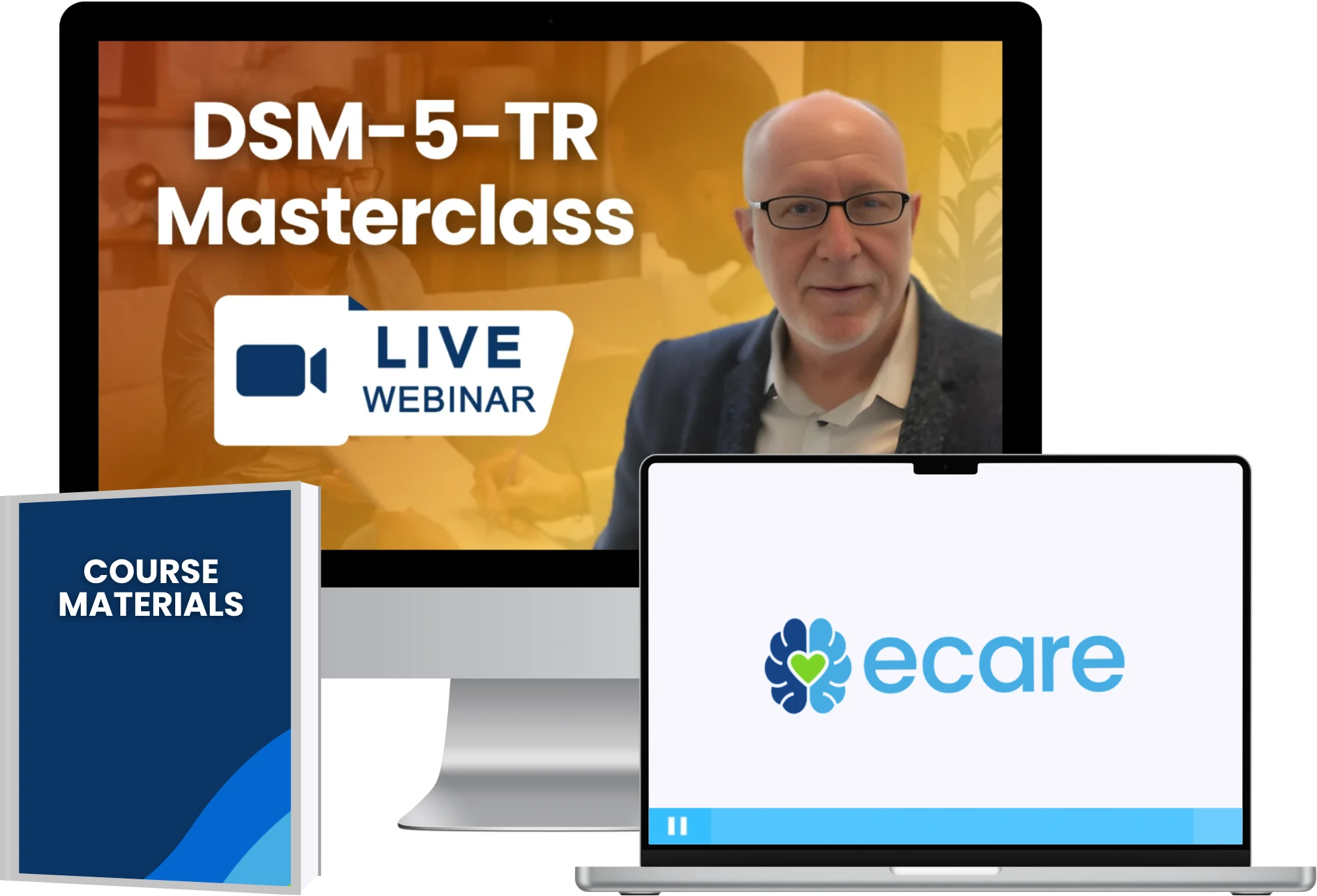

Save Your Free Seat For The Rethinking the DSM-5-TR Webinar
By entering your mobile number, you agree to receive text reminders about this Webinar from eCare Behavioral Health Institute. Message and data rates may apply. Reply STOP to opt out at any time.

The Webinar Starts In
SCREEN FOR FIVE HIDDEN DEFICIENCIES
Omega-3, Vitamin D, B12, Magnesium & Iron in One Training
9 Board-Approved CEs
Available for Purchase in Next Step
RECORDING WITH CE PURCHASE
Watch on Your Own Schedule
What Therapists Say About eCare's Live Trainings
"I was very surprised and delighted by this presentation. My expectations were low, to be honest, but I was blown away by the knowledge, examples, and tangible tips (exercises, books, resources) provided in this training. Honestly, the BEST TRAINING I've attended in YEARS!!!!"
- eCare attendee

"This is the first webinar in FOREVER that kept me fully engaged for more than 20 minutes! Almost always I'm drifting toward other windows & presentations become a background podcast. Not this one..."
- eCare attendee
"Totally excellent presentation! I've been in practice for over 30 years, so seldom do seminars give me such clear, fresh, helpful information from an interesting and engaging presenter. This was great, and I'll look for other webinars given by this presenter. Thank you!!"
- eCare attendee
"Loved this training. It was well organized & easy to follow & understand. It felt like something I could apply in practice. Often in other presentations I think that was a great abstract concept, now how do I apply it, but that was not an issue here. I loved that there were many examples of techniques and how to implement them."
- eCare attendee
"I loved and appreciated the interactive format. It kept me engaged. Having the presenter keep pace with the comments, reflect on them, and being able to read other attendees' comments made this feel much more LIVE and in person. I really appreciated that much more than presentations that go on for a while and then answer questions out of context."- eCare attendee
"The presenters you choose seem to really know the material and they live it, they just don't pontificate, they believe in what they are sharing. This is what holds my attention. I get bored with a canned lecture, your instructors keep me focused and excited about putting to use what I've learned."- eCare attendee
eCare Behavioral Health Institute provides continuing education for licensed mental health professionals, including LCSWs, LPCs, LMFTs and psychologists.




When Youth Therapy Gets Stuck: Trauma, Anxiety, and Emotional Dysregulation in Children
What You'll Discover In The ERP for OCD Webinar
Explaining ERP & its evidence doesn't always get a client with OCD to start it or stay with it. Catherine M. Pittman, Ph.D., HSPP, teaches the 2 missing pieces she adds to ERP, so a client who's been putting off the first exposure, or stopping after a few, can decide on their own to keep doing the exposures until the compulsions start to ease
If a client takes a racing heart near a trigger as a sign of danger, the first exposure can look reckless to them, and they can turn ERP down once it's explained.
Catherine explains the functioning of the amygdala in physical symptoms and avoidance: how to describe the body's fear response to a client, and why staying away from triggers can keep the fear going.
You'll be able to teach a client what their racing heart and their urge to avoid are telling them before the first exposure, so a client who hesitated can approach the first trigger on their plan knowing what their body is doing.
A client can know an obsession makes no sense and still not be able to stop the compulsion, and without a picture of what keeps the cycle going, they can take that as a personal weakness and pull back from treatment.
Catherine describes the role of the amygdala in maintaining obsessions and compulsions, for the purposes of client education, and how she puts that cycle into words a client can use.
You'll be able to show a client what keeps the cycle going, so they can decide for themselves to skip the compulsion when the urge comes.
If a thought about what an obsession means stops a client before an exposure starts, the session can turn into a debate about the thought, and the exposure may never start.
Catherine describes the role of the cortex in influencing amygdala activation, and how she uses it to modify what her objectives call self-defeating thinking patterns, alongside exposure.
You'll be able to work with the thoughts that set off the amygdala, alongside exposure, so a client can start the exposure they agreed to while the thought is still there.
When the only goal on a plan is for the obsessions or the anxiety to stop, every obsession that shows up can look to the client like proof that ERP isn't working, and the exposures can stop after the first few.
Catherine covers how she selects the goals to work on first from the client goals blocked by OCD (the course's phrase for the parts of life OCD keeps a client from), and how to build the ERP plan toward the one you choose together.
You'll be able to choose with the client a goal that gives them a reason of their own to do exposures, so the next exposure is a step toward the job, the relationship, or the family life they want back.
If an exposure plan names the trigger but not the compulsion the client will skip, a client can finish the exposure, do the ritual afterward, and leave the fear untested.
Catherine walks through how she uses Exposure with Response Prevention to help the amygdala develop new responses to triggers (her framing of what ERP does), from the exposure itself to the response prevention that goes with it, with the explanation and the goal already in place.
You'll be able to plan each exposure with the response prevention named, so a client can sit with a trigger they've been avoiding and skip the compulsion that usually follows it.
Step 1 / 2
Register For This Free 6-Hour Clinical Summit On June 2nd
Somatic Interventions Clinical Summit: Body-Based Healing for Trauma Clients When Talk Therapy Has Failed
The Webinar Starts In
When Youth Therapy Gets Stuck: Trauma, Anxiety, and Emotional Dysregulation in Children
What You'll Discover In The Rethinking the DSM-5-TR Webinar
Gregory compares the DSM-5-TR with the International Classification of Diseases, 11th Revision (ICD-11), the Research Domain Criteria (RDoC) & the Hierarchical Taxonomy of Psychopathology (HiTOP), takes on the controversies over where one condition ends & another begins, from complex posttraumatic stress disorder (PTSD) & prolonged grief to personality disorders, & shows how to reach a formulation you can rely on, so a client's treatment can be built on what they actually meet criteria for
A referral, an article or a colleague can describe a client in ICD-11's terms, or RDoC's or HiTOP's, while you record with DSM-5-TR criteria.
Gregory covers what's changed in the DSM-5-TR since it was printed, compares what each framework is built for and the main conceptual difference among them, and walks through at least two debated limits of the current DSM system.
You'll be able to set what each framework sees beside the DSM-5-TR criteria you record, so a client whose presentation crosses categories can get a plan that isn't limited to one category.
A severe trauma presentation can be recorded as borderline personality disorder, or framed only as trauma when borderline personality disorder is also present.
Gregory covers PTSD and complex PTSD (ICD-11) beside the DSM-5-TR's broader PTSD, and how borderline personality disorder can co-occur with either.
You'll be able to build a trauma formulation on current criteria, so a client's plan can address emotion regulation, self-worth and relationships as well as the trauma.
A bereaved client's grief can look like a major depressive episode, co-occur with one, or stay within their culture's norms, and the two manuals set different thresholds.
Gregory covers prolonged grief disorder, the major new disorder the DSM-5-TR added, including each manual's duration threshold.
You'll be able to assess a bereaved adult client on current criteria, so a client with disabling grief can get treatment for it, without normal grief being recorded as a disorder.
A personality pattern can fit several of the DSM-5-TR's ten personality disorder categories, or none of them.
Gregory covers the ten categories beside the DSM-5-TR's Alternative Model in Section III, ICD-11's model of severity and traits, and HiTOP's spectra.
You'll be able to formulate a personality pattern by category, severity and traits, so the plan can work on how the client functions with other people and at work.
A young adult with unusual perceptual experiences and some decline in functioning, or a client with too little history to tell a depressive disorder from a bipolar one, may not fit any category yet.
Gregory covers what's new in serious mental illness, including attenuated psychosis syndrome in the DSM-5-TR's Section III and the unspecified categories for a picture that's still developing.
You'll be able to assess a presentation that's still developing on current criteria, so a client can get care for what's there now, and a referral for early psychosis care if it's needed.
A young adult's gaming can cost them work, sleep and relationships, or be a pastime that does no harm.
Gregory covers what's new in use disorders, gambling disorder and gaming disorder (a full ICD-11 category the DSM-5-TR lists only for further study).
You'll be able to assess these presentations on current criteria, so treatment can go to the client whose gaming or gambling is doing real harm.
A score keyed to one manual's criteria can be taken as the answer, and a trauma measure built around DSM-5 PTSD criteria isn't built to capture what ICD-11 adds for complex PTSD.
Gregory applies a structured assessment tool to a clinical case vignette with you, step by step.
You'll be able to use an assessment measure alongside your clinical judgment, so a hard call can be based on more than one score or one impression.
A category carried forward from an earlier evaluation can stay on a record your own assessment doesn't support, and a condition the criteria recognize can go unrecorded.
Gregory works through a clinical video case to a formulation on contemporary criteria: which conditions it meets criteria for, which it doesn't, and which co-occur. He also covers coordinating with a psychiatrist or earlier evaluator who reached a different conclusion, and other clinical videos show new disorders in practice.
You'll be able to check a formulation in both directions, so a client's treatment can follow what they present now, not an earlier conclusion.
When a client meets criteria for three conditions, a plan template that asks for one primary condition can leave the others out of treatment.
Gregory walks through how dimensional models may change a plan's goals in at least two areas of practice, and covers the provisional specifier, explaining a working formulation to a client, and re-formulating when treatment isn't producing the expected progress.
You'll be able to turn a formulation into a treatment plan when symptoms cross categories, so the plan can address the co-occurring conditions, not only the primary one.
Step 1 / 2
Register For This Free 6-Hour Clinical Summit On June 2nd
Somatic Interventions Clinical Summit: Body-Based Healing for Trauma Clients When Talk Therapy Has Failed
The Webinar Starts In
MEET YOUR PRESENTER
Your Presenter: Gregory Neimeyer, Ph.D., One Of Two Psychologists Originally Trained On DSM-5 By The APA
Gregory Neimeyer, Ph.D.: Psychology; Professor Emeritus of Psychology, University of Florida; specializes in psychopathology and the classification of mental disorders.
Gregory Neimeyer, Ph.D., is Professor Emeritus of Psychology at the University of Florida, where he served as Director of Training and Graduate Coordinator of its doctoral programs and taught the DSM, the ICD and psychopathology to doctoral students. He's a lifetime inductee into the Academy of Distinguished Teaching Scholars.
He was one of two psychologists originally trained on DSM-5 by the APA. Since then, he has led hundreds of DSM and ICD trainings for clinicians, nationally and internationally, including for state psychological associations across the country. He's a Fellow of the American Psychological Association and has written more than 200 articles and 10 books.
His trainings have covered the DSM-5-TR's changes, prolonged grief disorder, how the DSM compares with ICD-11, and the revisions on culture and equity.
Throughout the Webinar, he sets the DSM-5-TR beside ICD-11, RDoC & HiTOP on the presentations where they part ways, and shows how to use assessment measures and your own clinical judgment to build a formulation, so the plan you write is built on what a client actually has, even when the frameworks disagree.




The Webinar Starts In
The Difference After One Day
With The Rethinking the DSM-5-TR Webinar, You Can:
Build a trauma formulation on current criteria, from PTSD to complex PTSD (ICD-11)
Assess a bereaved client against prolonged grief disorder's criteria as they stand now
Use an assessment measure alongside your clinical judgment where the call is hardest
Turn your formulation into a treatment plan when a client's symptoms cross categories
Without It, You Could Face:
A severe trauma presentation recorded under a category that covers only part of it
Disabling grief left unrecognized, or normal grief recorded as a disorder
A screen score taken as the answer, or a call made on impression alone
Co-occurring problems left out of a plan written around one category
The Webinar Starts In
After You Register, You'll See The Option To Get The Premium Pass: Lifetime Access To The Recording And The Transcript, Plus 6 CE Credits.
Frequently Asked Questions
What exactly is this, and what do I get?
A free 6-hour live Webinar with Gregory Neimeyer, Ph.D., on Thursday, December 17, 2026, from 10:00 AM to 5:30 PM ET (6 instructional hours, plus 90 minutes of breaks), on assessment and treatment planning as the DSM changes and frameworks such as ICD-11, RDoC and HiTOP reshape how mental disorders are classified. Registration is free, and after you register you can add the Premium Pass: lifetime access to the recording and the transcript, plus 6 CE credits.
What do you mean by structured assessment tools?
Questionnaires and interviews that check a presentation against criteria item by item. In this Webinar, Gregory applies a structured assessment tool or measure to a clinical case vignette, then works a clinical video case to a formulation on contemporary criteria, so you see the measure and your clinical judgment used together.
It's a Thursday and I see clients all day. Can I watch it later?
Yes, with the Premium Pass. It includes lifetime access to the recording and the transcript, so you can watch the whole Webinar, or return to the parts you need, whenever your schedule allows.
I use the DSM-5-TR every day. Will this tell me anything new?
Yes, by design. It's built at an intermediate level for clinicians who already work with the DSM-5-TR: what's changed in its criteria, where ICD-11 and the dimensional models part ways with it, and how to use assessment tools when they do.
I already know complex PTSD is an ICD-11 category. What's new here?
You likely do. The Webinar sets the two manuals side by side on more than that: prolonged grief disorder's different thresholds, personality disorders by category or by severity and traits, a measure keyed to one manual's criteria, and how to plan treatment when the manuals don't agree.
Is the DSM-5-TR still the current manual?
Yes. The DSM-5-TR is the current manual. Its criteria and text changed in 2024 and 2025, after the 2022 printing, and the next changes are due in early 2027.
Does this cover the next DSM? When is it coming out?
No publication date has been set. The organization behind the DSM has proposed a structure for the next edition in four parts, with named conditions kept as one of them. Gregory covers the work on the future of the DSM, and what's proposed is still being debated.
Will I be using RDoC or HiTOP with clients?
No. RDoC is a research framework, and HiTOP is a dimensional model whose self-report measure is still being tested. The Webinar compares them with the DSM-5-TR so you know what each adds to your thinking; the criteria you record stay the DSM-5-TR's.
Does this cover coding or billing?
No. In the US, records code in ICD-10-CM using DSM-5-TR criteria, and ICD-11 isn't in US use. The Webinar is about assessment, formulation and treatment planning.
I took one of Gregory's DSM-5-TR guides. Is this the same?
This goes further. It adds the other frameworks, five clinical areas, a structured measure applied to a case, a video case worked to a formulation, and that formulation turned into a treatment plan, over 6 hours instead of 3.
Will this ask me to work outside my scope?
No. The Webinar supports your own assessment, formulation and treatment planning. It doesn't replace a medical or psychiatric evaluation, and early psychosis specialty care stays a referral.
How do I get the 6 CE credits?
With the Premium Pass. CE credits for psychologists available through eCare Behavioral Health Institute, an APA-approved CE sponsor. You can earn the 6 CE credits live or from the recording. Full attendance is required for CE credit. The free seat doesn't include CE credits.
Is this approved for my license type and state?
To check approval for your license type & state, scroll to the bottom of this page & click the Board Approvals button.
The Webinar Starts In
Scope and Limitations Disclosure:
This Webinar is educational and is intended for licensed mental health professionals practicing within their scope of practice and jurisdiction. It supports assessment, case formulation and treatment planning using current DSM-5-TR criteria, with ICD-11, RDoC and HiTOP compared alongside them. RDoC and HiTOP inform clinical thinking and are not criteria for recording. It does not train participants in coding or billing, it does not replace a medical or psychiatric evaluation, and it does not qualify participants to work outside their scope of practice. All clinical decisions remain the responsibility of the licensed clinician.
Commercial Support Disclosure
Gregory Neimeyer, Ph.D., is an independent continuing education presenter whose work focuses on psychopathology and the classification of mental disorders. He reports no potential conflicts of interest and no commercial support for this program. This training does not require participants to purchase any additional products, books, or materials to complete the training.
Conflict of Interest Disclosure
Gregory Neimeyer, Ph.D., reports no potential conflicts of interest and receives no commercial support for this program.