
FREE 3-day HEALING TRAUMA WITH DBT Webinar
APRIL 15, 16 & 17, 2026 @ 10:00AM ET - 5:30PM ET
Help Your Most Trauma Clients Escape the Nightmares, Numbness, & the Relational Wounds Standard DBT Never Healed
An 18-hour clinical Masterclass hosted by Dr. Lane Pederson, co-owner of one of the largest DBT specialized practices in the US
Full 3-Day Recording + 18 CEs Available For Purchase (Next Step)
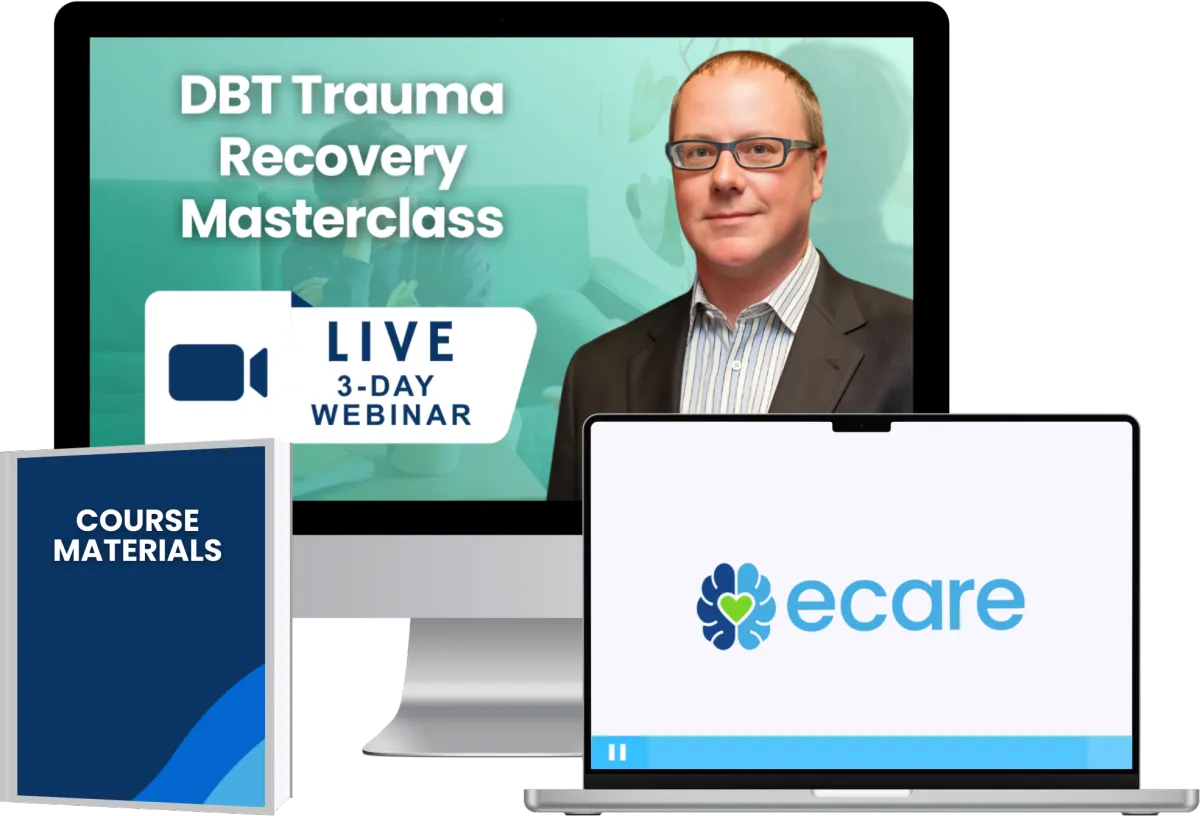

Register Below. Seating is Capped at 1200 Registrants Only

Learn Specialized Skills
Treat Complex Trauma Directly With DBT
18 CE Credits: Extra Cost
Board Approved
RECORDING WITH 18 CE PURCHASE
Watch On Your Own Schedule
Webinar Starts In:
DBT Trauma Recovery Masterclass: When Complex Trauma Drives Clients to Dysregulation, Chaos, and Re-Traumatization
What You'll Learn Inside the Healing trauma with DBT Masterclass:
DAY 1: April 15th
Identify Exactly Where Your Client's Trauma Is Living & Why Standard DBT Cannot Reach It
You will learn Dr. Pederson's complete clinical map for identifying how trauma is running simultaneously through your client's nervous system, memory, behavior, and relationships. Walk away knowing which system is most dysregulated and which intervention belongs there first.
DAY 2: April 16th
Move Your Client Through Dissociation, Shame, & Freeze Response Without Destabilizing Everything They Have Built
You will learn the RISE Method, a session-by-session framework for recognizing dysregulation the moment it surfaces, selecting the exact DBT skill that reaches it, and keeping your client regulated from the first minute to the last.
DAY 3: April 17th
Take Your Most Complex Trauma Clients From Surviving Their Life to Actually Living It
You will learn the specific interventions for repairing nervous system dysregulation, rebuilding relational trust after years of hypervigilance, and moving clients through the three phases of trauma recovery without re-traumatization.
Meet Your Expert Host:
Dr. Lane Pederson, PsyD
Dr. Lane Pederson has spent thirty years in the room with the trauma clients most therapists find impossible to reach. Clients with complex trauma histories so severe that standard DBT stabilizes them for months and leaves the wound completely untouched. He did not just study this problem. He built one of the largest DBT specialized practices in the United States treating it, and spent three decades watching what happened when DBT met trauma without a bridge between them.
What he kept seeing, across his own practice and in training over 40,000 clinicians across six countries, was the same gap everywhere. Brilliant, trained therapists who could keep complex trauma clients safe but had no framework for what came after safety. So he built one. The DBT Trauma Recovery Model is not adapted from someone else's theory. It is what thirty years of treating the most complex trauma presentations in existence actually taught him.

Recording + 18 CE Credit available for Purchase

WHAT CHANGES WHEN YOU CAN ACTUALLY TREAT THE TRAUMA:
WITH THIS MASTERCLASS:
You know exactly where trauma is living in your client and which specific intervention reaches each part of it
When dissociation surfaces mid-session you have a step-by-step sequence to bring her back without pushing her deeper into shutdown
You can move toward trauma processing safely using the DBT skills your client already has without risking everything she has built
You keep the complex trauma cases and watch clients who have been stuck for years finally start to heal
WITHOUT THIS MASTERCLASS:
Your client stabilizes with DBT skills and the trauma underneath keeps running everything
The moment dissociation surfaces mid-session, you freeze and fall back on generic stabilization tools
You move toward trauma processing, your client destabilizes, and you both retreat to safety indefinitely
You refer out the complex trauma cases you genuinely want to keep because you do not have the framework to treat them
Who is This Masterclass For?

Licensed Therapists Carrying Complex Trauma Clients Who Are Stable But Not Healing

DBT-Trained Clinicians Who Feel the Gap the Moment Trauma Surfaces in Session

Therapists Who Have Tried Trauma Processing and Watched It Backfire

Solo or Group Practice Clinicians Treating Chronic Dissociation, Shame, and Nervous System Dysregulation
Rated 4.7/5
What Other Clinicians Are Saying About Us:
"eCare's masterclass totally changed my mind"

"So much easier than I expected"
"Great content, and affordable credits"
eCare’s free trainings deliver more value than most paid courses.
Rebecca, LCSW
"Dr. Pederson has a rare ability to take the most complex trauma presentations and make the clinical path forward feel completely clear.
Lisa, LMFT
"eCare's masterclasses are the only CE trainings I actually apply in session."
Sarah, LMHC
"Every eCare training I've attended has given me strategies I use weekly."
Jennifer, LPC
Frequently Asked Questions
Will this actually help me with the complex trauma clients I am seeing right now?
Yes. Every intervention taught across the three days is designed for immediate clinical use. You will walk away with a session structure you can apply the very next day with your most complex cases.
I already know DBT. Is this too basic for me?
The opposite. This training picks up exactly where standard DBT ends. It is built specifically for clinicians who know DBT well and need a framework for what comes after stabilization.
Is this too advanced if I am newer to trauma work?
No. Dr. Pederson built this framework to be clear enough for immediate use regardless of experience level. If you are carrying complex trauma clients, this training is relevant to you right now.
What if I cannot attend all three days live?
Register anyway. Full recording access is available for purchase in the next step so you never miss a session. You can return to any intervention any time a case demands it.
Do I get CE credits just for attending live?
18 CE credits are available for purchase in the next step along with full recording access. You do not automatically receive CEs for attending. You claim them separately for $147 at a pre-webinar.
Are the CE credits board approved?
Yes. All 18 CEs are board approved. You can view all board approvals on the CE purchase page.
Can I get the recording if I cannot attend live?
Yes. Recording access is available for purchase regardless of whether you attend live. Purchase it in the next step and access all three days on your own schedule.
I have tried trauma training before and could not apply it in session. How is this different?
DTRM is built around the DBT skills you already use every day. This is not a new modality to learn from scratch. It is a framework that extends what you already know directly into trauma treatment so you can implement it immediately.
My clients do not respond well to exposure-based trauma work. Is this relevant?
This training was built specifically for that situation. DTRM treats trauma without exposure-based processing. Your client never has to walk through the fire to heal it.
Is this going to be too theoretical to actually use in session?
No. The entire framework is organized around real session moments: what to do when a client dissociates mid-session, how to move through shame-based shutdown, how to keep a client regulated from the first minute to the last.
What kinds of clients is this most useful for?
Clients with complex trauma histories, chronic dissociation, shame-based responses, nervous system dysregulation, and relational hypervigilance who have been in treatment for a long time and are still not healing.
I have attended CE trainings before that were not worth my time. How is this different?
Most CE trainings give you theory. This one gives you a complete clinical framework, a session-by-session structure, and specific interventions for the exact client presentations that have been hardest to treat.




Scope and Limitations Disclosure:
This training provides licensed mental health professionals with an evidence-based clinical framework for treating complex trauma using DBT-adapted interventions. It focuses on assessment, skill integration, and practical application across the mind, body, and relational systems. While evidence-based, interventions should be applied within the scope of each clinician's license and training. This training does not offer certification in trauma treatment and is not a substitute for clinical supervision. Participants are encouraged to apply the content within their individual scope of practice and applicable professional guidelines.
Commercial Support Disclosure
Dr. Lane Pederson, PsyD is an independent clinician, educator, and national continuing education speaker specializing in DBT and complex trauma treatment. References to the DBT Trauma Recovery Model, trauma-adapted DBT interventions, or related evidence-based approaches are provided for educational purposes only. Participants are not required to purchase any additional products, books, or materials to complete this course. The presenter has no relevant financial relationships to disclose beyond standard speaking compensation.