Live 3-Day Certification Training · December 3, 9, & 16 · Recordings Included
Christina Marsack-Topolewski, PhD, LMSW, takes you through all nine areas of autism-informed care, from assessment & behavior to sensory processing & family work, when you…
Get The Autism Certification To Assess, Support, & Treat Autistic Clients With A Whole-Person Framework, So You Can Help Them Communicate What They Need, Have Fewer Meltdowns, & Do More On Their Own At Home & School
You'll be able to pinpoint each client's support needs & co-occurring conditions, use a functional behavior assessment to help prevent the next meltdown, open up communication with AAC & visual supports, build a sensory plan around the client's day, & coach families & schools to use the same strategies, from early childhood through adulthood
Live Training starts Thursday, December 3rd
Final Price: $395
starts Thursday, November 26
Mid Price: $295
starts Thursday, November 19
Early Bird Price Ends In:
Early Bird Price Through Nov 18
$395
$195
Save $200 off the final price, about $11 per CE
The price goes up to $295 on November 19, then to $395 for the final week starting November 26. Enroll now to lock in $195.
18 CEs, lifetime access to all three recordings, & your $249.99 ASDCS application fee waived
WHAT'S INSIDE:
The 3-day live Autism Certification Training, with every day recorded
18 Board-Approved CEs
Training across all nine areas of autism-informed care, from assessment & behavior to sensory processing & family psychoeducation
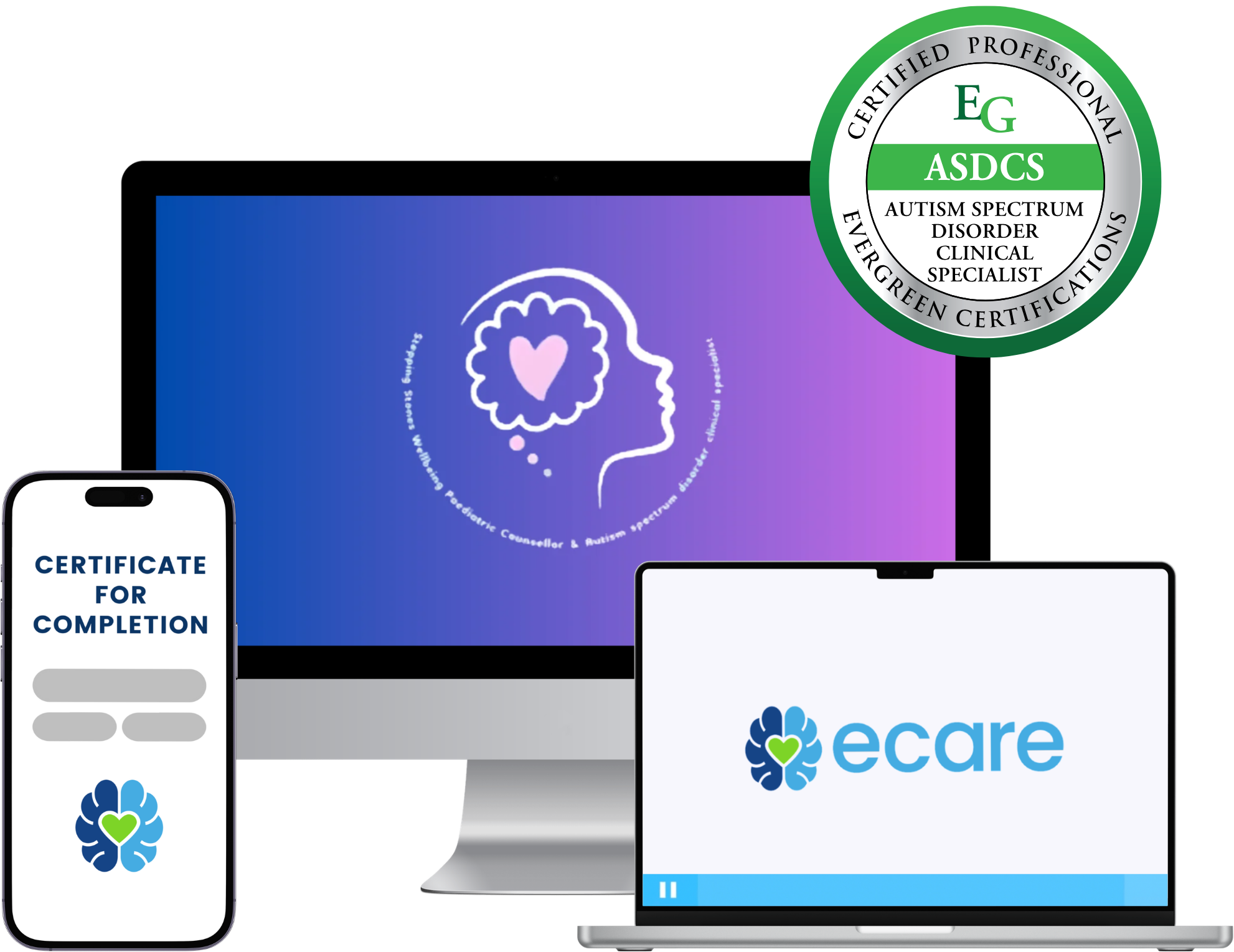
Meets the education requirements for Certified Autism Spectrum Disorder Clinical Specialist (ASDCS) Certification, through Evergreen Certifications
Waived certification application fee, a $249.99 value
Slide decks, case packets, planning worksheets, handout templates, & a resource & referral directory
Certificate of Completion & digital badge
Unlimited lifetime access to all three recordings
That works out to about $22 per CE, and the $249.99 certification application fee is waived.
Meets ASDCS
Meets ASDCS Education Requirements
18 CEs
Board Approved
Live Over 3 Days
Recordings Included
What Clinicians Say About Training With Dr. Marsack-Topolewski
"One of the very top experts in the field"
"I feel I have been trained on this subject matter by one of the very top experts in the field of ADHD/Autism! Her passion, expertise, and presentation style are just perfect for this incredibly informational, rich content. And thank you so much to eCare for this amazing offering! Looking forward to completing my certification through your course!"

"[She] did an amazing job specifically with explaining the difference and likeness between trauma and autism"
"Dr. Christina Marsack-Topolewski did an amazing job specifically with explaining the difference and likeness between trauma and autism and how trauma could be connected to autism."
"As an autistic therapist... the knowledge base and presentation were amazing"
"As an autistic therapist... the knowledge base and presentation were amazing. This is one of my favorite presentations. I loved it!"
"Her expertise and knowledge was very helpful"
"I felt like Dr. Christy really helped to validate and explain a lot of the struggles and obstacles I have been coming up against in my work with clients and her expertise and knowledge was very helpful."
"Things that made me think even as someone working with autism for 20 years"
"Held my attention well despite the length of the training. Good info and things that made me think even as someone working with autism for 20 years now."
THE PROBLEM
When Support Isn't Built Around How An Autistic Client Thinks, Communicates, & Processes Sensory Input, The Meltdowns & Anxiety Can Keep Coming
You know the session…
You ask how something made them feel, and the answer is "fine," or "I don't know," or a precise account of what happened with no feeling in it at all.
The worksheet comes back blank. The family wants to know why the meltdowns haven't eased.
Or you know the adult client…
She's had years of treatment for anxiety and depression, and she's still exhausted. Then she mentions, almost in passing, that she rehearses every conversation before she has it.
Both need a plan built for an autistic client. The techniques that work with most of a caseload may need adjusting for them, from how a question is worded to how much noise and light is in your office.
Ask abstract, open-ended questions ("How did that make you feel?") … and a client who thinks in concrete terms can leave confused, believing therapy isn't for people like them.
Treat a meltdown like a tantrum and wait it out … and a client already too overwhelmed to stop can escalate further, with no one helping them come back down.
Treat the anxiety and depression a woman came in with, and miss the camouflaging underneath … and the exhaustion can keep coming back while the effort of masking goes unaddressed.
Put a new behavior down to "just the autism" … and the anxiety, pain, or poor sleep behind it can go untreated.
And the cost doesn't stop at one session…
Here's What Could Happen WITHOUT The Autism Certification
YOU CAN'T BUILD A PLAN AROUND HOW AN AUTISTIC CLIENT THINKS & COMMUNICATES
You can see the meltdowns, the shutdowns, and the exhaustion. What you can't do is build a plan around the sensory load, the communication needs, and the co-occurring anxiety behind them, so you work with the techniques you already have and hope they carry over. The client keeps showing up every week, the meltdowns keep coming, and nothing at home gets easier.
YOU CAN'T TELL A SENSORY REACTION FROM A BEHAVIORAL ONE IN THE MOMENT
A client covers their ears and drops to the floor when it's time to move to the next activity. It looks like refusal, and holding the expectation seems like the right response. By the end of the session they're in a full meltdown, and you spend the next session rebuilding their trust in you. Without a way to sort a sensory reaction from behavior that serves another purpose, you're deciding on the spot whether to hold firm or back off.
THE FAMILIES WHO NEED YOU MOST GO SOMEWHERE ELSE
An autistic adult who's already tried several therapists is looking for one who understands autism, and so is the parent searching on behalf of their child. They look for evidence of autism-specific training, and a credential is evidence they can see. Without it, a client you're fully capable of helping can book with the clinician whose profile names autism, even when you'd have been the better fit.
Here's What You'll Be Able To Do With The Autism Certification
The Autism Certification Training shows you how to assess an autistic client's support needs, find what a behavior is for, build communication and sensory supports, teach the skills that carry into daily life, and bring the family and school along. So you can help each client communicate what they need, have fewer meltdowns, and do more on their own at home and at school.
With the certification, you'll be able to:
Recognize camouflaging in a client who's spent years masking, including the girls & women whose autism can be missed behind anxiety & depression for years
Turn an evaluation report into a plan you can work from, with a client's support needs, developmental level, & co-occurring conditions all accounted for
Explain the why behind what a parent sees at home: the uneven skills, the deep interests, & the attention that locks onto one thing at a time
Use a functional behavior assessment to find what a behavior is for, & help prevent the next meltdown
Give a non-speaking client more ways to ask for what they need, so a meltdown isn't the only way they have
Build an emotional vocabulary with a client who finds feelings hard to name, using visual supports & concrete language
Build executive functioning, perspective-taking, & self-regulation skills a client can use at school & at home
Tell a sensory reaction from a behavioral one in the moment, & build a sensory plan around the client's day
Get the family, the school, & the care team using the same strategies, from the IEP meeting to the classroom a client walks into
Answer the pharmacological & nutritional questions families bring you, know where your scope ends, & know who to call next
Say yes to the autism referral you'd have passed along, & be visible to the families looking for a therapist trained to work with autistic clients
This is how you go from seeing autistic clients to being the therapist who can help them communicate, have fewer meltdowns, and do more on their own, and the one families and schools think of first.
$195 early bird price · goes up to $295 on November 19
The Autism Certification Is Taught By Christina Marsack-Topolewski, PhD, LMSW

Christina Marsack-Topolewski, PhD, LMSW, is an associate professor of social work at Eastern Michigan University and a licensed social worker with about 20 years of experience working with people with developmental disabilities and their family caregivers. She has worked as a clinical therapist with children, adolescents, and adults, and she's a certified special education teacher and teacher consultant in Michigan.
She has published more than 70 peer-reviewed journal articles and encyclopedia entries, most of them on family caregivers of autistic adults. In 2024, she was invited by the National Autism Coordinator to present her research on family caregiving in autism at the Interagency Autism Coordinating Committee meeting at the National Institute of Mental Health.
Her research has been featured on NPR and ABC News Detroit, and in 2024 she received the Ronald W. Collins Distinguished Research Award for Research Excellence and the Arc of Oakland County's Advocacy Hall of Fame Award. Her work spans autistic people and their families across the lifespan, from the school years to the aging parents still caring for an adult child at home, who are the focus of much of her research.
AT A GLANCE
Format
Live over 3 days, with every day recorded
CEs
18, board-approved
Duration
18 hours across 3 days & 9 modules
Skill Level
All levels (no prior autism specialization required)
Recording Access
Unlimited, lifetime
The Autism Certification Training
Eighteen live hours over three days, covering all nine areas in Evergreen Certifications' standard for the ASDCS credential. Together they give you a whole-person framework for assessing, supporting, and treating autistic clients from early childhood through adulthood.
THE NINE AREAS
See the whole profile (Assessment): support levels, developmental level, & the co-occurring conditions that can change what you treat first
Explain the why (Neurodevelopment): the brain differences, the 5 cognitive theories, & the strengths behind what you see in session
Find what a behavior is for (Behavior): the 4 functions of behavior, the escalation cycle, & how to calm a meltdown before it peaks
Open more ways to communicate (Communication): AAC, echolalia, visual supports, & an emotional vocabulary for clients who find feelings hard to name
Build skills that carry outside your office (Social Skills): executive functioning, perspective-taking, & self-regulation, without asking a client to mask
Separate sensory from behavioral (Sensory Processing): all 8 sensory systems, sensory diets, & a 4-question decision framework
Get home & school using the same strategies (Environment): caregiver & educator psychoeducation, IEPs & 504s, & adapting the spaces a client spends their day in
Spot the motor piece (Motor Skills): motor planning, coordination, & when to bring in OT or PT
Answer the questions families bring you (Pharmacological & Nutritional Interventions): the main pharmacological classes, diets & supplements, & where your scope ends
DAY 1
FOUNDATIONS: UNDERSTANDING THE AUTISTIC BRAIN & BODY
Day 1 covers assessment, the neurodevelopmental profile, and behavior. You'll learn how to turn an evaluation report, the assessment tools, and a caregiver's history into a plan you can work from, including what a support level does and doesn't tell you and how autism can look different in girls and women. Then the brain and cognition behind what you see in session, and the strengths that come with them. Then behavior: what a behavior is for, what sets it off, and how to prevent and calm a meltdown.
Thursday, December 3
10:00 AM to 5:30 PM ET, with breaks
6 CEs
Live
Recording Included
MODULE 1
Assessment
Work out a client's support needs, developmental level, & co-occurring conditions, so the plan starts from the client in front of you
What the 3 DSM-5-TR support levels tell you & what they leave out, so a client who copes well in your office still gets a plan for the places they need the most support.
How to get a usable plan out of an ADOS-2, ADI-R, or Vineland-3 report you didn't write, so the scores turn into goals for your next session
Why a teenager can be years ahead in one skill & years behind in another (the uneven profile the training calls splinter skills), & how that profile tells you which intervention to start with
How autism can look different in girls & women, from camouflaging to the anxiety & exhaustion that can come with it, & the questions that help an adult client put words to it
The 11 co-occurring conditions the training covers, from ADHD & OCD to epilepsy, tic disorders, & sleep problems, so a new behavior gets checked against everything else the client is dealing with
MODULE 2
Neurodevelopmental Foundations
Understand how an autistic client's brain develops & processes information, so you can explain the why behind what you see in session
The 5 cognitive theories of autism the training covers (theory of mind, executive function, weak central coherence, enhanced perceptual functioning, & monotropism), & what each one can & can't explain about a client's day
Why a client deep in a favorite topic may not hear their own name called (the training explains it through monotropism), & how to bring them back without a standoff
How to treat special interests & splinter skills as strengths, & build them into the way you teach a client something new
Why a client can spot a complex pattern in seconds & still need a long pause to answer a simple question, & what that means for how fast you talk in session
The ideas about what causes autism that families still bring in, & how to answer them without dismissing the parent who asked
MODULE 3
Behavior: Function, Context, & Regulation
Find out what a behavior is for & what set it off, so you can prevent the next meltdown & calm the one in front of you
The 4 functions of behavior (escape, attention, access to something they want, & sensory), & how to tell which one you're looking at from what happens right before & right after
Meltdown, tantrum, or shutdown? The signs that separate the three, & why the response that helps one can make another worse
The 4 stages of the escalation cycle (trigger, rumbling, crisis, & recovery), & what to do at each one, so you can step in while it's still rumbling
What to check before calling it behavior: pain, hunger, poor sleep, & illness, the setting events a standard behavior plan can miss
When to support stimming & when to redirect it, so a client isn't asked to give up something that may be helping them stay regulated
DAY 2
COMMUNICATION, SOCIAL COGNITION, & SENSORY SYSTEMS
Day 2 covers how a client communicates, connects with other people, and processes what they see, hear, and feel. You'll cover communication with speaking, minimally speaking, and non-speaking clients, including AAC and the emotional vocabulary a client may not have yet. Then the social and emotional skills behind friendships and self-regulation, and how to get them to carry outside your office. Then the 8 sensory systems, with a framework for telling a sensory reaction from a behavioral one.
Wednesday, December 9
10:00 AM to 5:30 PM ET, with breaks
6 CEs
Live
Recording Included
MODULE 4
Communication
Build social & emotional communication with speaking, minimally speaking, & non-speaking clients, including those who use AAC
The worry that keeps some families from trying AAC (that it will stop speech from developing), & what the training says about it
What echolalia & scripting can be telling you, so a line a client repeats from a favorite show gets answered as a message
The 3 kinds of intentional communication (requesting, protesting, & commenting), & how to build the one a client isn't using yet
How alexithymia can make "How did that feel?" the hardest question in the session, & what to ask a client who can't name the feeling yet
How to build a visual schedule, choice board, or social narrative for a specific client, the hands-on part of this module, so you finish with a support you can put to use
MODULE 5
Social Skills Interventions
Build executive functioning, emotion recognition, perspective-taking, & self-regulation with interventions a client can take outside your office
5 cognitive theories of autisThe 6 parts of executive functioning, & the timers, checklists, & task breakdowns that turn "just start your homework" into a step a client can take
The difference between cognitive & affective empathy, & why it changes what you teach a client who cares deeply & still misses what a friend is feeling
Why the training teaches co-regulation before self-regulation, & what to do when a client can't use a calm-down strategy yet
What masking can cost a client's mental health, & how to run social skills work that builds connection without asking a client to hide who they are
How to get a skill from your office to the classroom, the playground, & the dinner table, with Social Stories™, comic strip conversations, video modeling, & role-play
MODULE 6
Sensory Processing
Tell sensory-driven behavior from other functions of behavior, & build sensory supports that fit the client
The 4 questions to ask before a behavior goes into the plan as defiance, so a client overloaded by a noisy space isn't handed more demands in it
The 8 sensory systems, including balance & movement (vestibular), body position (proprioceptive), & internal body signals (interoceptive): the systems behind a client who seeks out pressure & movement or can't tell when they're hungry
Why the same client can be over-responsive to sound & under-responsive to pain, & what a profile that changes from day to day means for the plan
What a sensory diet is (& what it isn't), & how to build an alerting, calming, & organizing plan around a client's day with the OT
How interoception ties into toileting, hunger, pain, & anxiety, so a client who can't tell you they're anxious has another way into that conversation
DAY 3
ENVIRONMENT, PHYSICAL DEVELOPMENT, & BIOMEDICAL CONSIDERATIONS
Day 3 covers the people and places around the client. You'll cover what to tell families, caregivers, and educators, IEP and 504 basics, and how to adapt a room; motor development and when to bring in OT or PT; and the pharmacological and nutritional questions families bring to you. The day closes with a review across all nine areas and how to bring them together into one treatment plan, plus a walk through the resource and referral directory.
Wednesday, December 16
10:00 AM to 5:30 PM ET, with breaks
6 CEs
Live
Recording Included
MODULE 7
Environmental Adaptations & Family/Caregiver Psychoeducation
Teach families, caregivers, & educators what to do, & adapt the spaces a client spends their day in
What to say to a family after an autism evaluation, when grief, relief, & guilt can all show up in the same conversation
IEP vs. 504: the basics you need to speak up for a client at a school meeting, & the classroom accommodations worth asking for
The 5 things to change in a room before a client walks in (lighting, noise, smells, visual clutter, & seating), including in your own office
The safety plan to put in place for a client who wanders, including what to share with emergency responders before it's needed
How to set up a home, clinic, & school loop with shared strategies & a common language, so a client isn't getting one approach at home & another at school
MODULE 8
Motor Skills
Spot fine & gross motor differences, build movement into sessions, & know when to bring in OT or PT
How motor planning (praxis) can make a new movement hard to start even when a client knows exactly what to do, so a slow start at sports or getting dressed isn't mistaken for low effort
How imitation ties motor skills to communication & social play, & simple ways to practice it in session
How to grade a task like handwriting, buttoning, zipping, or using a fork, so a client succeeds at each step before the next one is added
How to build a motor-break routine into a therapy or classroom session, & what movement can do for regulation & attention afterward
The signs it's time to refer to OT or PT, & how to work alongside them so your strategies match theirs
MODULE 9
Pharmacological & Nutritional Interventions
Know the pharmacological & nutritional approaches families ask about, & your role alongside the prescriber
The 6 pharmacological classes the training covers, from stimulants & SSRIs to alpha-2 agonists & sleep aids, & the co-occurring concerns each one is used for (the training covers why none of them targets autism itself)
How to spot a side effect that shows up as a change in behavior, & what to pass along to the prescriber
Gluten-free & casein-free diets, elimination diets, probiotics, & omega-3s: what the current evidence shows, & how to answer a parent's question without dismissing or endorsing it
How feeding selectivity, texture aversions, & GI problems can show up as behavior, & who to bring in when they do
Where your scope ends on pharmacological questions, & how to coordinate with the psychiatrist, pediatrician, & dietitian so the family hears one plan
Enroll
Get The Full Autism Certification Training & 18 CEs, & Move Closer To The ASDCS Credential
Live Training starts Thursday, December 3rd
Final Price: $395
starts Thursday, November 26
Mid Price: $295
starts Thursday, November 19
Early Bird Price Ends In:
Early Bird Price Through Nov 18
$395
$195
Save $200 off the final price, about $11 per CE
The price goes up to $295 on November 19, then to $395 for the final week starting November 26. Enroll now to lock in $195.
18 CEs, lifetime access to all three recordings, & your $249.99 ASDCS application fee waived
What Clinicians Say After Training With Dr. Marsack-Topolewski
"Nutrient dense"
"The information and discussion was so insightful. I think the best way to describe it is 'nutrient dense.' There was so much to learn, and so much that was directly useful for me."
"Will inform my lens when working with kiddos with autism"
"I am an eCare subscriber. This was the best course I have taken on this platform. Thank you so much. The perspectives I learned today will inform my lens when working with kiddos with autism. Excellent content!"
This Program Is A Good Fit If?
This program is a good fit if:
You have an autistic client on your caseload right now & want a plan built for how they think & communicate
You're newer to autism work & want all nine areas in one structured program
You've worked with autistic clients for years & want the credential that documents it
You work with families & schools & want home, school, & your office using the same strategies
You hold a current license, or will within two years of completing the program
Evergreen also has license and clinical-hour requirements for the ASDCS credential, listed below. You don't need to meet them before you enroll.
This program is intended for licensed and pre-licensed mental health professionals, including social workers, professional and mental health counselors, marriage and family therapists, psychologists, and school-based mental health professionals.
After You Certify, Here Is What You Will Be Able To Do
AFTER YOU CERTIFY:
You build the plan around a client's support needs
You use concrete language a client can work with
You give a non-speaking client more ways to ask for a break
You help a client through a meltdown with co-regulation & fewer demands
You tell a sensory reaction from a behavioral one
You recognize camouflaging behind an adult's anxiety
You build a behavior plan around what the behavior is for
You take the autism case you'd have referred out
Your credential documents your autism-specific training
WITHOUT THE CERTIFICATION:
The plan was built for a general caseload
A client gets questions they can't answer
A non-speaking client has few ways to ask for a break
A meltdown gets handled like a tantrum & escalates
A client in sensory overload gets treated as defiant
Years of masking keep getting treated as anxiety alone
The plan targets the behavior, & it keeps coming back
The autism case goes to someone with the credential
Nothing on record shows your autism training
Enroll
Get The Full Autism Certification Training & 18 CEs, & Move Closer To The ASDCS Credential
Live Training starts Thursday, December 3rd
Final Price: $395
starts Thursday, November 26
Mid Price: $295
starts Thursday, November 19
Early Bird Price Ends In:
Early Bird Price Through Nov 18
$395
$195
Save $200 off the final price, about $11 per CE
The price goes up to $295 on November 19, then to $395 for the final week starting November 26. Enroll now to lock in $195.
18 CEs, lifetime access to all three recordings, & your $249.99 ASDCS application fee waived
18 CEs · Board Approved
eCare is a board-approved Continuing Education provider by ASWB, NBCC, NAADAC and many other state boards. Programs that do not qualify for ASWB, NBCC, NAADAC and APA are clearly identified. eCare Behavioral Health Institute is solely responsible for all aspects of the programs.


Certification Process: How It Works
We partnered with Evergreen Certifications to help make your certification process fast & simple
1) Enroll Today
Your seat is confirmed and your login details arrive by email.
2) Attend The 3-Day Training.
Join live or watch the recordings (both count toward your CEs) and receive your Certificate of Completion, which covers the education requirement for the certification.
3) Submit Application to Evergreen Certifications
Once you've met all the certification requirements, submit your Certificate of Completion and your application to Evergreen Certifications, our partnered certification provider.

* Professional & clinical experience standards apply.
What Evergreen Requires For The ASDCS Credential:
Completion of this Certification Program (a minimum of 18 hours of continuing education in specific autism topics)
A minimum of a master's degree in your profession & a state or national license, with all training hours & supervision requirements completed to be licensed for independent practice in the state you're licensed
Attest that over the course of your career, you have a minimum of 100 clinical contact hours with clients with Autism Spectrum Disorder traits and/or diagnosis
YOU HAVE 2 YEARS TO COMPLETE THE OTHER REQUIREMENTS
You do not need to meet the requirements before you enroll. Complete the program now, and you have two years afterward to finish the rest and submit your application to Evergreen.
BONUS: YOUR $249.99 EVERGREEN APPLICATION FEE IS WAIVED
Evergreen charges a $249.99 application fee to every applicant. Because you completed your grief training through eCare, you receive a 100% off waiver code on completion, so you apply for certification at no extra cost.
RENEWAL
The ASDCS credential renews every 2 years. Renewal requires 12 clock hours of continuing education related to Autism Spectrum Disorder, and a $149.99 renewal fee paid to Evergreen.
Here Is Exactly What Happens After You Enroll

Your receipt and login details arrive by email.

Your course materials (slide decks, case packets, planning worksheets, handout templates, & the resource & referral directory) are waiting in your eCare account

You join the live training on December 3, 9, & 16, from 10:00 AM to 5:30 PM ET, with each day's recording added to your eCare account afterward (watching it counts toward your CEs)

You keep all three recordings in your eCare account for life

Your Certificate of Completion & digital badge are issued when you complete the training

Your 100% off Evergreen application fee waiver code arrives on completion

You submit your Certificate & application to Evergreen whenever you're ready, any time within two years of completing the program
Pricing
Take The Next Step Today
What's Inside
The 3-day live Autism Certification Training, with every day recorded
18 Board-Approved CEs
Training across all nine areas of autism-informed care, from assessment & behavior to sensory processing & family psychoeducation
Meets the education requirements for Certified Autism Spectrum Disorder Clinical Specialist (ASDCS) Certification, through Evergreen Certifications
Waived Certification Application Fee ($249.99 Value)
Slide decks, case packets, planning worksheets, handout templates, & a resource & referral directory
Certificate of Completion & digital badge
Unlimited lifetime access to all three recordings
Live Training starts Thursday, December 3rd
Final Price: $395
starts Thursday, November 26
Mid Price: $295
starts Thursday, November 19
Early Bird Price Ends In:
Early Bird Price Through Nov 18
$395
$195
Save $200 off the final price, about $11 per CE
The price goes up to $295 on November 19, then to $395 for the final week starting November 26. Enroll now to lock in $195.
18 CEs, lifetime access to all three recordings, & your $249.99 ASDCS application fee waived
Frequently Asked Questions
Do I need prior autism training to enroll?
No. The Masterclass was six hours on recognizing prolonged grief and treating it with six grief-focused interventions. This program covers the whole category across 18 hours: the types of grief and how they differ, the cultural and spiritual context, complex and traumatic presentations, family and group work, and the ethics of grief practice. Prolonged grief appears inside it as one presentation among several.
I mostly see adults. Or I mostly see children. Is this for me?
Yes. It is built for clinicians newer to grief treatment and for experienced clinicians deepening what they already do. It starts with how the types of grief differ from each other and builds from there.
Is this training live or recorded?
18 CEs on completion of the program.
What if I can't attend all three days live?
Every day is recorded and added to your eCare account. Watching the recording counts toward your CEs and your Certificate of Completion, and you keep the recordings for life.
How many CEs will I earn in total?
18 CEs on completion of the program.
Is this program board approved for Continuing Education?
Unlimited lifetime access to all training materials, including the session recordings, which you can replay as many times as you want.
My schedule is packed. Is this program flexible enough for me?
Yes. Everything is recorded, so you watch on your own time, and there is no schedule to keep up with.
Who is Evergreen Certifications?
Yes. eCare is a board-approved Continuing Education provider by ASWB, NBCC, NAADAC and many other state boards. Programs that do not qualify for ASWB, NBCC, NAADAC and APA are clearly identified. eCare Behavioral Health Institute is solely responsible for all aspects of the programs.
How does the actual certification process work?
There is one short quiz at the end of each module, three in total. They reinforce key concepts rather than catch you out. You need 80% to pass, with three attempts per quiz.
Who is Evergreen Certifications?
Evergreen Certifications is a nationally recognized organization that provides professional certifications for mental health and healthcare providers.
What counts toward the 100 clinical hours?
Evergreen asks you to attest that, over the course of your career, you've had at least 100 clinical contact hours with clients with Autism Spectrum Disorder traits and/or diagnosis. The hours can come from any point in your career.
Is this a full autism certification?
No. Register and complete this program now, and you have two years afterward to meet the remaining requirements and submit your application to Evergreen.
Can I take the training for the CEs without applying for the certification?
Yes. You can complete the training and earn your 18 CEs without applying for the credential. The application is optional, and you have two years after completing the program to decide.
Will I have to pay a separate certification fee?
No. Everyone who completes this program receives a 100% off waiver code covering Evergreen's $249.99 initial application fee, delivered on completion. Renewal every 2 years has its own $149.99 fee, covered below.
How does renewal work?
The ASDCS credential renews every 2 years, with 12 clock hours of continuing education related to Autism Spectrum Disorder and a $149.99 renewal fee paid to Evergreen.
Am I required to buy a book or any other materials?
Licensed mental health professionals: social workers, mental health counselors, marriage and family therapists, and psychologists who want practical clinical grief skills.
Will the price go up?
Yes, on a set schedule: $195 through Wednesday, November 18; $295 from Thursday, November 19, through Wednesday, November 25; and $395 from Thursday, November 26. The $249.99 ASDCS application fee is waived at every price.
What is your refund policy?
See the published policy at https://www.ecarebehavioralinstitute.com/refund-policy
Who is this program designed for?
Licensed and pre-licensed mental health professionals: social workers, professional and mental health counselors, marriage and family therapists, psychologists, and school-based mental health professionals who work with autistic clients and their families.
Register Now To Start Your Autism Certification
For any questions, contact our support team at [email protected]
Live Training starts Thursday, December 3rd
Final Price: $395
starts Thursday, November 26
Mid Price: $295
starts Thursday, November 19
Early Bird Price Ends In:
Early Bird Price Through Nov 18
$395
$195
Save $200 off the final price, about $11 per CE
The price goes up to $295 on November 19, then to $395 for the final week starting November 26. Enroll now to lock in $195.
18 CEs, lifetime access to all three recordings, & your $249.99 ASDCS application fee waived
Professional & clinical experience standards apply.
eCare partners with Evergreen Certifications to provide professional certification as a Certified Autism Spectrum Disorder Clinical Specialist.
MPORTANT CERTIFICATION INFORMATION
Certification does not imply endorsement of clinical competency. As a licensed professional, you're responsible for reviewing scope of practice in your jurisdiction. The ASDCS credential documents that you've met Evergreen's education and experience standards, and it doesn't authorize the practice of any technique outside your existing scope of licensure.